
Africa is no longer a new pharmaceutical market. It is already a fast-growing one. The continent’s pharmaceutical market was worth USD 27.65 billion in 2024. It may reach USD 36.96 billion by 2033.
For Indian API exporters, this growth is important. Africa already makes up 12.9% of India’s total pharmaceutical exports. India also supplies around 20% of Africa’s pharmaceutical imports.
Africa is also trying to increase local drug API manufacturing. But this is increasing the need for Indian APIs, not reducing it.
This blog explains why Africa is becoming a major export market for Indian API manufacturers. It also explains what is driving demand and what exporters should know before entering the market.
Africa’s Pharmaceutical Market Is Expanding Faster Than Global Expectations
Africa’s pharmaceutical growth is not happening for one reason. Many factors are driving growth at the same time. Together, they are creating strong demand for medicines and APIs.
Rapid Population Growth and Urbanisation
Africa’s population may reach 2.5 billion by 2050. More people are also moving to cities.
People in cities usually visit hospitals and clinics more often. Urban lifestyles also increase diseases linked to:
This adds to patients with chronic diseases.
More patients means:
Rising Healthcare Spending Across Africa
African governments are raising their spending on medical care.
Between 2018 and 2023, every year the public healthcare expenditure in sub-Saharan Africa increased by approximately 6%. There are also those nations that are increasing national health insurance schemes.
Indicatively, Nigeria began strengthening a universal healthcare initiative in 2022. This is aimed at ensuring that half of the population is covered by 2025.
Growing Demand for Generic Medicines
Almost 60% of medicines used in Africa are imported. Most come from India and China.
With 60% of healthcare spending in sub-Saharan Africa coming out-of-pocket, many patients in Africa pay healthcare costs from their own pockets. Because of this, affordable generic medicines are very important.
Indian API manufacturers are among the largest generic medicine producers in the world. This puts them in a strong position to meet Africa’s demand for low-cost medicines.
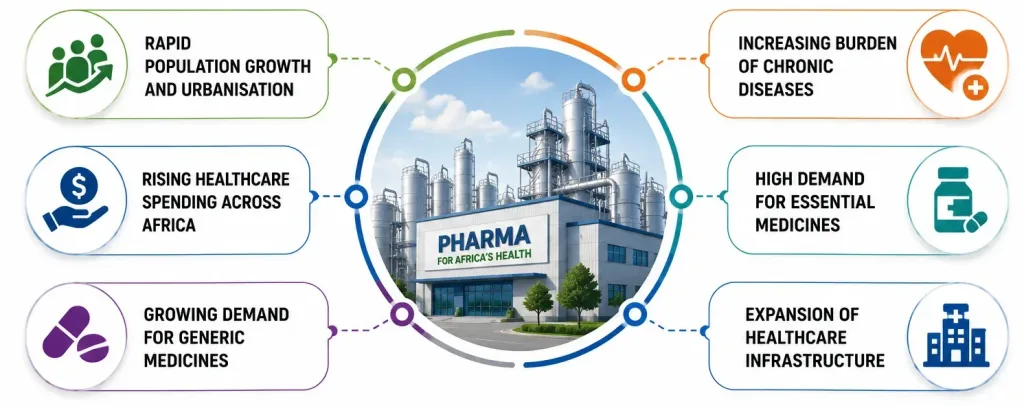
Increasing Burden of Chronic Diseases
Africa is seeing a fast rise in chronic diseases, such as:
These diseases are increasing because of urban lifestyles and changing food habits.
At the same time, infectious diseases like malaria, TB, and HIV/AIDS are still common.
This creates steady demand for many API categories, including:
Indian manufacturers already produce all these APIs on a large scale.
High Demand for Essential Medicines
Almost 50% of Africa’s population still cannot fully access essential medicines.
This is both a healthcare problem and a business opportunity.
International organisations are increasing healthcare funding and medicine procurement across Africa.
These include:
Because of this, demand for the WHO Essential Medicines List (WHO-EML) medicines is growing every year.
India remains one of the biggest suppliers of these medicines and APIs.
Expansion of Healthcare Infrastructure
Africa is building more:
The African Development Bank estimates that USD 11 billion may be needed by 2030 to support pharmaceutical industry growth in Africa.
As healthcare infrastructure grows, medicine use also increases. This means API demand will also continue to grow.
Now that we understand what is driving Africa’s pharmaceutical demand, let us look at why Indian API manufacturers are strongly placed to meet this demand.
Why Indian API Manufacturers Are Gaining Strong Positioning in Africa
India’s strong position in Africa’s pharmaceutical market did not happen by chance. It is anchored on five key strengths.
Cost-Effective API Manufacturing
India produces APIs at a lower cost than many Western countries. At the same time, quality standards remain strong.
In a continent whose healthcare expenditure is mostly out-of-pocket, and government procurement budgeting is limited, price competitiveness is not one factor among many. It is the most important procurement criterion.
Strong Global Regulatory Compliance
India has:
This number of plants is more than is noted in any other country other than the United States.
WHO-GMP standards are relied upon by many African regulators inspecting the quality of medicines.
This trust has been built over many years.
Large-Scale API Production Capacity
There are over 500 API products produced in India. It is also the source of approximately 20 per cent of all exports of generic drugs all over the world in volume.
This high capacity of production assists Indian manufacturers in dealing with both:
Mass production contributes to stability in product quality, as well.
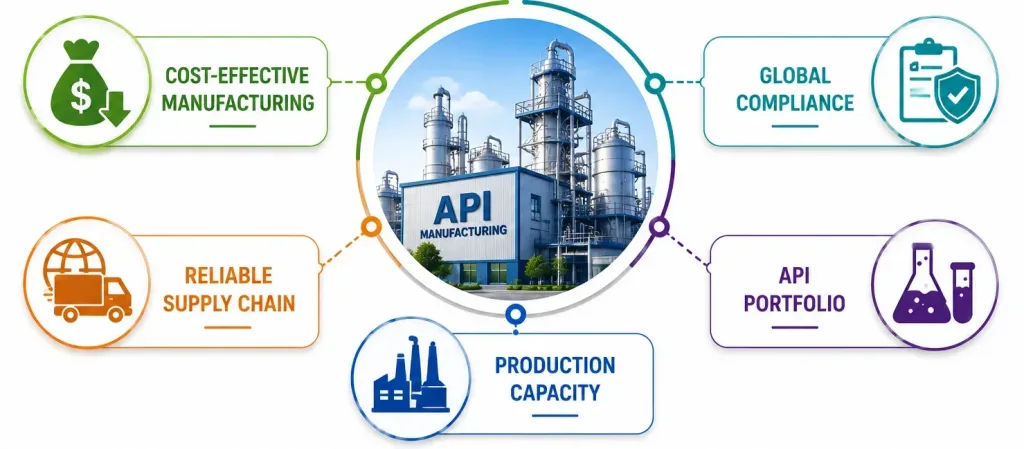
Wide Range of API Portfolio
India has been a source of APIs to all the major categories of diseases in Africa, which include:
Africa imports many of these medicines from India. The healthcare needs of Africa and the strengths of India in producing APIs match greatly.
Reliable Supply Chain Capabilities
India’s pharmaceutical exports grew from USD 15.07 billion in 2013-14 to USD 27.85 billion in 2023-24.
This steady export growth has increased trust in Indian pharma products across:
In FY25, India exported pharmaceutical products to more than 200 countries.
This demonstrates that, in India, there are good logistics and exporting systems of global supplies.
We have now seen why Indian manufacturers are highly positioned, but what about why Africa is emerging larger API?
Africa’s Push for Local Drug Manufacturing Is Increasing API Import Dependency
The reason many believe Africa is is because it is becoming more and more dependent on API imports.
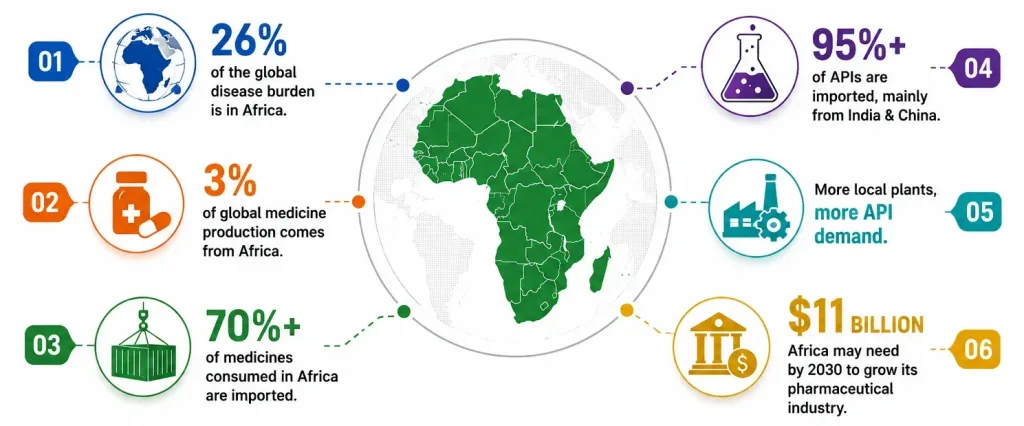
Africa bears the 26 percent of the disease burden and produces 3 percent of the medicines in the world.
Over 70 percent of the medicine consumption in Africa is an import. Over 95 percent of APIs, as well, are imported, primarily out of India and China.
With more local medicine plants in African countries, these new plants nonetheless require importation of APIs.
Tablets and formulations are produced on most of local factories. They are not the APIs manufacturers.
More than 95 percent of the APIs are imported to Africa. This implies that every new factory in Nigeria, Kenya, Ghana, etc. produces a new demand of Indian APIs.
The African Development Bank says Africa may need USD 11 billion by 2030 to grow its pharmaceutical industry.
Now that we’ve covered local manufacturing, let’s look at the China+1 strategy.
The China+1 Strategy Is Benefiting Indian API Exporters
The coronavirus has caused significant issues in the pharmaceutical supply chains worldwide.
A lot of businesses were reliant on China for APIs and raw materials. In case of supply issues, buyers began seeking alternative suppliers other than those in China.
This resulted in the China+1 strategy.
Under this approach, companies purchase APIs not only in China, but also in at least one additional country in order to hedge the risk of supply.
One of the greatest beneficiaries of this shift has been India.
Due to the need to find safer supply chains, many pharmaceutical businesses around the world are increasing their enquiries and orders to many Indian API manufacturers.
This further renders India significant to African buyers.
Quite a number of APIs are already being imported into Africa by India and China. Today, the China+1 policy is raising confidence in India as a reliable supplier.
Indian manufacturers offer:
The process also occurred during the pandemic, where Indian suppliers still supplied as Chinese supply chains were disrupted.
The trend is also influenced by global politics.
There are still tensions in the US-China trade. In late 2024, China also cancelled API export tax rebates. This has rendered the Chinese API prices less stable.
The stable prices and certainty of supply are significant to the African buyers who have limited budgets to work with when they have to buy.
Now that we understand the China+1 trend, let’s look at the top African markets.
Key African Countries Creating Major API Export Opportunities
Not all African countries offer the same business opportunities. Four countries currently offer the biggest API export opportunities for Indian manufacturers.
| Country | Market Position | Key API Categories | Procurement Pathway |
| South Africa | Largest pharmaceutical market in Africa; India exported USD 718.54 million in pharma products in FY24 | Cardiovascular, oncology, antidiabetic | SAHPRA-regulated; private sector + state tender |
| Nigeria | Active universal health coverage push; strong generic demand | Anti-infectives, antidiabetics, antimalarials | NAFDAC registration required; NGO + government tender |
| Kenya | Fastest-growing, expanding private healthcare | ARVs, anti-TB, cardiovascular | PPB registration; KEMSA procurement |
| Egypt | North Africa’s largest market; ; increased local production that requires API inputs. | Anti-infectives, cardiovascular, oncology | EDA registration; growing CDMO partnerships |
South Africa and Nigeria together account for most pharmaceutical imports in Africa.
Indian exporters with WHO-GMP certification and high regulatory compliance are both key target markets of the two countries.
We have discussed some of the major markets now it is time to discuss AfCFTA.
How AfCFTA Could Transform Pharmaceutical Trade Across Africa
The African Continental Free Trade Area (AfCFTA) includes 54 African Union countries. It is the biggest free trade area in the world in terms of number of countries.
Nowadays, 97 percent of pharmaceutical supply in Africa is imported or locally manufactured, but not exported inside Africa.
Each country has different:
Because of this, pharmaceutical trade inside Africa is still low.
AfCFTA will help to decrease these obstacles. The medicines accepted in one African nation can be approved in other African countries as regulations become closer with the African Medicines Agency (AMA), and more readily be accepted in other countries.
This is a great opportunity to Indian API exporters. An example could be a partnership with the one buyer in South Africa or Kenya, which may subsequently assist suppliers to join numerous other African markets with the same buyer
It is also possible that Africa will boost its earnings by USD 450 billion by 2035 due to AfCFTA.
This would bring more healthcare expenditure in the continent. The Indian API exporters that access the market are likely to be most benefited when the African trade increases.
Having an idea of AfCFTA, now we can examine the issues exporters can encounter.
Challenges Indian API Exporters Must Understand Before Entering Africa
Africa has good business prospects yet there are obstacles to overcome.
The market is not easy. Various challenges have to be ready in Indian exporters.
Regulatory Approval Challenges
Africa is a continent with 54 countries and a majority of them have varying regulatory systems.
The current Ghana, Nigeria, South Africa, and Tanzania are the only countries that have the current regulatory status of WHO Maturity Level 3.
Countries may differ significantly in terms of approval timelines. There are also differing documentation requirements. Before entering a market Indian exporters have to research that market.
Import and Registration Barriers
In many African nations, local product registration is mandatory prior to imports.
Some countries can take 12-36 months to complete this process.
Some countries may also require:
These obstacles can be addressed, however it requires time, investment and local collaborations.
Logistics and Supply Chain Issues
Logistics systems are very different across Africa. It has developed infrastructures that are even better e.g. those of South Africa and Egypt.
Shipping and cold chain management can be more challenging for smaller or landlocked countries.
The following are some of the factors which Indian exporters must look into keenly in each market:
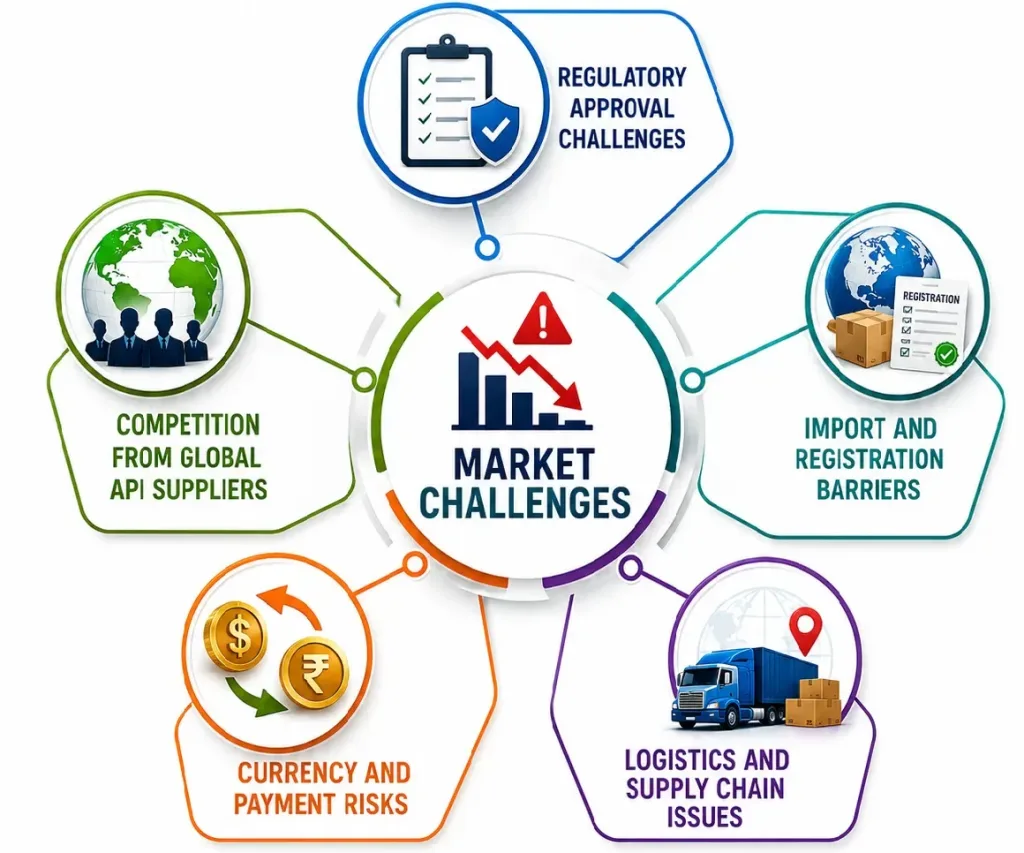
Currency and Payment Risks
There is a rapid change in the value of some African currencies.
On the other hand, it may be due to foreign exchange crises which result in the delays experienced in payment within a particular country.
As can be experienced in Nigeria and other markets (like Ethiopia):
The Indian exporters should use less risky terms of payment especially to new buyers.
Competition From Global API Suppliers
Africa is not the only territory of API suppliers.
The market is also competed by China, Europe and some of the suppliers within the region.
Chinese suppliers tend to be price competitors. In certain high-value markets in Europe competition in terms of regulatory reputation is observed among suppliers.
Indian exporters must compete through:
Now that we’ve covered the challenges, let’s answer some common questions.
Strategic Opportunities for Indian API Manufacturers in Africa
India already enjoys a robust presence in the pharmaceutical industry in Africa, however, the larger scope is how the Indian producers of API can expand on and into the market in several ways using various business opportunities.
Contract Manufacturing Opportunities
Africa has set its eyes on the enhanced local production of pharmaceuticals and as a result, is generating high demand for the Indian contract manufacturing services.
A large number of African pharmaceutical companies desire to manufacture medication domestically, yet lack sufficient numbers of API manufacturing plants and technical skills.
Through this, they are offloading the production of APIs to manufacturers in India rather than constructing costly facilities initially.
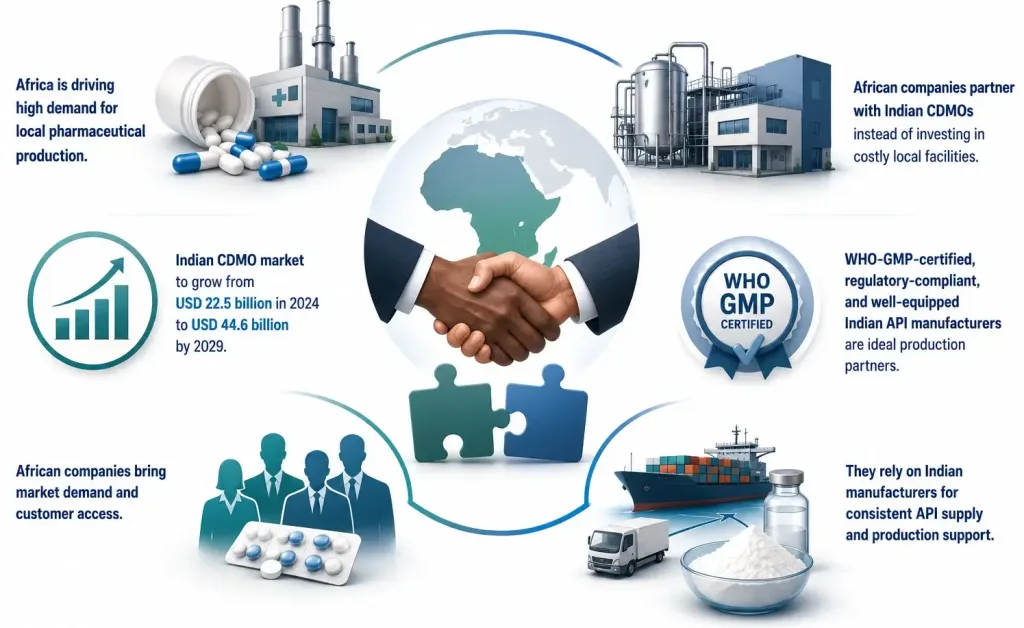
The Indian CDMO market is projected to increase from USD 22.5 billion in 2024 to USD 44.6 billion by 2029 and the African pharmaceutical enterprises are playing a key role in this increase.
WHO-GMP-certified, regulatory-compliant, and well-equipped manufacturers of Indian APIs are in an exceptionally good position to be trusted production partners to African formulators.
The African companies could possess good market demand and access to customers, yet, they rely on the Indian manufacturers to have a stable supply of APIs and to help to produce them.
Local Distribution Partnerships
Indian API manufacturers may find it a lot easier to enter African markets through the assistance of local distribution partners.
Local distributors have already knowledge of the regulatory system, processes of importation, logistics, customer supply chains, government tenders and hospital relations in the country.
In Africa, more than 70 percent of medicines are imported, and the local distributors have a significant part in the distribution process of products between importers and hospitals, pharmacies, NGOs, and government health agencies.
With the Indian API manufacturers that can establish good relations with the registered local importers they can get access to the market quicker and evade numerous regulatory challenges.
Such a relationship is also beneficial to manufacturers to comprehend local demand and pricing systems as well as tender opportunities so accurately as compared to attacking the market on their own.
Growth in Generic Drug Demand
Africa is growing fast in terms of demand for generic medicines, and the trends are likely to grow faster at a CAGR of approximately 8.24% until the year 2030.
A significant contributing factor is the fact that humans in most African countries require cheap medicines. There is also increased coverage of healthcare and the governments are investing in cheaper treatment programs.
India is the largest volume producer of generic APIs in the world, and therefore, it stands to gain with this increasing demand.
African pharmaceutical firms require the availability of cheap and consistent sources of APIs to develop generic medicines and the Indian manufacturers already have the necessary size, experience and pricing power to enter this market.
Moreover, numerous African governments are increasing the number of essential medicines programs and centralized procurements.
This implies that those API suppliers are able to get more and stable volumes of orders in the long run.
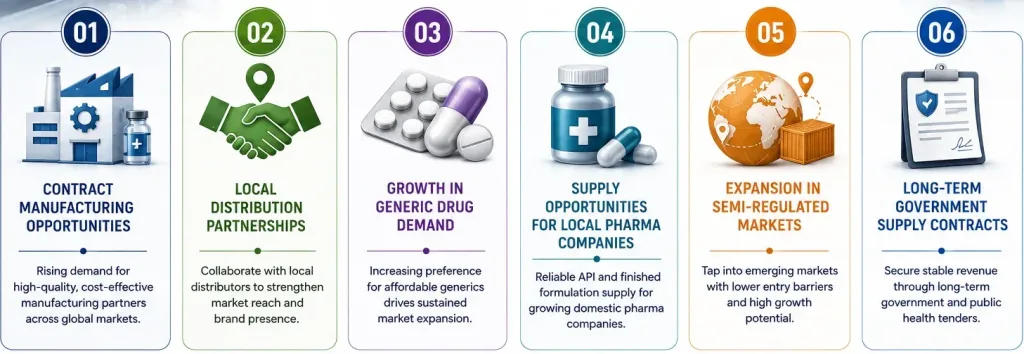
Supply Opportunities for Local Pharma Companies
A number of African states like Nigeria, Kenya, Ethiopia, Ghana, and Egypt are aggressively developing their local pharmaceutical production industries.
The businesses are seeking good API suppliers that can offer stability, consistency, and quality in their supply in addition to regulation.
The exports of Indian API to the emerging markets are already surging greatly, particularly in the regions like anti-infective drugs and antidiabetic medicines.
African drug companies choose to deal with pharmaceutical experts who are certified to produce medicines as per WHO-GMP standards since regulatory bodies demand high standard requirements to approve medicines.
Expansion in Semi-Regulated Markets
There are numerous African nations with semi-controlled pharmaceutical systems in which it is usually sufficient to have WHO-GMP certification to be considered as a supplier.
In contrast to very regulated markets like the US or Europe, not everything would require manufacturers to have costly certifications, such as USFDA or EMA approval, to enter these markets.
This is a perfect prospect for Indian API manufacturers interested in expanding their exports to various countries but may lack access to firmly regulated markets, yet.
Africa is a more convenient and shorter route to first time exporters who seek to establish business operations internationally.
APIs are already supplied to some semi-regulated markets in Africa, Asia and Latin America by the Indian manufacturers.
The emerging semi-controlled markets of Africa could enable the Indian exporters to make more sales internationally with the less entry and speedy commercial prospects.
Long-Term Government Supply Contracts
The governments of Africa are also trending towards longer-term purchase agreements of necessary medication and medical supplies.
Indeed, some organizations like WHO and the World Bank are urging the African nations to enhance the security of medicine supply by means of multi-year purchasing agreements.
These long-term contracts present extremely significant prospects to Indian API manufactures as they give them consistent and stable demand within a few years.
Another significant competitive edge may be acquired by manufacturers that develop high-quality results of meeting the regulations, take part in governmental tenders, and create an effective track record in supply at the initial stage.
Other countries like South Africa, Kenya, and Nigeria are implementing growth programs in government healthcare coverage and with this, the procurement volume will increase tremendously in the future.
Early entrants of Indian API manufacturers could get long-term business opportunities before the stronger competition enters into business.
Future Outlook for Indian API Exports to Africa
The pharmaceutical market in Africa is set to expand at an alarming rate in the coming decade, and it is likely that it can provide one of the most crucial future export markets of Indian API manufacturers.
This opportunity is being defined by a number of long-term trends, and the level of demand for APIs is growing steadily even up to 2030 and further.
Africa’s Rising API Demand
The speciality API market in Africa is expected to expand with a CAGR of approximately 7-9% in the years 2026-2035.
High population growth rate, increased urbanization, rising healthcare awareness, and rising chronic illnesses like diabetes, cardiovascular diseases, and cancer are all factors that contribute to this growth.
With the rise in efforts by local pharmaceutical manufacturers to produce medicine, the demand will automatically increase in terms of importation of the API.
Medical budgets of the government are also growing and this will create more in terms of the volume of medicine purchases in hospitals and in government healthcare systems.
Africa’s Growing Pharma Market
By 2030, the pharmaceutical market size in Africa is projected to be around USD 77 billion with a CAGR of close to 10%.
This renders Africa as being among the rapidly expanding pharmaceutical areas in the world.
APIs are in every pharmaceutical product, thus the increase in the medicine market is directly proportional to the increase in API demand.
Already, the Indian manufacturers are significant in supplying the APIs and finished drugs to the continent since almost 60% of medicines used in Africa are presently imported.
China+1 Supply Chain Shift
The international pharmaceutical market is moving towards the so-called China+1 approach, through which a company lessens its reliance on China by incorporating other manufacturing and supply partners.
This is not merely a temporary phenomenon caused by the pandemic. It is turning into an extended worldwide supply chain approach.
Increasing manufacturing prices in China, geopolitics and supply chain risks are also stimulating pharmaceutical buyers to diversify their sourcing.
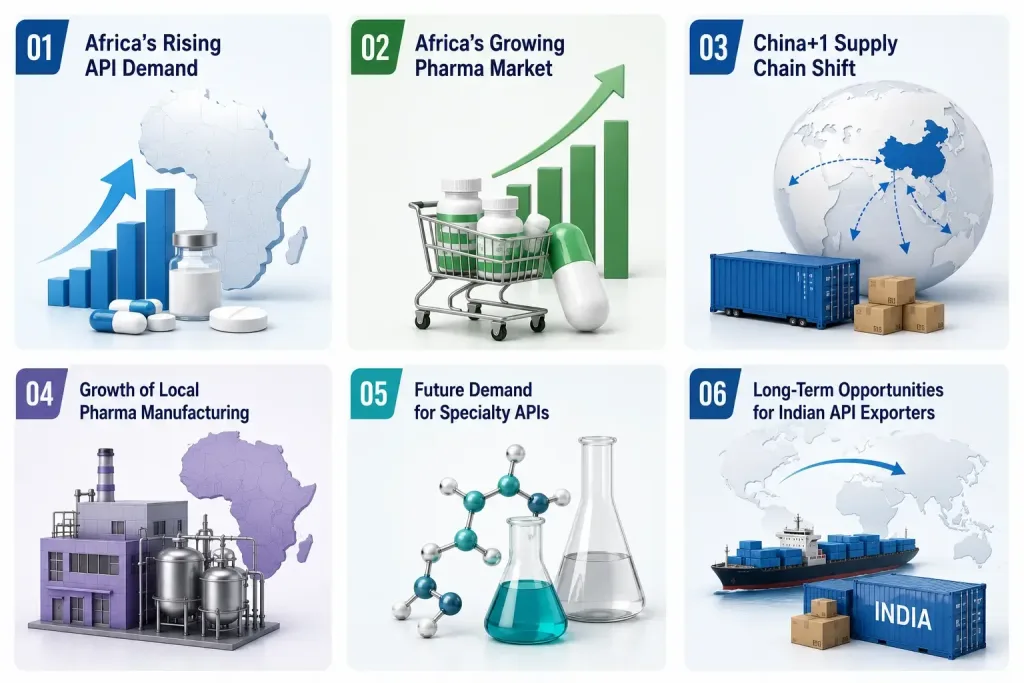
Growth of Local Pharma Manufacturing
Governments in Africa are putting a lot of funds in local production of pharmaceuticals.
Egypt has a national initiative that aims to boost local medicine manufacturing with its Pharma 2030 program and South Africa has its Pharmaceutical Industry Master Plan program.
The African Development Bank has also been already terming huge investment prospects on the pharmaceutical manufacturing framework of the continent.
The demand for APIs will be correspondingly increased as new medicine production facilities are being constructed.
Future Demand for Specialty APIs
Depending on the conventional generic medicines will not be enough in the future African pharmaceutical market.
The need of specialty medications, including the oncology drugs, biologics, biosimilars, and CNS treatment, is likely to be considerably increased as well, particularly in higher income and urban areas.
In 2026 and beyond to 2032, patent expirations of many world blockbuster drugs will give generic API producers opportunities to capture these advanced segments of medicine.
Indian drug companies are already increasing investments in the specialty APIs, biologics, and high-potency APIs which places them in a good position to meet the demand of Americans in the future.
Long-Term Opportunities for Indian API Exporters
The long-term outlook for Indian API exporters in Africa is extremely positive.
India’s pharmaceutical industry is targeting a turnover of USD 130 billion by 2030, with exports playing a major role in this growth.
At the same time, Africa’s pharmaceutical market is expanding rapidly and becoming more organized, regulated, and investment-driven.
Indian manufacturers that begin building regulatory approvals, distribution partnerships, government tender participation, and long-term customer relationships today can benefit from years of continuous market growth.
Conclusion – Africa Is Not the Future for Indian API Exporters. It Is the Present
Africa’s pharmaceutical market is growing quickly.
The continent needs APIs in the same categories where Indian manufacturers are already strong global suppliers.
Africa’s push for local manufacturing is increasing API demand, not reducing it.
The China+1 strategy is also helping India become a preferred supplier.
AfCFTA may turn Africa into a much larger connected pharmaceutical market in the coming years.
The opportunity is already here.
Indian API exporters that build supplier relationships in 2025 may gain strong long-term advantages in pricing, tenders, and regulatory positioning.
Those who wait may face more competition later.
Explore Actiza Industry WHO-GMP certified API portfolio for the African market supply:
Explore Actiza Industry WHO-GMP certified API portfolio for African market supply-antidiabetics, cardiovascular APIs, anti-infectives, antimalarials, anti-TB, and ARVs.
Contact our export team for documentation packages, stability data, and market entry support. View our certifications or browse our full API catalogue.