
Active Pharmaceutical Ingredients (APIs) are the substantial ingredients of medications that function in the body to make the required therapeutic effects happen.
They are the building blocks of all drugs and are very important for how well a medicine works, how safe it is, and how it moves through the body.
APIs are not just chemicals but an essential formulation. Every step of their manufacturing must be precise, follow the rules, and come up with innovative ideas.
The global API market will steadily rise from USD 253.27 million in 2024 to USD 419.16 million by 2032, with a CAGR of 6.5%.
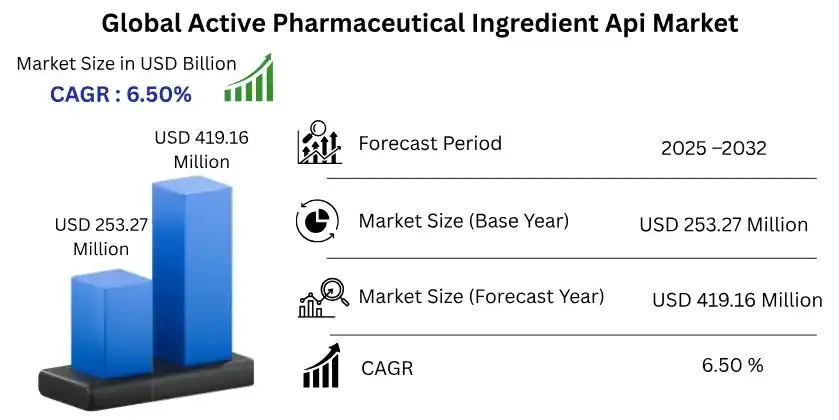
The strong growth is due to more people getting chronic conditions, more people wanting generics, and advanced technology used in production.
There are many global players in this side of pharmaceuticals, contributing their part. At Actiza Industry, we are an emerging manufacturer with years of expertise making APIs.
We have technical awareness and adherence towards strict international quality standards. Our company’s main aim is to provide high-quality APIs and contribute well in the market.
Global API Market: Country Comparisons & Stat Data
India vs. China:
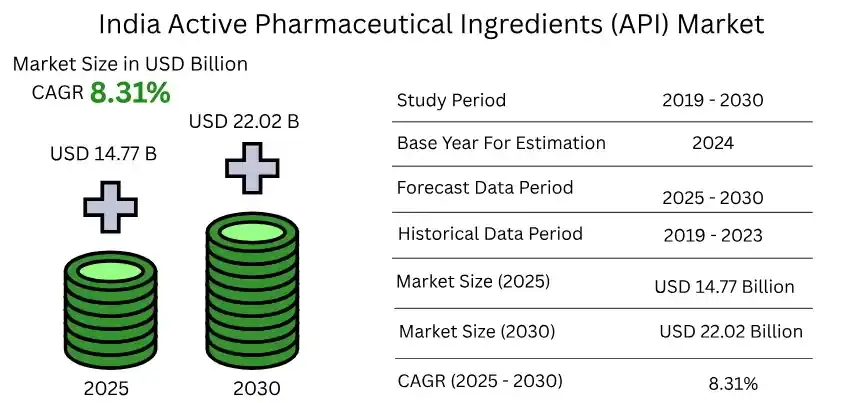
India is presently known as the “Pharmacy of the World.” Its local API market is strong, with USD 14.77 billion in 2025.
It is estimated to reach USD 22.02 billion by 2030, with a CAGR of 8.31%. The Indian API industry is prominent because it produces high-quality products, follows the rules, and has affordable prices.
China is the biggest producer of APIs by volume, but it is also the biggest producer since it has a lot of factories and can make things cheaply.
India is great at creating high-quality APIs that meet the demanding criteria set by the USFDA, WHO-GMP, and EU. This difference makes India a popular choice for markets that are heavily regulated.
India vs. EU/US:
India supplies 40% of the generic APIs used in the US and more than 50% of the vaccines needed in the EU. This means that India is very important to the supply networks of Western pharmaceutical companies.
The EU is making fewer APIs. It has relocated a lot of its production to countries with lower costs, such as China and India.
The fact that production localization is still being looked at across Europe just shows how important India is to keeping API flows going to important areas.
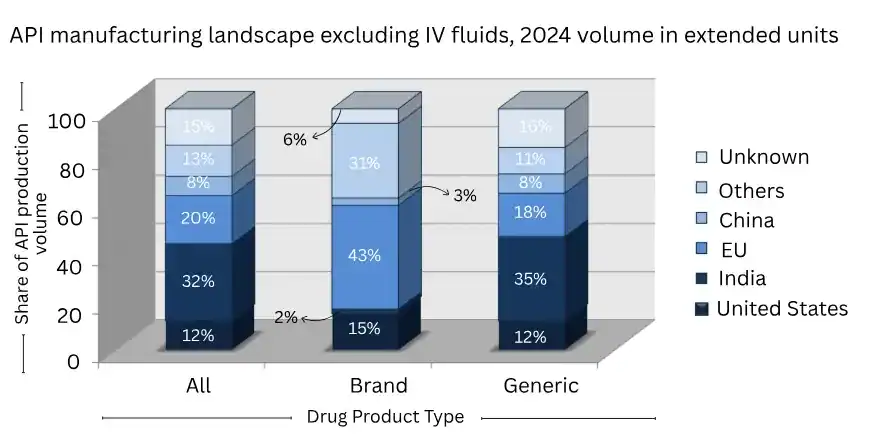
India has the most generic medication APIs in the 2024 API production landscape, with a 35% share. The EU and China come next.
The EU has a 43% share of branded products, while it has a much smaller share of generics. India is the best in making generics, which makes it the leader in volume. This is especially true for drugs that are very important and for treating long-term illnesses.
Uses of APIs: Across Countries & Markets
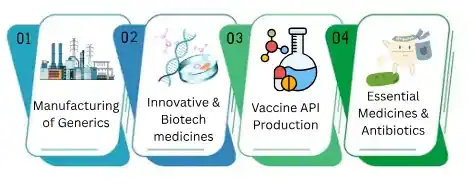
Manufacturing of Generics:
India supplies a lot of APIs to makers of generic drugs in North America, Europe, Africa, and Southeast Asia. This makes it easier for people all around the world to get medicines at a low cost.
Its strong position in generics helps public health programs and national insurance plans that depend on low-cost, high-quality medications.
Innovative & Biotech medicines:
Most branded medicine APIs come from Europe and the United States. But currently, many novel treatments depend on biotech API innovation from India and China.
Some of these are monoclonal antibodies, peptides, and oncology APIs. India is a crucial player in the biologics and specialized categories because there is a lot of demand for these kinds of advanced APIs around the world.
Vaccine API Production:
India manufactures more than 60% of the global vaccines, which shows how well it is at making vaccine APIs.
Indian businesses have joined together with some of the best public health organizations in the world. India is now a major player in the global vaccine manufacturing industry.
The country has a 40% market share in terms of vaccines, as per the data of the World Health Organisation in 2021.
Essential Medicines & Antibiotics:
Due to strict environmental rules and expensive operating expenses, the EU has seen a drop in the manufacturing of antibiotic APIs. India has filled in to address this issue. Its cost-effective production system has made it a major supplier of antibiotic APIs to Europe and other countries.
Country‑Level Dependence & Supply Chain Resilience
India–EU Dependency:
The EU gets more than half of its APIs from India, which was very important during the COVID-19 pandemic. India’s API exports helped keep Europe’s pharmaceutical supply chain stable during times of shortages.
India–US Relations:
India’s API supply meets over 40% of the US’s generic medicine needs, which is very important for keeping healthcare costs down. India is an important API partner for US producers because it has many FDA-approved facilities.
Geopolitical Risk Management:
As countries reassess their supply chains because of geopolitical tensions, pandemic interruptions, and concerns about sustainability, India stands out as a safe option.
For example, Xellia Pharmaceuticals is transferring its factory from China to Europe. This indicates how weak the present system is. It also shows how important it is to have reliable and varied sources, which India can give.
Your Manufacturing Edge: India–Global Synergy
Our facilities are top-notch and follow cGMP rules. We have been in this field for decades. We have gotten clearances from the USFDA, the EU-GMP, the WHO, and others.
This makes sure that our API production satisfies international requirements. We offer solutions that meet the changing needs of global markets, from new ways to do process chemistry to quality control from start to finish.
We deal with people in North America, Europe, Central Asia, Africa, and Latin America. This makes India an even stronger leader in production and innovation.
Significance of APIs in the Pharmaceutical Industry
APIs decide how well a drug will function as a medicine. Their molecular integrity, purity, and potency affect not only how well drugs work but also how safe they are for patients and how well they work in the clinic.
APIs affect medicine pricing, access, and new ideas. They are very important in the pharmaceutical value chain. This is exactly why we must take APIs manufacturing seriously and responsibly.
Key Challenges in API Manufacturing
Country Relations & Strategic Outlook
India is working to make its relationships with other countries stronger.
It is important to have good global networks nowadays. This will help in trade and technology transfer between APIs.
India has become a major provider of APIs thanks to bilateral agreements, regulatory harmonization, and pharmaceutical diplomacy. This is good for both developing and developed countries in the long run.
The Future of APIs: Innovation & Expansion
Conclusion
APIs are what make drug research possible, and India is at the top of this important field. India’s API industry has the best quality, compliance, and scalability in the world.
It powers global generics and makes complicated medicines possible.
As demand rises, companies like ours that have excellent capabilities, know the rules, and can reach people all over the world will help determine the future of healthcare across the globe.