
Introduction: Why API Purity Matters in Modern Pharmaceutical Manufacturing
In pharmaceutical manufacturing, the purity of an Active Pharmaceutical Ingredient (API) is vital. It ensures the safety, effectiveness, and reliability of medicines. APIs manufacturing are responsible for creating the desired therapeutic effect.
Impurities or contaminants can reduce a drug’s effectiveness. They might also lead to harmful side effects.
High API purity ensures consistent drug performance, accurate dosing, and better stability. Even small variations in purity levels can affect how a medicine is absorbed and how it works in the body.
Pharmaceutical manufacturers have strict quality control. They also follow regulatory standards during API production.
Understanding API Purity and Its Importance in Drug Development
API purity shows how much of the active chemical is in a pharmaceutical ingredient. A highly pure API has very few unwanted substances.
These include organic impurities, leftover solvents, inorganic residues, or trace metals. Keeping this purity is crucial for the active compound to work well in medicine.
Global bodies like the FDA, EMA, and WHO require drug companies to manage impurities. They must follow ICH (International Council for Harmonisation) guidelines.
These guidelines help standardize safety and quality requirements across the global pharmaceutical industry.
Important ICH standards related to API purity include:
In most pharmaceutical uses, a good API usually has a purity of 98% to 99.9%. This level changes based on the type of molecule. It also depends on the formulation and standards from pharmacopeias like USP, BP, or IP.
Why API Purity Directly Impacts Patient Safety
Impurities in active pharmaceutical ingredients are not just a manufacturing problem. They can impact patient safety and treatment outcomes directly.
Even small amounts of harmful contaminants can lead to bad reactions. They can also reduce drug effectiveness or trigger major product recalls.
Several real-world incidents highlight the importance of strict impurity control:
Because of these risks, pharmaceutical companies rely on advanced analytical testing, strict process controls, and regulatory oversight to ensure that APIs meet the highest purity standards before they are used in finished medications.
The Different Types of Chromatography
Chromatography is a common method in the pharmaceutical and chemical industries. It helps separate, identify, and measure parts of a mixture.
It works by passing a sample through two phases: a stationary phase and a mobile phase. This setup helps separate different compounds based on their chemical properties.
1. High-Performance Liquid Chromatography (HPLC)
High-Performance Liquid Chromatography (HPLC) is a popular method in pharmaceutical labs. It uses high pressure to push solvents through a column.
This column contains a stationary material. It separates compounds in liquid samples. HPLC is very accurate and sensitive. It’s great for spotting impurities. It also measures API concentration in drug development and quality testing.
2. Gas Chromatography (GC)
Gas Chromatography is primarily used for the analysis of volatile and semi-volatile substances. In this technique, an inert gas vaporizes the sample and carries it through a column.
GC is used to find leftover solvents. It also detects other volatile impurities in pharmaceutical ingredients.
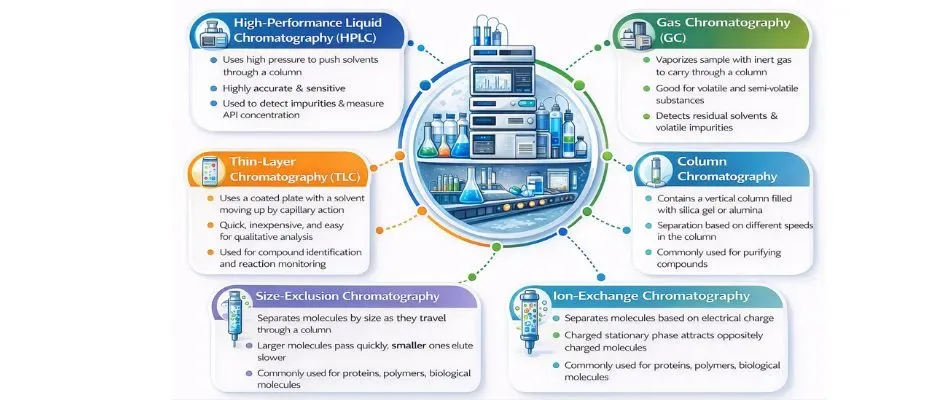
3. Thin-Layer Chromatography (TLC)
Thin-Layer Chromatography is an easier and cheaper method for fast qualitative analysis. A small sample goes on a coated plate. A solvent then moves up the plate by capillary action to separate the sample.
TLC is commonly used for preliminary testing, compound identification, and monitoring chemical reactions.
4. Column Chromatography
Column chromatography separates compounds in a vertical column. This column contains a solid adsorbent, like silica gel or alumina.
The mixture travels through the column using a solvent. Each component moves at a different speed, which causes separation. This method is a common practice in laboratories for purifying compounds.
5. Ion-Exchange Chromatography
Ion-Exchange Chromatography separates molecules based on their electrical charge. The stationary phase has charged groups.
These groups interact with molecules in the sample that have the opposite charge. This technique is often used for separating proteins, peptides, and certain pharmaceutical compounds.
6. Size-Exclusion Chromatography (SEC)
Gel filtration chromatography, or size exclusion chromatography, separates molecules. It does this based on size and weight. Larger molecules speed through the column.
Smaller molecules fit into the pores of the stationary phase. So, they take longer to pass through. SEC is commonly used in the analysis of proteins, polymers, and biological molecules.
What Is Chromatography in Pharmaceutical Analysis?
Chromatography in pharmaceutical analysis is a lab technique. It separates, identifies, and measures various chemical components in a drug sample.
It is a key tool in the pharmaceutical industry. It helps scientists check the quality of Active Pharmaceutical Ingredients (APIs). It also measures their purity and composition in finished medicines.
The technique lets a mixture pass through two phases:
As the sample moves through these phases, different compounds travel at different speeds. It depends on their chemical properties. This includes polarity, size, and interaction with the stationary material. This difference in movement leads to the separation of the individual components.
In pharmaceutical labs, chromatography serves many purposes.
It helps:
It is key in drug development, quality control testing, and stability studies. This helps ensure that medicines meet strict safety and quality standards.
Major Chromatography Techniques Used in API Purity Testing
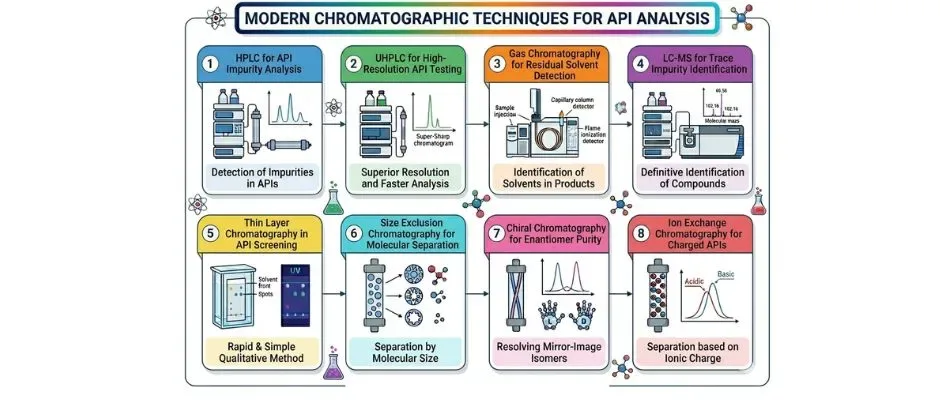
Real-World Applications of Chromatography in API Manufacturing
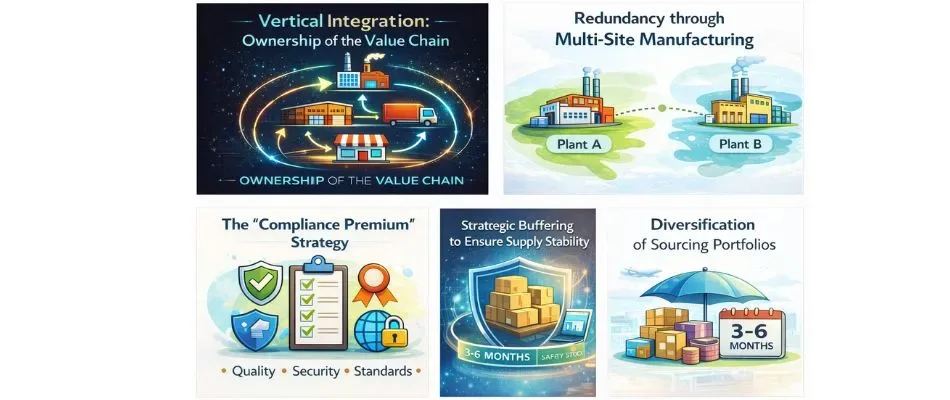
Types of Chromatography Used in Pharmaceutical API Testing
Chromatography is a lab method employed to separate and examine various substances found in a mixture.
It has two main parts. The stationary phase stays still. The mobile phase moves through it and carries the sample. These phases interact with each compound in a distinct manner. Thus, they move at varying speeds and become distanced from one another.
Modern HPLC systems can detect impurities at very low levels, even down to parts per million (ppm).
Advanced analytical tools can detect impurities as low as 0.001% (about 10 ppm). This helps pharmaceutical labs check drug purity with great accuracy.
Over 70% of impurity testing in pharmaceutical labs uses chromatography. This is because these techniques are reliable.
In chromatography, each chemical compound has a unique retention time. This helps scientists pinpoint impurities during analysis. Also, LC–MS (Liquid Chromatography–Mass Spectrometry) systems offer greater sensitivity. They usually detect limits between 1 and 10 ng/mL.
LC–MS can spot tiny contaminants. Its use in pharmaceutical impurity profiling has grown a lot over the last ten years.
Regulatory agencies also define impurity limits that manufacturers must follow. Report impurities if they exceed about 0.05%. They need to be identified above 0.10% and fully qualified if over 0.15%.
Most pharmaceutical APIs need to stay pure at 99% or higher. Stability studies check for any impurities that may develop over time.
Key Advantages of Chromatography in API Purity Analysis
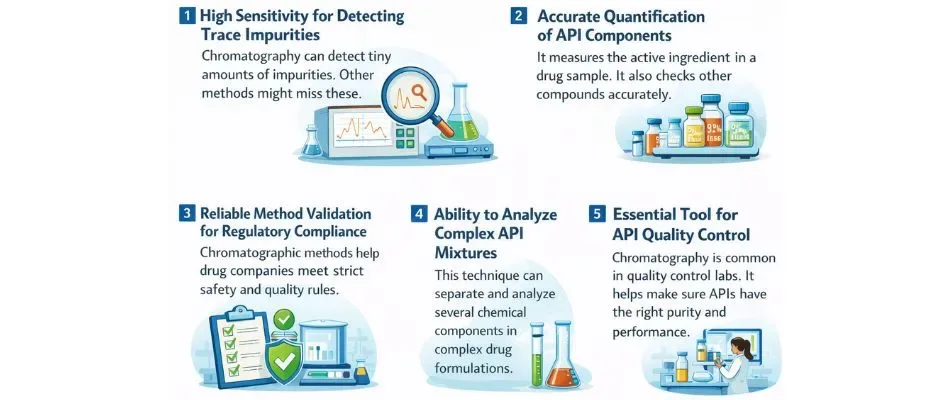
Emerging Innovations in Chromatography for Pharmaceutical Analysis
| Category | Projected Value by 2026 | Growth Trend (CAGR) |
|---|---|---|
| Category | Projected Value by 2026 | Growth Trend (CAGR) |
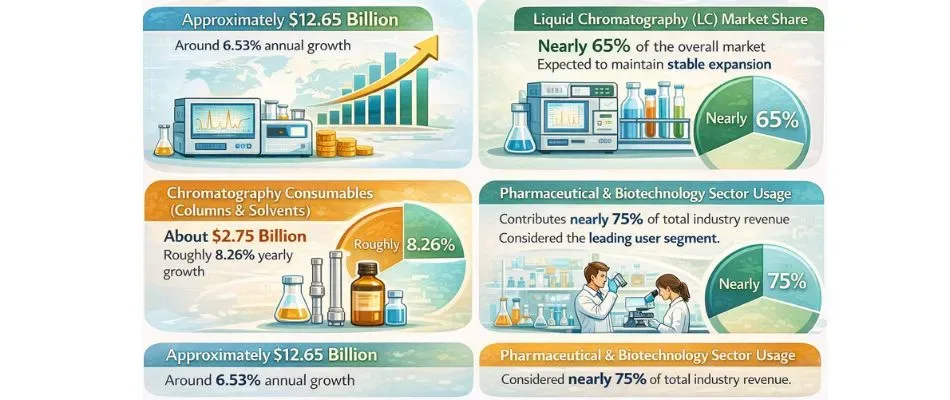
| Global Chromatography Industry | Approximately $12.65 Billion | Around 6.53% annual growth |
| Liquid Chromatography (LC) Market Share | Nearly 65% of the overall market | Expected to maintain stable expansion |
| Chromatography Consumables (Columns & Solvents) | About $2.75 Billion | Roughly 8.26% yearly growth |
| Pharmaceutical & Biotechnology Sector Usage | Contributes nearly 75% of total industry revenue | Considered the leading user segment |
Future Outlook: Chromatography in Next-Generation API Quality Control
Chromatography will likely be more important in API quality control. As pharmaceutical rules tighten and analytical tech gets better, its role will grow.
Experts expect the global chromatography market to hit about USD 43.05 billion by 2032. This growth comes from a rising need for accurate drug testing. Modern systems are getting smarter and more automated. They can now detect impurities with greater accuracy.
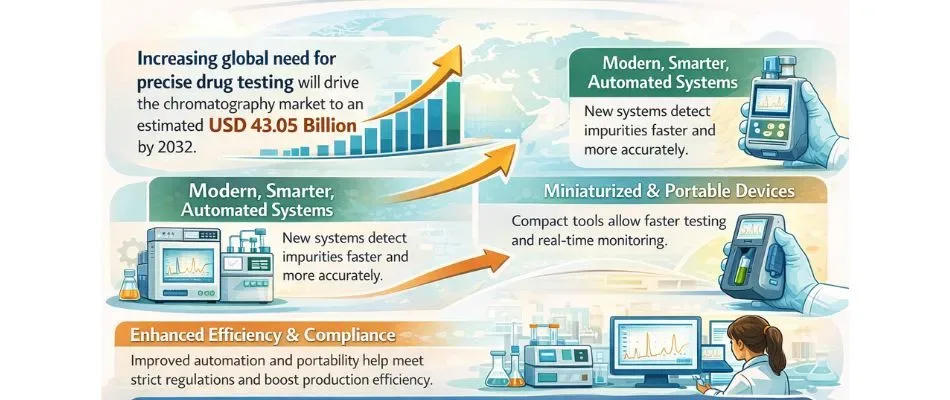
Miniaturized and portable chromatography instruments are being developed. They will help with faster testing and real-time monitoring in drug manufacturing.
These innovations will help pharmaceutical companies. They will check global regulations. They will improve production efficiency. They will also set new standards for reliable API testing and quality assurance.
Conclusion
Chromatography is essential. It helps ensure the purity and quality of active pharmaceutical ingredients (APIs).
It helps detect impurities through precise separation, identification, and quantification of chemical compounds. This ensures that pharmaceutical ingredients meet strict regulatory standards.
Chromatography is a key tool in drug development. Its high sensitivity and reliability make it vital for manufacturing and quality control.
Pharmaceutical technology is advancing, and chromatography remains vital. It ensures medicines are safe, effective, and high-quality.