
The Growing Global Burden of Respiratory Diseases
Breathing difficulties are a big problem around the world. COPD is the fourth leading cause of death worldwide.
In 2021, it resulted in around 3.5 million fatalities, making up 5% of global deaths.
In 2023, 36% of respiratory disorders were COPD. By 2050, the total number of COPD cases worldwide is expected to reach nearly 600 million.
This is a 23% increase from 2020. This increase puts a heavy burden on healthcare systems.
To address these challenges, we need strong drugs and active programs.
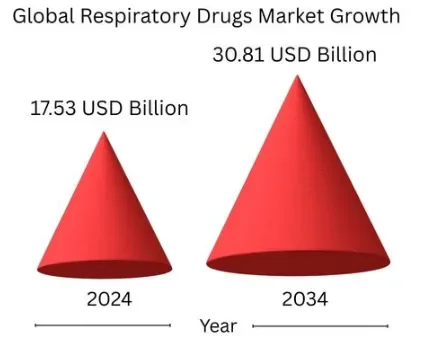
By 2034, the global market for respiratory drugs is expected to hit USD 30.81 billion.
This is a rise from USD 17.53 billion in 2024, showing a CAGR of 5.8%.
Key points –
Understanding Respiratory APIs
Respiratory APIs are essential for helping the body breathe better. These medications are made for the lungs.
They provide quick and mostly safe relief from usual breathing issues.
What Are Respiratory APIs?
Respiratory APIs help with breathing issues. These APIs develop treatments for breathing problems such as asthma, COPD, and allergies.
These medications help in various ways. Bronchodilators help relax tight airways.
They lower swelling through corticosteroids. Leukotriene blockers reduce allergy symptoms.
Some treatments mix these actions for better support. These APIs are aimed at direct lung delivery.
They improve airflow, ease discomfort, and make daily breathing simpler.
Common Formulations Using Respiratory APIs
Global asthma affects about 350 million people, while COPD impacts around 310 million.
Respiratory active pharmaceutical ingredients, or APIs, are found in many types of medicines.
These APIs must meet strict standards for particle size and purity to work properly and safely in the lungs.
Inhalers
By inhalers, APIs are taken directly to the lungs for fast action.
A pressurized device is often used to deliver a controlled dose, and thus, a patient who requires quick relief is facilitated.
Metered-dose inhalers deliver precise doses using HFA propellants and are very consistent.
With repeated use, they maintain an accuracy of over 95%.
Nebulizers
Nebulizers convert liquid formulations into a fine mist that can be easily inhaled.
They are great for infants, senior citizens, and anyone with a condition that makes using inhalers difficult.
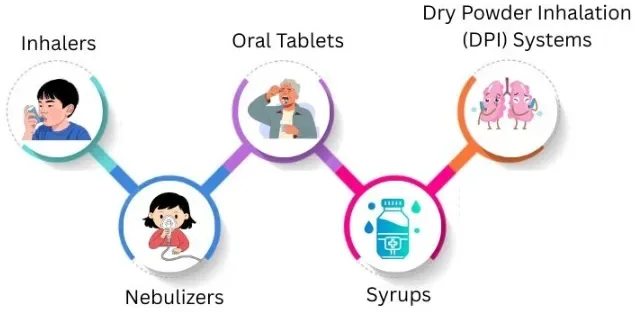
Oral Tablets
Healthcare providers use oral tablets when a respiratory API needs to work throughout the body.
They provide simple dosing and have long-lasting effects.
Tablet APIs need to break down easily and stay stable for proper absorption.
Syrups
Syrups are simple liquids that are easy to take. They work well for kids and older people.
These products help ease coughs and breathing discomfort.
Asthma affects more than 6 million kids in the US, and many of them rely on liquid medications that are easy to use.
Dry Powder Inhalation (DPI) Systems
DPIs use micronized powder that patients inhale with a strong breath.
In inhaled respiratory products, doses are often just a few micrograms.
This can be up to 1,000,000 times smaller than standard oral API doses.
Global Market Overview & Demand Drivers
The global respiratory API market is expanding. Chronic respiratory diseases are becoming a larger issue worldwide, driving this growth.
The WHO indicates that about 500 million people have asthma or COPD.
These conditions result in around 4 million deaths annually. This shows we urgently need better treatments.
The Asia-Pacific and Africa regions are growing fast.
This growth comes from better access to healthcare and generic APIs.
India’s Role as a Key Supplier of Respiratory APIs
India is a leading source of respiratory APIs worldwide.
It has a strong manufacturing base, skilled staff, and a history of meeting tough international quality standards.
India produces more than 500 APIs. It accounts for around 57% of the APIs that follow WHO standards.
Production Scale & Export Reach
India’s respiratory API manufacturing sector is quite large.
It operates with support from WHO-GMP, EU-GMP, and USFDA-certified facilities.
This strong quality base helps India meet growing global needs. It offers important APIs to high-demand markets worldwide.
With its advanced production systems and wide export reach, India stays a leading global supplier.
India has the most USFDA-approved plants and 2,000 WHO-GMP facilities.
Competitive Edge of Indian Manufacturers
Backward Integration
Indian companies are stepping up their local businesses with backward integration.
This strategy keeps them competitive. They can cut costs, improve quality, and speed up delivery by controlling key components of API production.
It also ensures a steady supply of raw materials for making respiratory APIs in large quantities.
Local Intermediates
India manufactures lots of its essential materials right in the country.
This method avoids import delays and keeps production steady.
It also helps manufacturers keep high output and handle global orders without delays.
Currently, about 60% of the raw materials used in the Indian pharma sector are imported as APIs.
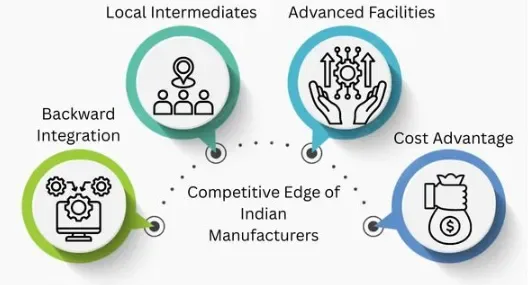
Advanced Facilities
Indian firms are investing in advanced micronization units and top-notch inhalation plants.
Such plants make particles that have the ideal size and flow for dry powder inhalers.
In 2024, the largest Indian pharmaceutical companies allocated USD 2.8 billion to R&D.
They also meet strict international standards for the quality and performance of respiratory APIs.
Cost Advantage
Lower labour costs and strong technical skills cut down total production expenses.
Large plants offer economies of scale. This enables India to offer affordable, high-quality respiratory APIs that meet strict global standards.
Top Respiratory APIs Exported from India
India is a key supplier of respiratory APIs globally.
The leading companies in India bring high-quality ingredients that are the source of products like inhalers, tablets, and nasal sprays.
1. Actiza Industry
Actiza Industry provides top-notch APIs for respiratory health.
These are essential for developing treatments for breathing difficulties.
We focus on regulated production and strict quality assurance. It leads to safe handling practices.
This ensures the API stays pure and stable while also meeting legal needs for global pharmaceutical partners.
2. Cipla Ltd.
Cipla is a major brand name in India for respiratory care.
Cipla provides APIs for the treatment of asthma, COPD, and allergy, backed by strong research teams and world-class manufacturing that meet high standards.
3. Lupin Ltd.
Lupin is the company behind the APIs that are used in a lot of respiratory treatments, and they are known for their research on complex molecules.
Their products are distributed to a lot of regulated markets globally. They prioritize safety, effectiveness, and affordability.
4. Sun Pharmaceutical Industries Ltd.
Sun Pharma is the exporter of diversified respiratory medicines and APIs.
It manages large, internationally certified facilities that ensure high-quality standards.
They develop complex formulations for long-term inhalation therapy and branch-based treatment.
Innovations & R&D in Respiratory APIs
Recent changes in respiratory APIs aim to produce smaller, purer particles.
This, in turn, makes them more accessible to the lungs.
Micronization and Particle Engineering
Micronization is a technique that is used to create fine-particle APIs.
These particles are able to get to the lower parts of the lungs, thus enhancing deposition.
Scientists use controlled crystallization to set the shapes of these particles, which helps with their flow.
Particle engineering is not just about reducing size.
It mainly concentrates on the shape, surface texture, and size distribution as well.
These procedures help the APIs mix well in inhalers, so they provide consistent doses.
The new methods aim to make the particles more stable, refined, and easier to inhale.

Combination and Novel APIs
Modern inhalers can carry out a triple therapy regimen by using novel respiratory APIs.
In short, this therapy combines LABA, LAMA, and ICS in one single dose.
These combinations help asthma and COPD patients breathe better.
These diseases are less complex, so more pathways can be targeted at the same time. The main goal of the research is to provide patients with stable, uniform, and convenient multi-API blends.
Green Chemistry in API Synthesis
Green chemistry in API synthesis focuses on cleaner and safer ways to make drug ingredients.
It uses solvent recovery and eco-friendly methods. This helps reduce emissions, waste, and pollution.
These practices reduce energy use, rely on safer materials, and help the environment.
This method supports global sustainability goals and ensures ESG compliance.
It makes API production more trustworthy and ensures it’s ready for the future.
Quality, Compliance, and Safety Standards
API manufacturers use strict quality control in their production.
This ensures every batch is reliable, safe, and hygienic.
ICH Q7 is accepted by major regulators such as the FDA, EMA, Health Canada, and Japan’s PMDA across over 100 countries.
These measures make production safer and more reliable, lowering risks and building trust with both regulators and consumers across the globe.
For high-quality products, Indian pharma companies follow these guidelines closely:
Global Supply Chain & Logistics Excellence
Indian API exporters rely on strong global logistics systems.
They use modern tools and smart planning to provide high-quality APIs globally.
Temperature Control
Indian pharmaceutical exporters are now using systems that control temperature in their logistics.
The product is kept safe and maintains its quality during the entire journey.
Major Pharma Ports
In India, port cities like Mumbai, Chennai, and Visakhapatnam handle a lot of shipments.
One benefit of these ports is fast customs clearance. This speed really helps with exports and imports.
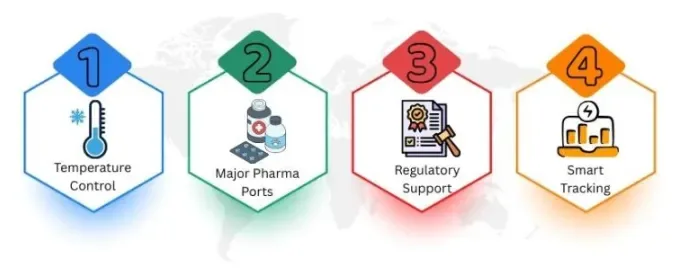
Regulatory Support
Export teams simplify things and take care of customs paperwork and compliance issues.
They prepare the needed forms, certificates, and safety files.
This helps prevent delays and streamlines border import processes.
Smart Tracking
ERP tools and live-tracking systems make shipping clearer.
Buyers can track dispatch and delivery schedules.
This helps them manage inventory and avoid production delays.
Future Outlook: The Next Frontier in Respiratory Therapies
The future of respiratory care will be more advanced with the help of modern technologies.
Respiratory APIs and biosimilars from biotech are greatly valued in the global market.
Digital inhalers and smart devices help patients gain better control of their health.
India is expanding its HPAPI facilities and adding AI for quality checks.
By 2030, the country is expected to be one of the top three global exporters of respiratory APIs.
Conclusion
Respiratory API demand is rising globally. New technologies are coming in, and key healthcare markets are backing this growth.
India is spearheading this progress. Its large manufacturing base, solid quality systems, and broad export reach are vital.
The demand for inhalation APIs, combination therapies, and ingredients for smart devices is on the rise.
This industry is likely to grow steadily. Innovation and strong supply chains will enhance respiratory care in the future.