
Introduction: The Pharma Industry 4.0 Revolution
The pharma industry is witnessing a massive digital transformation.
This new era is commonly referred to as Industry 4.0.
It integrates new technologies like artificial intelligence (AI), machine learning (ML), and the industrial internet of things (IIoT).
They are turning medicine manufacturing smarter, quicker, and more trustworthy.
Global API manufacturing market for active pharmaceutical ingredients was $219.76 billion in 2024.
It is expected to grow to $233.43 billion by the year 2025, at a CAGR of 6.2%.
It is happening as there is high pressure on pharmaceutical companies to reduce shortages, reduce costs, and yet meet strict quality standards.
Industry 4.0 allows production systems to interact with data in real time.
That means fewer errors, less wastage, and more control of the process.
For API manufacturers, this digital revolution shortens the times to develop drugs, improves safety, and makes supply chains smooth.
Market Size and Projected Growth of Industry 4.0 in Pharma
The Pharma 4.0 market is projected to expand significantly within the next decade.
It is indicated to reach $81.2 billion in 2034.
This is with a compound annual growth rate of approximately 18–19%, which is significantly greater than conventional growth within the pharma industry.
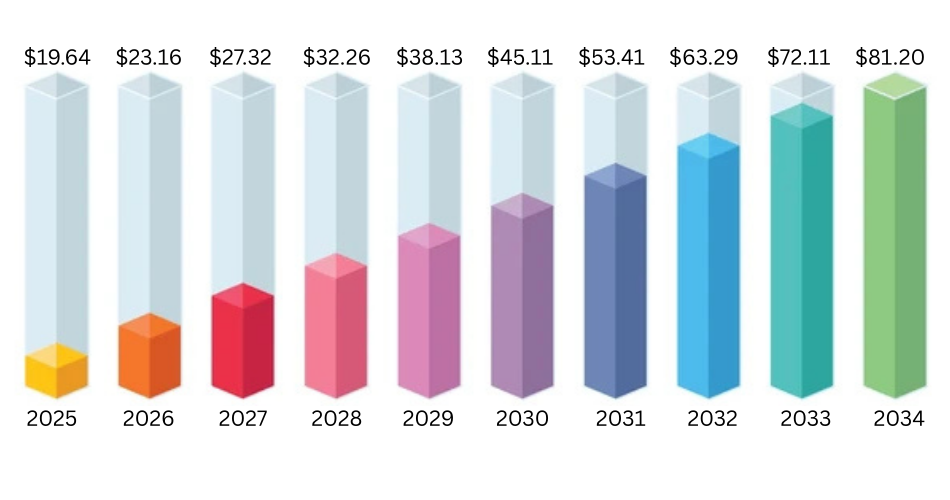
The growth path is uniform every year. In 2025, the market will be around $19.64 billion.
By 2026, it will increase to $23.16 billion, and by 2027 to $27.32 billion.
By 2028, the figure will increase again to $32.26 billion.
In 2029, the market will be projected at $38.13 billion.
The 2030s see even greater leaps. In 2030, the Pharma 4.0 market will grow to $45.11 billion, then to $55.41 billion in 2031.
In 2032, it could possibly reach $63.20 billion, and by 2033 approximately $72.11 billion.
Finally, in 2034, the Pharma 4.0 market will cross over $81.20 billion.
This growth is not for Pharma 4.0 alone. The global pharmaceutical manufacturing sector as a whole is also expanding well.
It is anticipated to expand at a CAGR of more than 6% until 2029, driven by investment in smart factories and digital infrastructure.
AI in API Development
Predictive R&D and Molecule Design
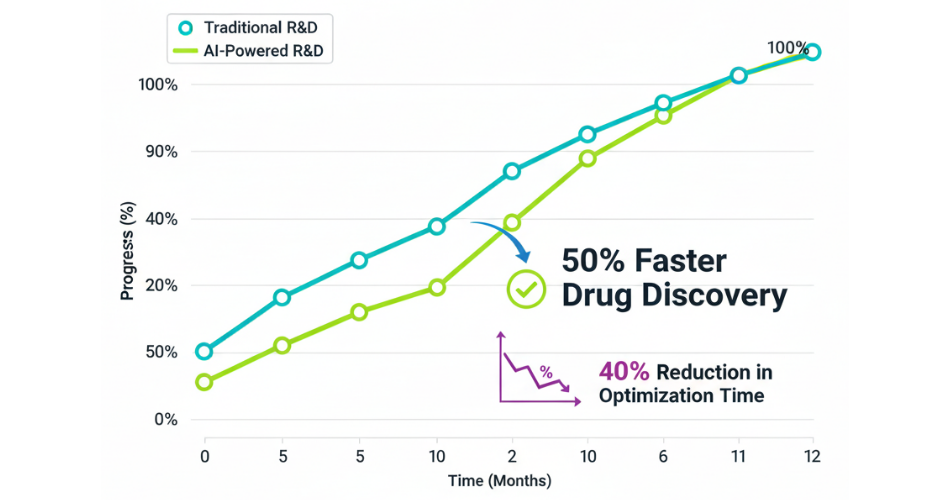
AI is already changing the way drug research works. Deloitte says that AI can cut the timescales for drug discovery by 50%.
That means new drugs can be found and tested in half the time.
AI is also being used to predict the crystal structure, solubility, and stability of APIs.
These predictions allow better molecules to be designed, which raises the chances of success.
Process Optimization
AI is also supporting production scaling up. Chemical reactions are hard to manage.
AI models now predict reaction yields and impurities in such processes.
For example, a leading global pharmaceutical manufacturer used AI-powered predictive models to reduce process optimization time by about 40%.
Quality Control & Batch Release
AI is also being used in quality control. AI-based spectroscopy hardware checks impurities in real-time.
Pilot demonstrations at MIT found that these machines reduced batch rejection rates up to 30%.
This leads to more batches passing quality checks, and drugs reach patients earlier and with fewer delays.
Machine Learning in Process Scale-Up
Data-Driven Scale-Up Models
Machine learning is being used in an effort to go from lab-scale research to manufacturing at large factory scales.
ML models pick up on past data and predict what will happen at scale-up.
This makes it easier to avoid mistakes which take a lot of time and money.
Process Analytical Technology (PAT)
PAT is the other key tool. PAT consists of sensors that provide real-time measurements on the shop floor.
Through machine learning, PAT can change processes quickly if anything gets off course.
For example, if temperature or pressure shifts occur, the system adjusts to keep the product within secure ranges.
This improves quality and eliminates waste.
Industrial IoT (IIoT) and Smart Manufacturing
Industrial Internet of Things (IIoT) integrates machines, sensors, and software into an intelligent network.
It is highly transforming the production of medicines by pharma companies.
IoT spending in pharmaceutical manufacturing by regions was USD 2,578 million in 2025.
The spending is expected to go up to USD 14,220 million in 2033 with a CAGR of 23.1%.
The most important data indicate:
By 2025, 45% of pharma manufacturers will fully integrate IoT into their systems.
This will speed up production and cut down on downtime.
IIoT can cut unplanned downtime by up to 50% because of real-time monitoring and predictive maintenance.
With IIoT, continuous manufacturing can cut production cycle times by half, boosting throughput while ensuring regulatory compliance.
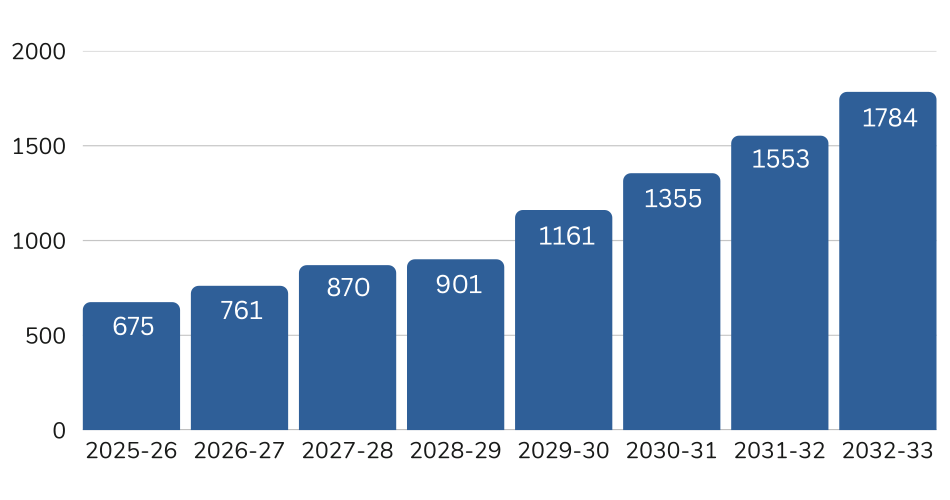
Spend growth is also reflected in numbers. From $675 million in 2025–26, it increases to $761 million in 2026–27, to $870 million in 2027–28, and $901 million in 2028–29.
Following years project even greater growth, reaching $1,161 million in 2030–31, $1,355 million in 2031–32, $1,553 million in 2032–33, and finally $1,784 million in 2033–34.
Digital Twins & Big Data Analytics
A digital twin is a replica of an existing process or system in the virtual realm.
In the healthcare industry, the digital twin market can reach $29.3 billion by 2030.
In the pharmaceutical sector, digital twins are utilized to replicate complete manufacturing processes.
This enables companies to test changes in a virtual environment initially before applying them to real equipment.
Big data analytics has a massive contribution as well.
With the merging of supply chain and manufacturing data, the time-to-market can be reduced by 10–20%.
Thus, patients are getting new treatments earlier.
Big data makes it easier to detect issues early, forecast demand, and enhance efficiency in the supply chain.
Regulatory Compliance and Quality Assurance
Industry 4.0 technologies are also assisting pharma businesses in complying with stringent guidelines defined by organizations such as the FDA and the EMA.
Sustainability & Green Chemistry in API Production
Smart production is also driving sustainability. Research has shown that API plants with Industry 4.0 technology have achieved:
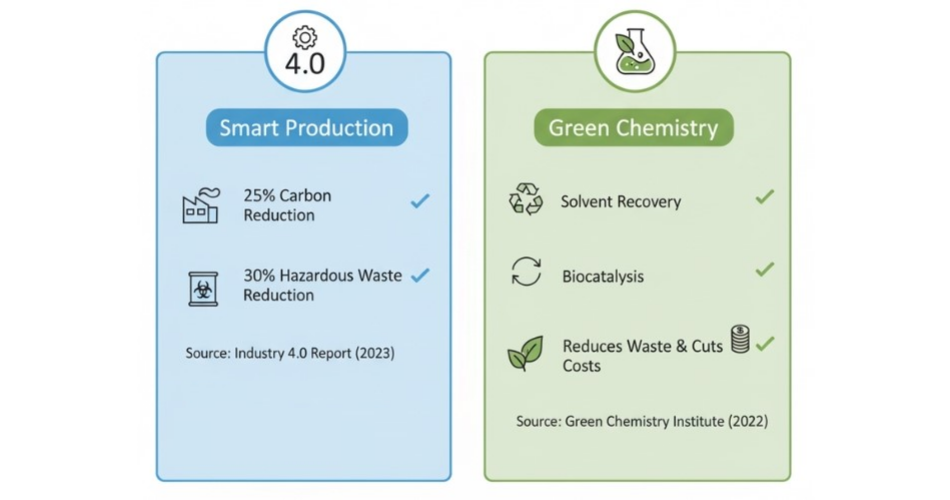
Green chemistry is another critical part of the revolution.
Technologies such as solvent recovery and biocatalysis reduce waste and cut costs.
These processes are sustainable and more efficient, allowing the industry to hit global environmental milestones.
Supply Chain Traceability & Security
Pharma supply chains across the world are large and intricate. They suffer from counterfeiting, delays, and shortages.
To aid in resolving this, organizations are utilizing blockchain with IIoT.
Blockchain gives an immutable digital record that can’t be changed, guarding all API traceability.
This boosts transparency and protects authenticity.
Real-time monitoring also helps with logistics.
Automated inventory control reduces delays, keeps stock at the right level, and strengthens supply chain resilience even during crises.
Workforce Evolution & Skill Development
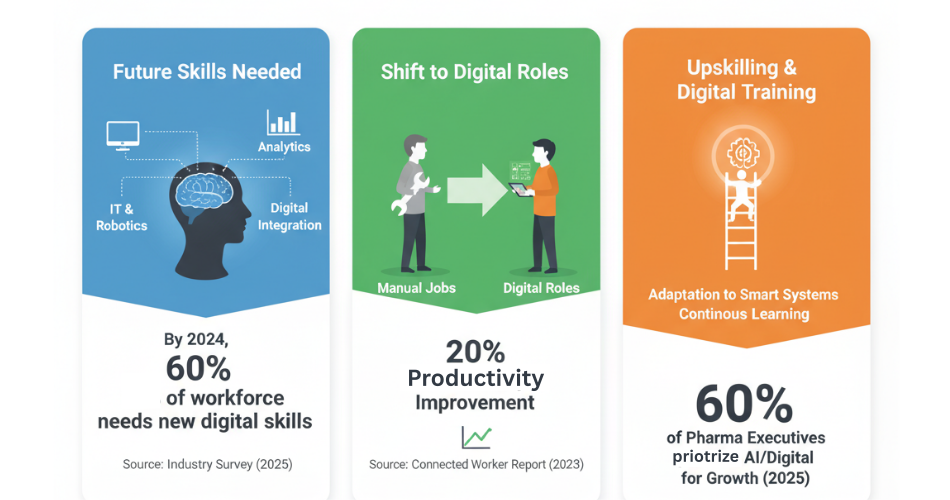
Industry 4.0 is changing the skills needed in the pharma workforce.
By 2034, the industry will need more workers with expertise in IT, robotics, and analytics. Many manual jobs will shift into digital roles.
In 2025, 60% of pharma executives named AI and digital integration as their top priority for growth, as reported through surveys.
Those firms that adopted connected worker solutions witnessed productivity improvements of more than 20%.
Upskilling and digital training are increasingly becoming the need of the hour so that workers can handle complex smart systems.
Personalized Medicines & Flexible Manufacturing
A key breakthrough is the rise of personalized medicine, enabled by Industry 4.0 technologies.
Industry 4.0 allows manufacturers to quickly retool production lines in order to make small, patient-spec batches of APIs.
Flexible manufacturing makes possible just-in-time manufacture, reducing waste and getting medicines to where they are needed.
New technologies such as 3D drug printing are making this possible, allowing for correct dose to correct patient.
The outcome is better patients and higher treatment compliance.
Challenges & Mitigation Strategies
Implementation of Industry 4.0 in pharma isn’t without problems:
Solutions in the pipeline:
Future Outlook: Industry 4.0 Pharma by 2034 and Beyond
Industry 4.0 is going to transform the world pharma industry by 2034, as per research that predicts:
Pharma 4.0 is set to be a defining milestone in pharmaceutical manufacturing, reshaping how APIs are developed and delivered.
It will make processes more efficient, more ethical, and stronger.
Most importantly, it will help provide safer and cheaper medicines to patients around the world.