
Introduction
The Indian pharmaceutical industry continues to strengthen its global footprint. Export have majorly hit Gnearly to USD 27.9 billion in FY 2023–24.
This shows a growth of about 9.67% from last year.
It has been witnessed that the country has the most US FDA-compliant manufacturing plants outside the United States.
It also boasts around 1,400 WHO-GMP certified facilities. Underscoring its world-class production standards.
This is being determined as “Pharmacy of the World.” Majorly here India is playing an important role in the pharma industry.
This means providing almost 40% of generic medicines in the US and about 50% of the world’s vaccine needs.
Global API Market Landscape & India’s Share
The global API market is key to making medicine available and affordable around the world.
The API is the key part that makes drugs work and ensures they are supplied reliably.
India has also emerged as one of a major player in the API market.
This is due to strong manufacturing, cost efficiency, and meeting international quality standards.
Bain & Company’s “Healing the World” report states that India has around 650 pharmaceutical plants that meet US FDA standards.
This, in turn, reflects the country’s strong regulatory alignment and quality assurance.
This makes it a trusted source for global pharmaceutical companies.
However, the same report does highlight India’s extensive export reach.
The country meets about 40% of the U.S. demand for generic medicine produced here.
In Africa, it meets 50% of the generics need. This majorly covers to more than 200 countries worldwide.
The India Brand Equity Foundation (IBEF) says India has more than 2,000 WHO-GMP-certified facilities.
These certifications show that India meets strict international manufacturing standards.
This indicates India as a top exporter of APIs and finished pharmaceutical products.
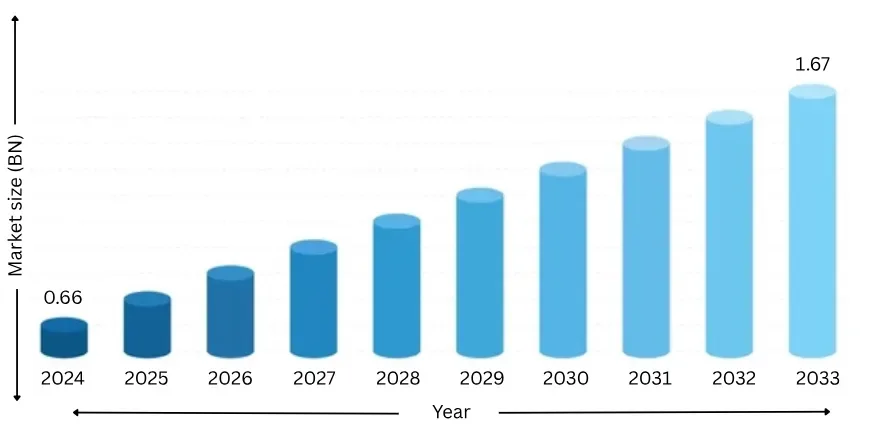
The image illustrates, the global API market size forecast from 2024-2033.
As per the chart, the market is expected to grow steadily from USD 0.66 billion in 2024 to USD 1.67 billion by 2033.
This represents the compound annual growth rate of 10.8%.
Moreover, the consistent upward trend does show the increasing demand for APIs.
This is all because of the rising demand for generic drug manufacturing and the rising prevalence of chronic diseases.
Cost Advantages that Drive Affordability
India’s pharma industry has a strong cost advantage. This helps to make medicines more affordable worldwide.
The country benefits from lower costs for labour, utilities, and land.
This makes drug manufacturing significantly more cost-effective compared to other global markets.
The Department of Pharmaceuticals states that India benefits from low production costs.
This isn’t just about the workforce.
It also has low land rates and cheaper resources, like water and electricity.
These factors can enable Indian manufacturers to offer high-quality API.
Regulatory Infrastructure & Quality Credentials
Indian pharmaceutical sector is playing a strong role towards the strong commitment and rules to the global quality and standards at the same time.
The country has the most U.S. FDA-compliant manufacturing plants outside the U.S.; it has more than 650 facilities.
India’s manufacturing ecosystem includes approximately 1,400 WHO-GMP approved pharmaceutical plants.
This is around 253 facilities certified by European regulatory authorities such as the EDQM and the EMA.
According to the Pharmexcil directory, India has around 950 companies. These companies run 1,329 WHO-GMP–certified facilities.
This is a particularly extensive network of globally accredited manufacturing units.
Government Policies & Strategic Incentives
The government of India has also come out with some strong policies and programs.
This helps strengthen the country’s pharma manufacturing base.
This is majorly the case for Active Pharmaceutical Ingredient (API) and bulk drug segments.
The government wants to increase domestic API production with the Production Linked Incentive (PLI) Scheme.
This will help reduce reliance on imports, especially from China.
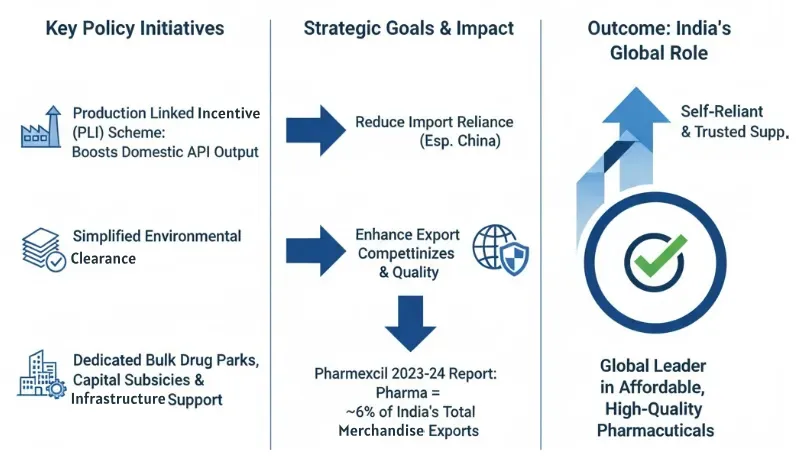
The policy document from the Department of Pharmaceuticals highlights several key measures.
It aims to simplify environmental clearances. It also plans to develop dedicated bulk drug parks.
The document also provides capital subsidies and infrastructure support.
Pharmexcil’s 2023-24 report says the pharmaceutical sector makes up about 6% of India’s total merchandise exports.
This highlights its important role in both the national economy and global trade.
India is boosting its role as a global leader in affordable, high-quality pharmaceuticals.
Its policy efforts and strategic incentives are key to this growth.
Export Reach & Market Penetration
As per the Bain & Company report, India is exporting pharma products to more than 200 countries.
This meets almost 40% of the U.S. demand for generic drugs. It also covers about 50% of Africa’s pharmaceutical needs.
The India Brand Equity Foundation (IBEF) says that pharmaceutical exports are vital to India’s trade.
They have a strong presence in both developed and developing markets.
In FY 2022–23, India’s pharmaceutical exports reached about USD 25.3 billion.
India is a leading global supplier of affordable, high-quality medicines.
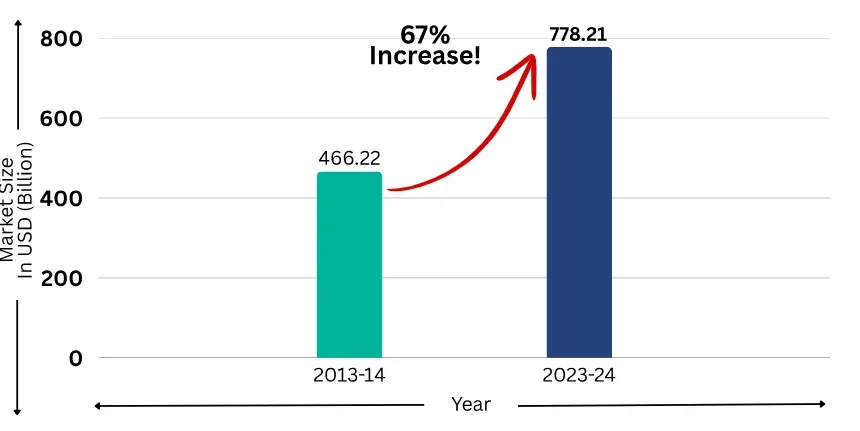
The chart shows that India’s exports have risen sharply in the last decade.
They went from USD 466.22 billion in 2013–14 to USD 778.21 billion in 2023–24. That’s a 67% increase.
India’s rapid growth highlights its rising role in global trade.
This change stems from strong growth in fields like pharmaceuticals, engineering, and tech services.
The steady rise shows that the nation has stronger manufacturing, diverse exports, and improved global competitiveness.
R&D, Innovation & Technological Strength
The Indian pharmaceutical industry thrives on strong research and development.
This is thanks to the country’s skilled scientists and advanced national labs.
Government reports highlight these capabilities.
The sector has made great strides in meeting international regulatory standards by 2024.
India has about 396 US FDA-approved facilities. This shows that it meets international regulatory standards.
Over 750 Indian facilities are registered with the US FDA.
Over 200 of these are approved for sterile injectable and other complex formulations.
Competition & Comparison: India vs China & Others
The image presents the two pie charts that compare the API and volume across major global producers.
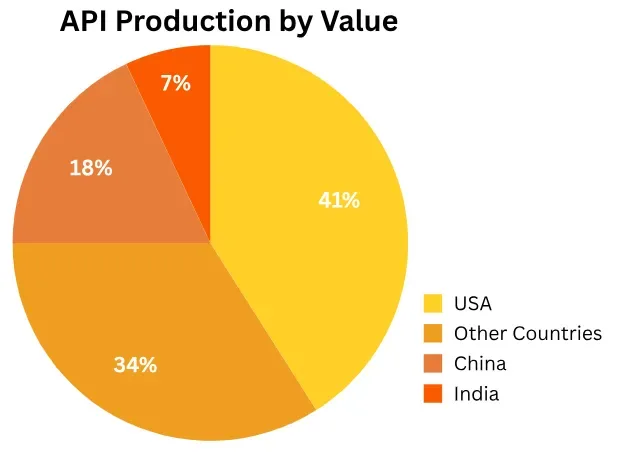
In the first chart, API production by value is shown. The USA leads with 41%. China follows with 34%.
Japan accounts for 18%, and India contributes 7%.
This shows that the USA and other developed countries dominate high-value API production.
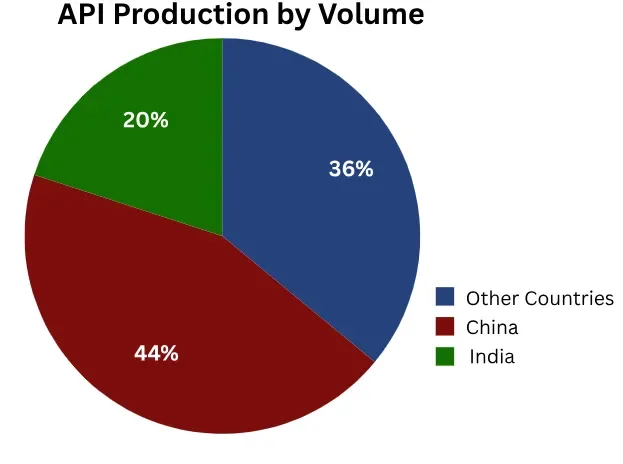
In the second chart (b), API production by volume shows China leading with 44%.
Other countries have 36%, while India accounts for 20%. China and India produce APIs in large amounts.
In contrast, the USA focuses on higher-value APIs. This shows differences in costs, technology, and market positions among these global players.
India imports many pharmaceutical intermediates, mostly from China.
Its true strength comes from strong regulatory compliance, solid quality systems, and a complete manufacturing process.
The Bain & Company report shows that India aims to change from a high-volume producer to a high-value exporter.
It emphasizes the need to diversify and improve its product mix.
This change has directed the flow of India towards the global pharma market.
It focuses on innovation, advanced formulations, and growth powered by technology.
Challenges / Risk Factors
The Indian pharmaceutical sector now faces new challenges and risks. These could impact its growth.
Rising costs from environmental rules are increasing operational burdens, especially in strict manufacturing areas.
The industry depends a lot on imported intermediates, mainly from China. This reliance makes the supply chain less stable.
In addition to these issues, global regulators like the US FDA are watching closely.
This has led to more audits and warning letters. As a result, Indian manufacturers must boost their quality assurance and compliance systems.
Future Outlook & Growth Trajectory
India’s pharmaceutical industry is growing rapidly. It is expected to rise nearly USD 120–130 billion by 2030.
This growth comes from increasing global demand and new ideas from within the country.
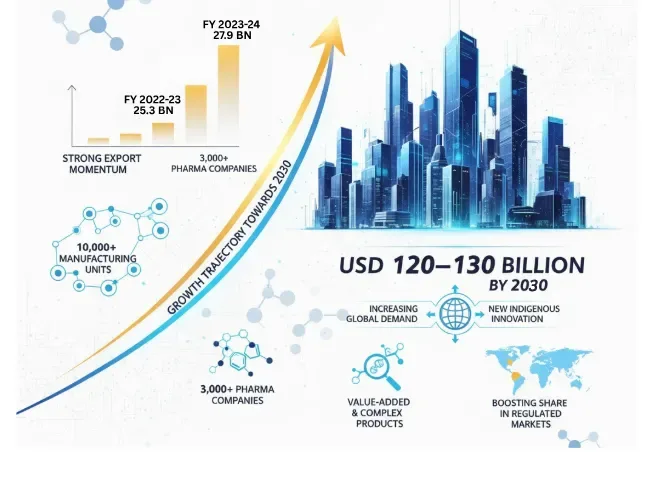
In FY 2023–24, pharma exports reached USD 27.9 billion. This is an increase from about USD 25.3 billion the previous year.
This growth shows strong export momentum. India comes with the strong network of more than 10,000 manufacturing units and more than 3,000 pharmaceutical companies.
Now, it is focused on boosting its share in regulated markets. The country aims to emphasize value-added and complex products.
Conclusion
India stands out as a top hub for pharmaceuticals. Its mix of low costs, strong regulations, and government support drives this.
Plus, India has a wide global reach and solid innovation skills.
India has challenges, but trends indicate it will enhance its role in the global API and pharmaceutical supply chain.