
Introduction
API manufacturing is now more demanding. Global medicine needs are rising, and regulatory standards are getting stricter.
Conventional batch production usually has many steps that can take weeks. This leads to bottlenecks and reduces productivity.
To stay competitive, pharmaceutical manufacturers must focus on process optimization that-
Core Definitions & Baseline Metrics
Yield
In API manufacturing, yield shows how efficient production is.
It means the percentage of the final active pharmaceutical ingredient obtained. This is compared to the maximum amount that can be made from the starting materials.
In many small-molecule API processes, a single-step yield of over 90% is very efficient. Experts see a yield of 70–80% across multiple steps as strong. This is good for large-scale production.
In many small-molecule API processes, a single-step yield of over 90% is very efficient. Experts consider an overall yield of 70–80% across several steps to be strong and good for large-scale production.
Throughput & First-Pass Yield
Throughput shows how many APIs are made in a given time. It imitates the output of the manufacturing process.
First-Pass Yield (FPY) shows how many materials finish production. It counts only those that don’t need reprocessing. This makes it a key indicator of process efficiency and product quality.
Process Intensification & Continuous Manufacturing
Process intensification aims to boost manufacturing performance. It does this by increasing efficiency and cutting processing time.
Continuous manufacturing helps materials move smoothly through production. This reduces downtime and improves consistency compared to traditional batch methods.
Growth of Continuous Manufacturing
Continuous manufacturing is rapidly growing in the pharmaceutical industry. It’s expected to increase at about 12.2% CAGR through 2033.
This growth mostly comes from improving production efficiency. It also keeps product quality steady.
Continuous systems work with fewer interruptions than traditional batch processes. This cuts down idle time between stages. As a result, manufacturing cycles speed up significantly.
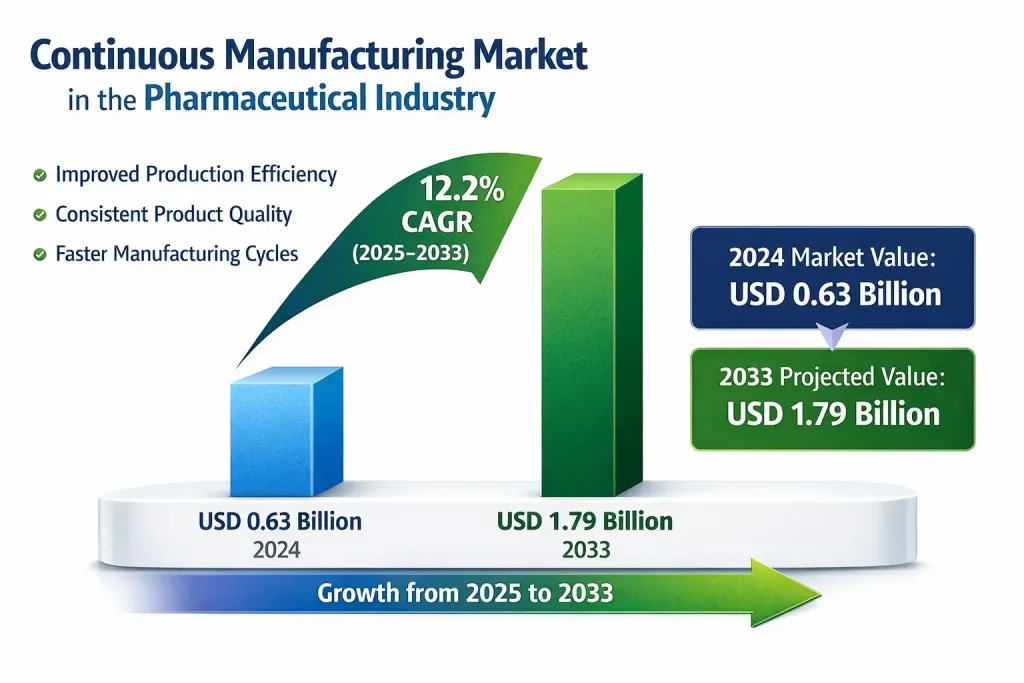
The global continuous manufacturing market was worth USD 0.63 billion in 2024.
It is projected to grow to USD 1.79 billion by 2033.
This means a CAGR of about 12.2% from 2025 to 2033.
Batch Vs Continuous Manufacturing (Key Metrics)
Traditional batch processes usually take about 5 to 7 days. They capture roughly 500 to 1,000 data points each hour.
Continuous manufacturing can operate for 100–200 days without stopping. It produces 10,000–50,000 data points each hour. This helps improve monitoring and process control.
Case Evidence Yield & Throughput Improvements
Quantified Yield Increase Example
A European API maker boosted performance by fixing process problems and cutting yield losses.
In three months, the company boosted production throughput by 64%. They did this by finding bottlenecks and improving key process parameters.
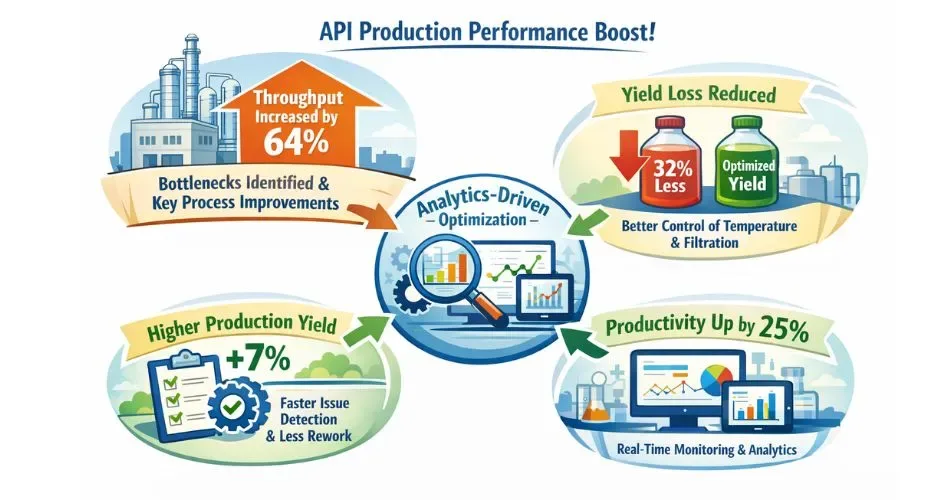
Earlier, some batches produced up to 32% less than expected. However, better temperature control and improved filtration timing helped stabilize the process.
These changes boosted overall manufacturing efficiency.
Analytics-Driven Optimization Impact
A pharmaceutical manufacturing facility used advanced analytics and real-time process monitoring. This led to significant efficiency gains.
The approach led to a 7% boost in production yield and a 25% rise in overall productivity.
These improvements happened because we detected process issues faster.
There was also less need for rework. Plus, we used the manufacturing equipment better.
Digital Transformation, AI, & IoT Quantified Value Add
AI & Advanced Analytics
AI and advanced analytics in pharmaceutical manufacturing boost process stability. They do this by analyzing production data and predicting possible deviations.
So, production variability goes down. This leads to steadier yields and better efficiency overall.
IoT Adoption Trends
Investment in IoT technologies within pharmaceutical manufacturing is expanding rapidly.
Spending in this area hit around $2,578 million in 2025.
Analysts expect it to rise to over $14,220 million by 2033. This shows a strong CAGR of about 23.1%.
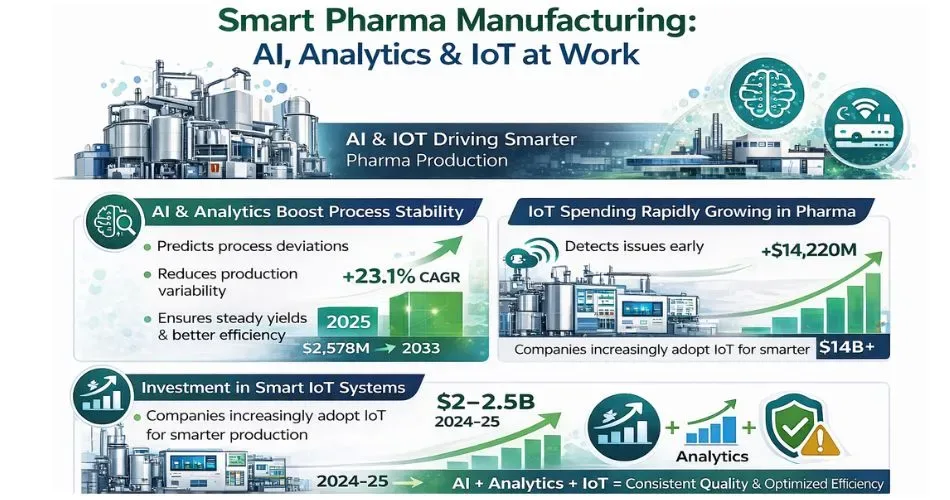
IoT systems allow real-time monitoring of equipment and processes. This helps spot issues early.
As a result, companies can cut unexpected downtime by up to 50%. This leads to a smoother production flow and better throughput.
Process Analytical Technology (PAT) & Quality by Design (QbD)
Process Analytical Technology (PAT) helps monitor and control manufacturing in real time. It detects process variations early, reducing the risk of batch rejection.
Quality by Design (QbD) aims to build processes. These processes have clear critical parameters and quality traits.
This helps manufacturers ensure consistent quality and achieve predictable production yields.
Operational Metrics & Digital Yield Drivers
Integrated Digital Solutions
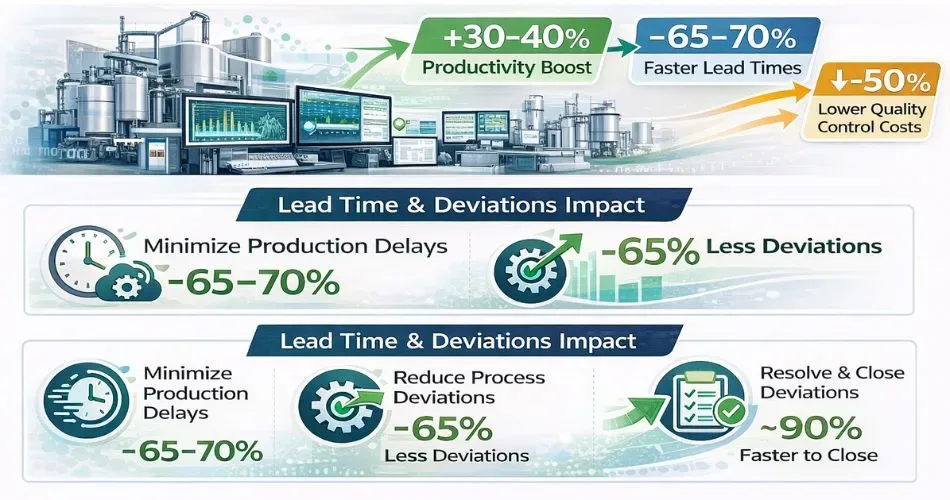
These solutions can boost productivity by 30–40%. They can cut production lead times by 65–70% and reduce quality control costs by almost 50%.
Automated monitoring also helps. Improved process management plays a big role, too.
Lead Time & Deviations Impact
This faster process helps minimize production delays and operational disruptions. Digital tracking and management systems can reduce process deviations by over 65%.
They also help resolve and close deviations almost 90% faster.
Process Intensification Benefits
Industry analysis shows that ongoing API manufacturing boosts production performance.
Cycle times can decrease by nearly 90%, reducing production from months to just a few days.
Continuous operation boosts throughput by about 90%. It does this by reducing idle time between stages.
Compared to traditional batch systems, you can cut capital investment by 20–75%. This happens because of better facility use.
Productivity & OEE Improvements
Real-time analytics and digital monitoring tools helped a pharmaceutical facility. They increased overall equipment effectiveness (OEE) by about 25%.
These systems helped plan production better. They cut down rework and improved equipment coordination.
So, process interruptions were cut down. This made manufacturing schedules more reliable and efficient.
Regulatory & Compliance Support for Optimization
Regulatory bodies like the FDA and EMA are now backing modern manufacturing. This support boosts efficiency and enhances product quality.
Regulators support real-time monitoring and continuous manufacturing. They also promote Process Analytical Technology (PAT). These ideas come from guidelines like ICH Q13.
These initiatives urge pharmaceutical companies to use better process optimization methods. They also stress the importance of strong compliance and consistent product standards.
Future Outlook – Market Growth Forecasts
The global API CDMO (Contract Development and Manufacturing Organization) market is growing.
This rise is due to higher pharmaceutical demand and more complex manufacturing processes.
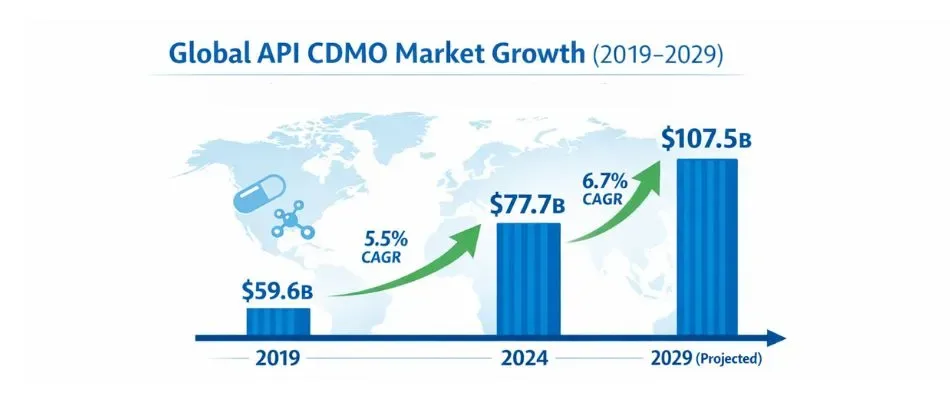
The market grew from about $59.6 billion in 2019 to nearly $77.7 billion in 2024, reflecting a 5.5% CAGR.
This is moreover expected to reach nearly $107.5 billion by 2029. This growth is about 6.7% CAGR.
It comes from rising drug demand. It also stems from better manufacturing needs and a focus on optimizing processes.
Global small molecule CDMO market across different years for the API & FDF segments.
2019:
2024:
2029 (Forecast):
Technology Adoption Forecasts
AI, IoT, and continuous manufacturing are on the rise.
They will enhance production efficiency and improve process stability in pharmaceutical manufacturing.
IoT investment is expected to grow by about 23% each year until 2033.
At the same time, continuous manufacturing adoption should rise by around 12.2% each year.
The industry is moving to smarter production systems. These systems are also more efficient.
Conclusion
Industry data shows that process optimization helps pharmaceutical manufacturing. Digital technologies also make a big difference.
Plant optimization boosted throughput by 64%. Analytics-driven systems raised yield by 7%. They also increased productivity by 25%.
IoT technologies can cut unplanned downtime by almost 50%. Also, advanced digital platforms boost productivity by 30–40%.
Also, continuous manufacturing is gaining traction. It’s expected to grow at about 12.2% each year until 2033.
This shows the industry is moving towards more efficient and tech-driven production methods.