
Executive Summary: India as the Global De-Risking Anchor (2024–2030)
The Global Pharmaceutical Supply Chain is changing quickly.
Countries are reducing their reliance on China and seeking safer supply chains.
India is becoming a key partner for the U.S. in APIs and FDFs.
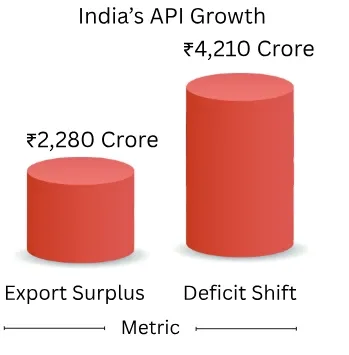
The U.S. is facing shortages, while India supplies 40% of U.S. generics. Plus, India has an export surplus of ₹2,280 crore.
Its API market is anticipated to reach around $31 billion by 2030, supported by a large number of FDA-approved sites, lower costs, and PLI-driven growth.
India’s strong PLI support has really paid off, transforming a ₹1,930 crore deficit into a ₹2,280 crore surplus.
As a result, India is now the most trustworthy API + FDF partner globally.
The strategy for global buyers is to increase sourcing from India, create long-term API partnerships, and be in harmony with its expanding backward integration ecosystem.
Introduction: Why the World Needs Supply Chain Diversification
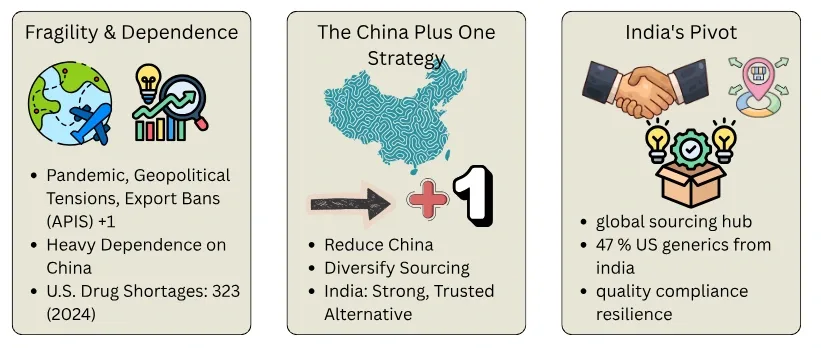
The global pharma supply chain has proven to be quite fragile.
These problems stem from the pandemic, export bans, and geopolitical tensions.
Heavy dependence on China, especially for APIs, makes the world vulnerable.
The U.S. had 323 drug shortages in early 2024 and imports 90% of its generics.
Of that, 47% comes from India. As a result, countries are now choosing a “China Plus One” strategy.
This shift pushes India forward as a strong and trusted alternative for global sourcing.
India’s Pharmaceutical Industry Overview
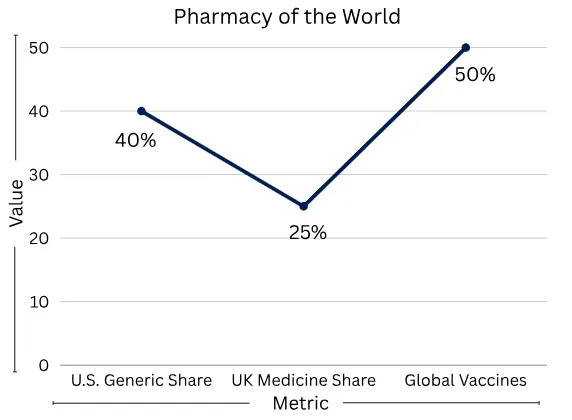
India holds the label “The Pharmacy of the World” and has the third-largest pharmaceutical industry by volume and the 14th-largest by value.
It provides 40% of generics in the U.S., 25% of medicines in the UK, and over 50% of global vaccines.
Its reach extends to more than 200 countries. The domestic market ranges from $50B to $55B, while exports total $26.5B.
There are 3,000 companies and 10,500 units. This includes over 2,000 WHO-GMP, 250-300 TGA, and 500 U.S. FDA plants.
India offers 60,000 generic brands in over 60 therapy areas.
India’s advanced ecosystem for contract development and manufacturing (CDMO) and contract research and manufacturing services (CRAMS) makes it stand out.
The country plays a key role in the global pharma market.
It is home to thousands of world-class manufacturing units and close to 60,000 generic brands.
Active Pharmaceutical Ingredients (API), KSMs & Bulk Drugs
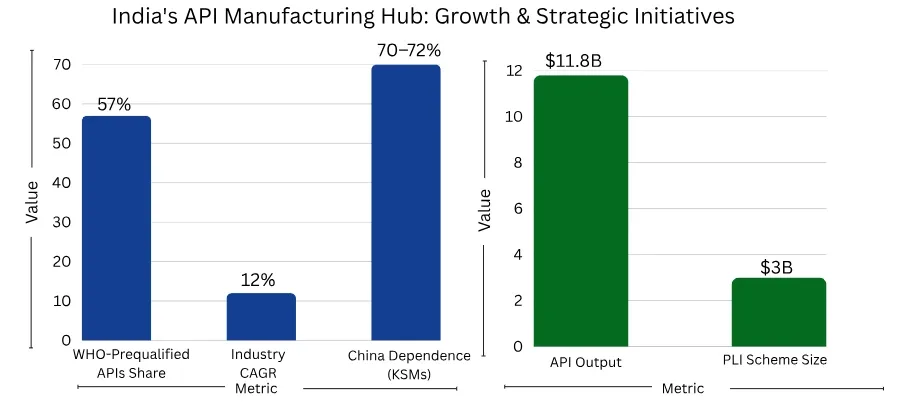
India is one of the world’s leading API producers. It accounts for roughly 57% of WHO-prequalified APIs and brings in about $11.8 billion in output.
The industry is expanding at a CAGR of more than 12%. Yet, the industry faces a “volume-vs-value” gap and relies on China for ~70–72% of KSMs and intermediates.
Government support through a $3B PLI scheme and 03 Bulk Drug Parks aims to cut this dependence.
India’s API market is projected to grow strongly through 2024–2030, supported by rising investments and expanding CRDMO capabilities.
Generics, Formulations & Biosimilars
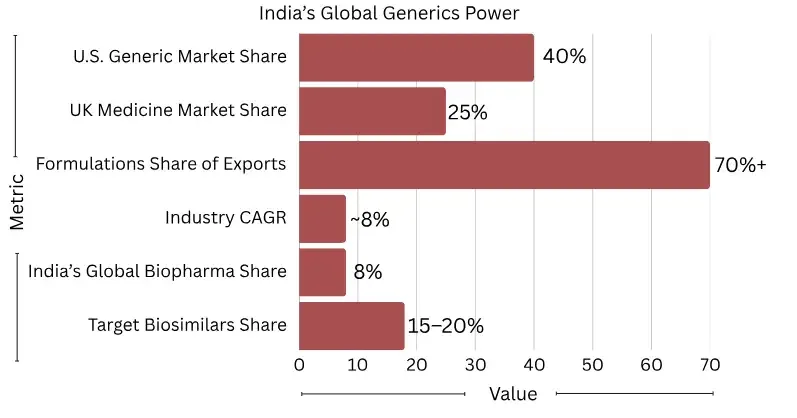
India dominates global generic drug exports, supplying about 40% of U.S. generics and 25% of UK medicines.
Formulations make up over 70% of India’s pharma exports, growing at nearly 8% CAGR to reach $27B in 2023.
India has strong capabilities in regulated and semi-regulated markets and is expanding its biosimilars base.
The goal is to grow from about 8% of the global biopharma market and capture 15–20% of the biosimilars segment.
Its low-cost FDF structure gives a major competitive edge.
Contract R&D and Manufacturing: CDMOs & CRAMS
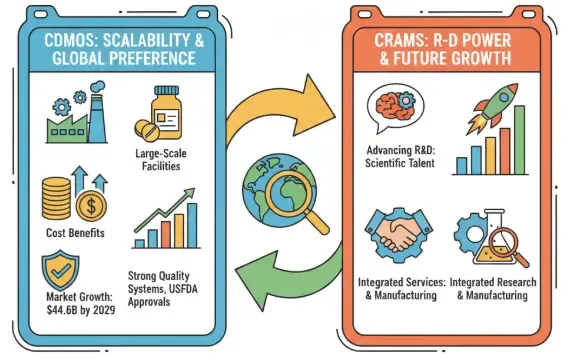
India can effectively develop and manufacture on a large scale.
It has big facilities that support everything from discovery to full production for global markets.
Global pharma prefers Indian CDMOs because of:
India’s R&D is advancing, supported by strong scientific talent and growing expertise in CRAMS.
CRAMS is expected to surge to $22-25 billion by 2035, a seven-fold jump.
Export Trends and Global Reach
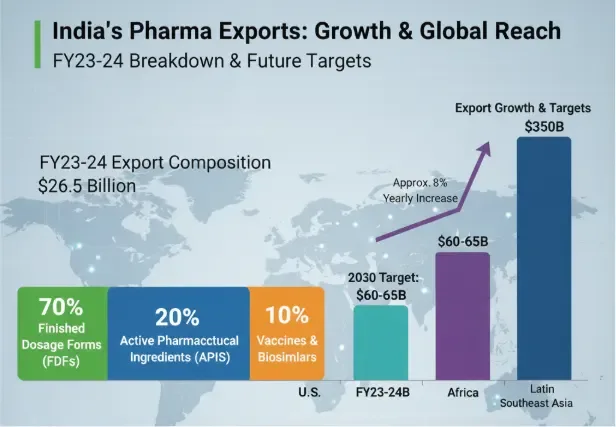
India’s pharma exports increase by about 8% yearly, hitting nearly $26.5 billion in FY23–24.
This includes 70% finished dosage forms (FDFs), 20% active pharmaceutical ingredients (APIs), and the rest made up of vaccines and biosimilars.
This growth is driven by strong demand from the U.S., EU, Africa, Latin America, and Southeast Asia.
Formulations make up about 70% of shipments, supported by India’s leadership in global vaccine supply.
As exports diversify by country, India also sees rising growth in oncology, anti-infective, and cardiovascular products.
India aims to boost its exports to $60–65B by 2030 and $350B by 2047.
Its strengths in vaccines and growth in oncology, anti-infective, and cardiovascular drugs support this goal.
India’s Competitive Edge: Cost, Quality & Innovation
India’s pharmaceutical sector is recognized globally for its affordable prices and stringent regulations.
A. Structural Cost Leadership
India delivers one of the lowest production cost structures worldwide, with manufacturing costs 30–35% lower than in the U.S. and Europe.
This benefit is due to low costs, large facilities, and high productivity.
The country features 752 plants approved by the USFDA, 2,050 certified by WHO–GMP, and 286 by EDQM.
India is a more appealing partner for pharma companies due to a drop in inspection issues.
USFDA OAIs have fallen 50% and EMA non-compliances are down 27%.
India has emerged as a top destination for cost-effective, quality-driven products in the industry.
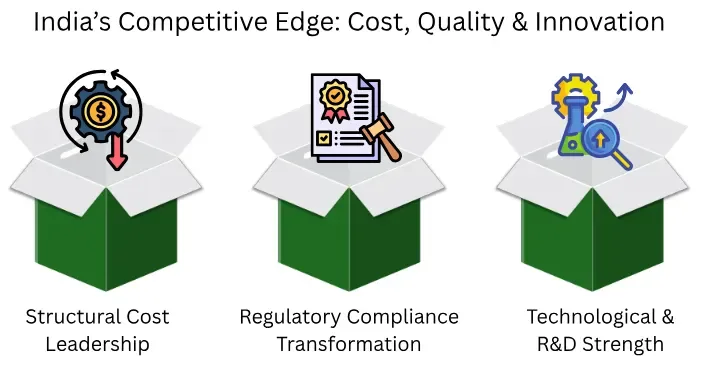
B. Regulatory Compliance Transformation
India’s upgrade of GMP systems and digitization has enhanced regulatory compliance.
Compliance outcomes have improved significantly.
More companies are using digital QMS, PAT tools, and traceability systems.
This has boosted quality, transparency, and readiness for regulated markets.
C. Technological & R&D Strength
India’s pharma industry is evolving with the help of flow chemistry, biocatalysis, and continuous processing.
These methods make production cleaner, faster, and cheaper.
Digital tools and AI improve quality control, increasing speed and accuracy.
India has more than 55 H&LS GCCs and $650 million from top CDMOs.
This strong talent pool fuels R&D growth, even with a short-term 6–7% hiring slowdown.
Policy Initiatives & Government Incentives
India is upgrading pharma manufacturing with well-structured policies.
These are aimed at increasing self-reliance and also at lifting the economy in the long run.
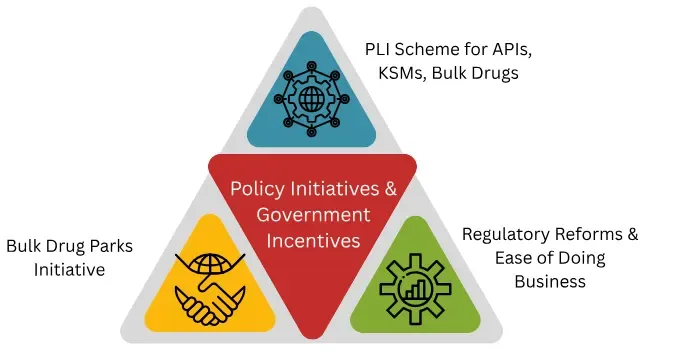
A. PLI Scheme for APIs, KSMs, Bulk Drugs
The PLI scheme has given domestic output a big boost by encouraging new greenfield API and KSM facilities.
As of Dec 2024, investments totalled ₹4,253.92 crore, more than what was committed, with 34 completed projects now producing 25 key bulk drugs.
This policy turned India’s ₹1,930-crore deficit in FY22 into a ₹2,280-crore surplus by FY25.
It also boosted CAPEX growth and cut down on imports.
Domestic value addition hit 83.70%, and 35 APIs that were once highly dependent are now produced locally.
B. Bulk Drug Parks Initiative
The Bulk Drug Parks Initiative helps India build a complete manufacturing system.
It creates large, top-quality hubs with shared facilities.
The ₹3,000-crore centres in Andhra Pradesh, Gujarat, and Himachal Pradesh help reduce costs.
They do this by sharing infrastructure and managing waste better.
This helps India by relaxing environmental rules and reducing capital needs.
This encourages local bulk drug production and, in the long run, boosts competitiveness.
C. Regulatory Reforms & Ease of Doing Business
India is updating policies to ease business operations.
A key change is to speed up approvals for essentials. This includes raw materials, manufacturing sites, and product registrations.
Companies can work faster with quick clearances and single-window systems. They can also track their activities online.
Port infrastructure development and support desks make export activities easier.
This helps pharma companies deliver products on time and grow smoothly in global markets.
Trade Agreements, International Partnerships & Diplomacy
India is building global trade ties through FTAs with the EU, UK, Australia, and the UAE.
This effort helps to open important markets and boost export opportunities.
Pharma-Specific Cooperation Agreements
India teams up with other countries to make medicines.
They also work on quality standards and help to get products to market more easily.
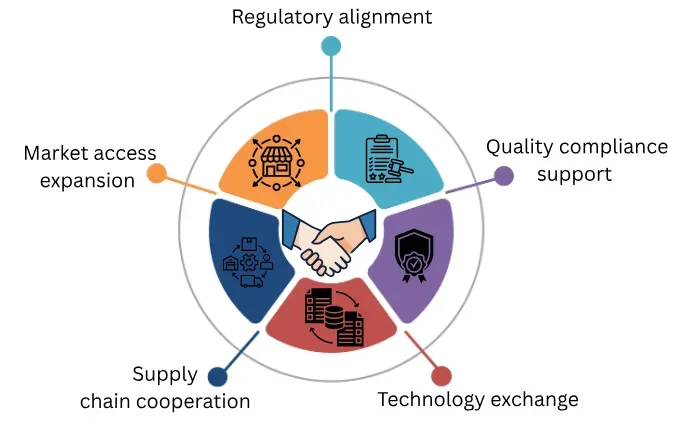
Trade agreements support Indian pharma exporters. They reduce tariffs, make documentation simpler, and open big markets more easily.
These relationships boost India’s role as a trusted global health supplier, especially in generics and vaccines.
FTAs are increasing market access and improving cooperation.
Therefore, India is turning out to be a partner of great value to the countries that are in need of safe, affordable, and reliable healthcare products.
Comparison: India vs China (and Other Global Players)
India and China are the leading pharma producers, but they have distinct approaches when it comes to cost, quality, and supply chain setup.
1. Cost Advantages
Manufacturing costs in India are nearly 20% cheaper than in China.
India’s $27 billion exports in 2023 make its medicines a strong choice for global buyers.
2. Regulatory Maturity
India is home to more than 370 facilities recognized by the US FDA, almost double the number in China, roughly 170.
The good compliance record of India convinces the highly regulated markets like the US and EU to open their doors.
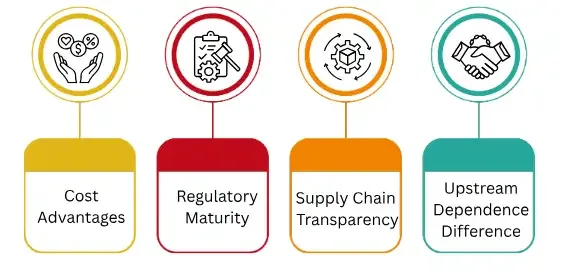
3. Supply Chain Transparency
India is one of the world’s largest suppliers of generic medicines and vaccines, holding 20% and 60% shares, respectively.
It has strong processes and a vast export network that spans over 200 countries.
China offers key APIs but gives less visibility in downstream processes, which worries global buyers.
4. Upstream Dependence Difference
China dominates APIs, supplying around 70% of India’s raw materials, while India leads in finished formulations.
India’s growing PLI-backed API production is reducing this gap and making its supply chain more self-reliant each year.
Buyers are moving to India mainly because of its low-cost advantage, better compliance, and API self-reliance that is on the rise.
India becomes a reliable and trustworthy sourcing partner for long-term collaboration.
Strategic Advantages and Key Challenges
India’s pharma industry is on the rise, but its growth has its share of strengths and weaknesses.
Advantages
India stands out in scale, cost, compliance, and innovation. This gives global buyers confidence in sourcing reliably.
Challenges
India faces many key challenges that prevent it from becoming self-sufficient and stable.
India’s Long-Term Roadmap (2024–2030 and Beyond)
India is moving away from the strategy of large-scale production of generic medicines and is instead directing its energies towards high-end products and innovation-driven growth.
Vertical Integration
India will enhance integration by boosting API and KSM capacities.
This aims to reduce import reliance and foster robust growth in the domestic pipeline.
API & KSM Leadership
India will emerge as a key global producer due to large-scale capacity building and PLI-backed plants.
They aim to increase exports to $60–65 billion by 2030.
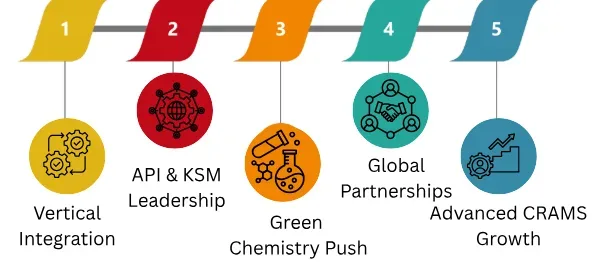
Green Chemistry Push
Almost all the companies will adopt eco-friendly methods. About 75% of the leaders surveyed regard sustainability as their highest priority.
They carry it out to save money and align with international standards.
Global Partnerships
India is going to be more connected with the US, EU, Japan, and other parts of the world.
This will boost high-value exports and help develop advanced therapies together.
Advanced CRAMS Growth
India plans to enhance its CRAMS/CRDMO capabilities. It will leverage digital tools and biologics infrastructure.
This effort aims to compete on a global scale and foster innovation-led manufacturing.
Future Outlook & Opportunities for Global Buyers
India is gearing up to be the top destination for pharma sourcing.
This change benefits global buyers with better costs, quality, and long-term reliability.
India is set to become a major player in high-value projects by boosting its HPAPI, biosimilars, and CDMO services.
This could be a great chance for the country to expand its presence in the industry.
Working with India provides buyers with robust supply chains.
By using creative solutions, buyers can secure steady growth and enjoy a successful journey.
Conclusion
India is quickly becoming the world’s most reliable pharma supplier.
This rise is backed by strong growth, better quality, and more API capabilities.
Over the period from 2024 to 2030, India will be at the forefront of diversification.
Buyers around the world are shifting to safer, clearer, and cheaper supply sources.
India provides a strong base for the future, diverse skills, and growing innovation.
It’s a great choice for global partners looking for dependable pharma supply chains.
Frequently Asked Questions
1. What is India’s role in the global pharmaceutical supply chain?
India is the largest supplier of generics, vaccines, and APIs to more than 200 countries and is therefore one of the most important global health partners, combining high quality with low-cost production.
2. How is India reducing dependence on China for APIs?
India is boosting local API plants using PLI schemes, building new bulk drug parks, and enhancing local capacity. This aims to reduce dependence on Chinese imports.
3. What are India’s strengths in pharma manufacturing?
India offers low production costs, many FDA-approved sites, strong talent, and reliable quality, supporting large-scale supply for global markets.
4. How does India compare to China in pharmaceutical production?
India leads in generics and vaccines with stronger regulatory compliance, while China dominates APIs but faces more transparency and quality concerns.
5. What government initiatives support India’s pharma industry?
Schemes like PLI, bulk drug parks, faster approvals, and digital systems boost manufacturing. They also strengthen self-reliance and support long-term export growth.
6. How do trade agreements benefit India’s pharma exports?
FTAs cut tariffs, simplify paperwork, and create new markets. This helps Indian pharma companies grow quickly in the US, EU, and emerging areas.
7. What international collaborations involve India?
India partners globally for vaccine development, biosimilars, quality training, technology exchange, and smoother regulatory access across key markets.
8. What challenges does India face?
India relies heavily on imports for certain KSMs. It also deals with infrastructure gaps, strict compliance demands, and the need for better digital and sustainable systems.