
Executive Summary
The world is facing extreme stress with antibiotic supplies in 2025. The main reason is a shortage of active pharmaceutical ingredients (APIs).
These are the essential building blocks of a drug that make it work. Without APIs, antibiotic medicines cannot be made.
A WHO report (2025) lists shortages of antibiotics as one of the top five drug shortages worldwide. Studies show that 80% of antimicrobial shortages last more than six months, which leads to delays in care and higher risks for patients.
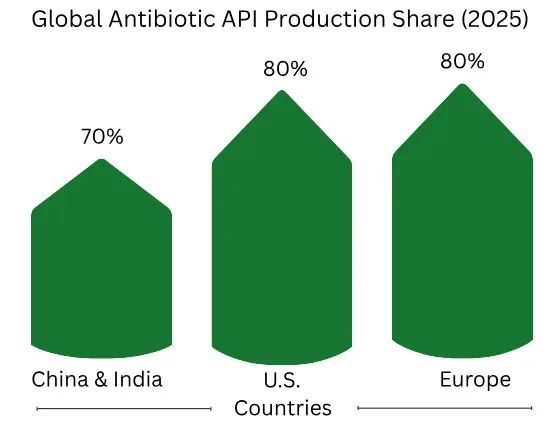
China and India make about 70% of the world’s antibiotic APIs. Both countries are under pressure from higher energy costs and tighter environmental rules.
The U.S. imports more than 80% of its generic APIs, while Europe also depends on imports. This heavy reliance on a few countries creates global risks.
2025 Outlook: Current Antibiotic API Shortage Landscape
In 2025, the shortage of antibiotic APIs is a global issue. Pharmacies, hospitals, and health systems are all reporting problems.
Most often, patients cannot procure the medication they need at the time.
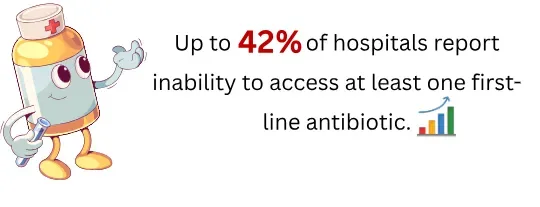
Amoxicillin, ceftriaxone, and azithromycin are among the most frequently reported shortages, with hospital surveys showing up to 42% of facilities unable to access at least one first-line antibiotic at any given time.
Most of the world’s production is still being done by China and India. When their production is delayed, the whole world feels the impact.
At the same time, heavy energy prices and stricter green rules have put a premium on production.
A Nature study noted that bulk API manufacturing remains fragile, concentrated among fewer than two dozen major producers globally. The crisis is no longer limited to esoteric drugs.
Even generic antibiotics are under stress, with the WHO noting that low- and middle-income countries are disproportionately vulnerable, as richer nations outbid them during shortages.
What Are APIs, and Why Are They Critical?
APIs are the most important part of any medicine. They are the chemical compounds that actually fight infections inside the body. Without them, antibiotics are placebo tablets. For example, in amoxicillin, the amoxicillin API is the active ingredient that kills bacteria.
Creating APIs is not easy. It requires special factories, chemicals to react, and quality control measures. Because of this, most of the global supply originates from a limited number of countries.
When these countries are in trouble, the global level does not have a lot in reserve. This is one of the reasons APIs are considered to be the pillars of modern medicine, and shortages of them quickly mean drug shortages.
Key Drivers of Antibiotic API Sourcing Pressure in 2025
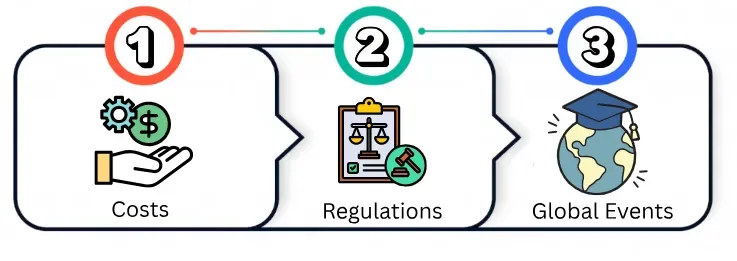
Costs
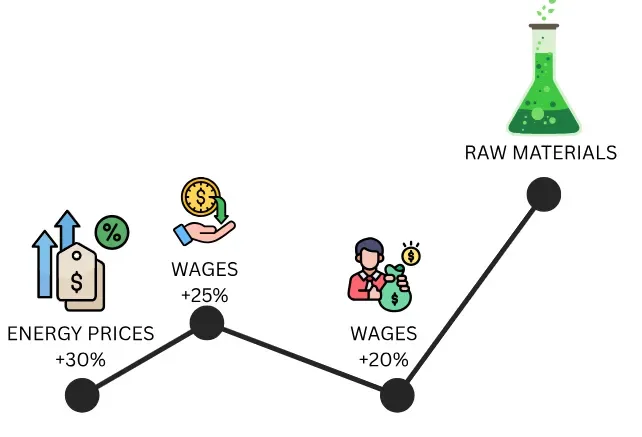
Factories face higher energy prices, higher wages, and higher raw material prices.
A USP (U.S. Pharmacopeia) report noted that API production costs rose by 25–30% between 2022 and 2025, largely due to energy and chemical input inflation.
Regulations
Governments are placing stricter regulations on safety, pollution, and quality. While this benefits patients, it hinders production. In the EU, approval for a new antibiotic API plant can take 5–7 years, delaying supply increases.
Global Events
Wars, trade embargos, and transportation delays add more risk. For example, a Red Sea shipping disruption in early 2025 delayed nearly 20% of Europe’s incoming antibiotic consignments.
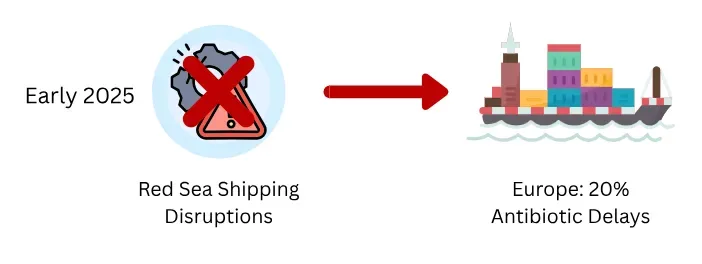
Causes of Global Supply Pressure: Manufacturing, Regulatory, and Geopolitical Drivers
Manufacturing Economics
Most API production is concentrated in China and India. This reduces costs but creates dependency. A single shutdown can shake the global market. The FDA shortage database shows that 60% of drug shortages in 2025 link back to just three factories in Asia.
Small U.S. and European producers cannot compete on price, and many have closed. As a result, supply is less diverse and more exposed to disruption.
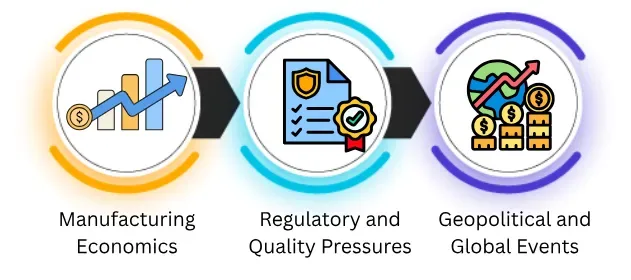
Regulatory and Quality Pressures
Strict pollution rules in China and India have led to plant closures. In recent years, China has shut down several API factories due to environmental enforcement.
In the West, complex approval processes delay expansion. Even if governments want more local production, it often takes years to begin.
Geopolitical and Global Events
Export bans are another issue. India sometimes stops API exports to secure its own needs.
A report from USP (U.S. Pharmacopeia) stated that the price of API manufacturing went up 25–30% from 2022 to 2025, partly fueled by inflation for chemical and energy inputs.
Country-Specific Impacts and Key Exporters
China
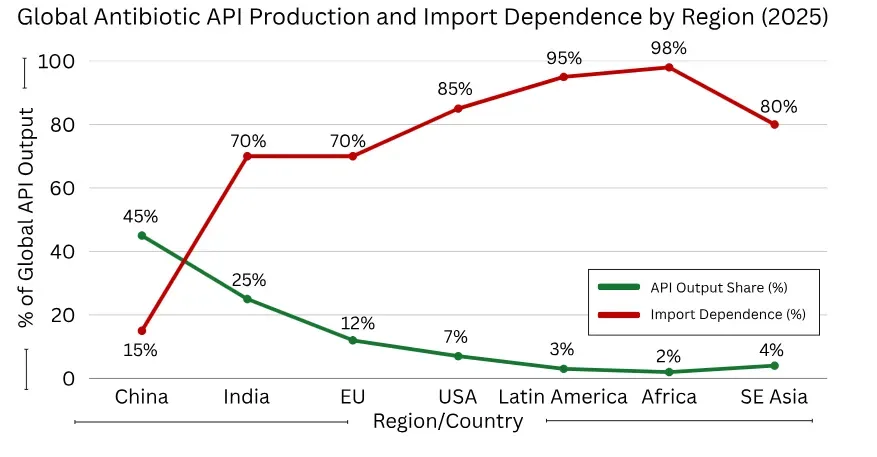
China is the world’s largest producer of antibiotic APIs.Accounts for 40–45% of global API output but faces rising costs and environmental curbs.
But new environmental policies and higher local costs have hampered production.China also keeps more APIs for internal use, limiting exports.
Because of this, other countries are becoming more susceptible to shortages.
India
India is also a major contributor. India imports the overwhelming majority of intermediates from China and manufactures them into APIs or final pharmaceuticals.
Produces APIs but depends on ~70% of its intermediates from China. India also sometimes limits exports to protect its own supply.
India is still a large net exporter and will continue to supply the majority of the world market, however.
European Union
The EU once produced more antibiotics, but most factories closed in earlier decades.It has become difficult to compete with high prices and stringent environmental regulations.
Makes APIs but imports ~70% of intermediates from China. Still one of the top exporters.The EU is now prioritizing resilience over low prices. New projects are being supported to revive local production, but outcomes will take years.
United States
The. The U.S. depends highly on imports for APIs. Some government efforts are trying to restore production within the nation, but it is costly and tedious.
Lost 60% of its API capacity since the 1990s. Reshoring projects are starting but will take years.So far, the U.S. remains vulnerable to foreign supply shortages.
Other Regions
Latin America, Africa, and Southeast Asia make up. Very few APIs. They mainly rely on imports.Because they possess less purchasing power, they are more.
Latin America and Africa produce less than 5% of global APIs. Likely to be affected by shortages, as richer countries bid them out.
Role of Intermediates and API Product Manufacturing
APIs are made from smaller chemicals called intermediates. China makes over 70% of these intermediates.
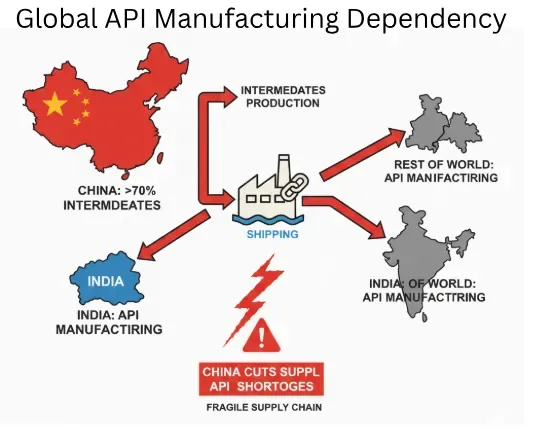
India depends on them to manufacture APIs. If China cuts or delays supply, India and the rest of the world face immediate shortages. This shows how fragile the chain really is.
Supply Chain Vulnerabilities and Risk Mitigation Strategies
Single-Sourcing and Concentration
Dereasing to a single source is perilous. When that sole source fails, there are no ready substitutes.
Just-in-Time Inventories
A number of companies keep little inventory at low expense. This is working with slick supply, but when supply shortfalls happen, it compounds the problem.
Regulatory and Compliance Delays
Stringent approval processes hold up factory opening. Even if governments want additional local manufacturing, years go by before it can start.
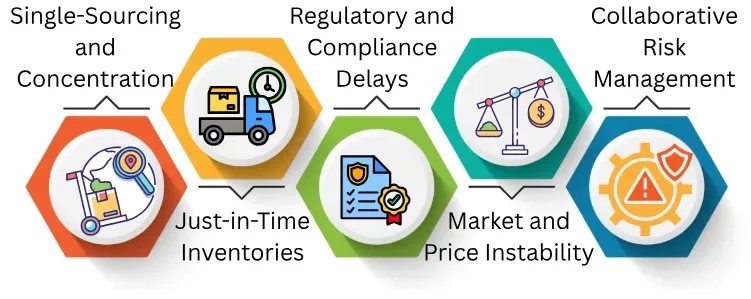
Market and Price Instability
API prices are rising dramatically. Some have doubled over the past few years. Poor countries are most affected since they are not able to afford higher prices.
Collaborative Risk Management
Some of the measures include stockpiling, local cooperation, and state backing for local production. Cooperation would help in spreading risks and mitigating shortages.
Regulatory Responses and Industry Adjustments
World Health Organization (WHO)
The WHO termed shortages of antibiotics an emerging global health threat. It is requesting countries to share information, increase openness, and extend production sources.
European Medicines Agency (EMA) and EU
The EMA and EU are funding efforts to restart antibiotic manufacturing in Europe. They are also monitoring shortages and green production methods more closely.
These actions will take time, but are indicative of a shift from focus only on cost to focus on resilience as well.
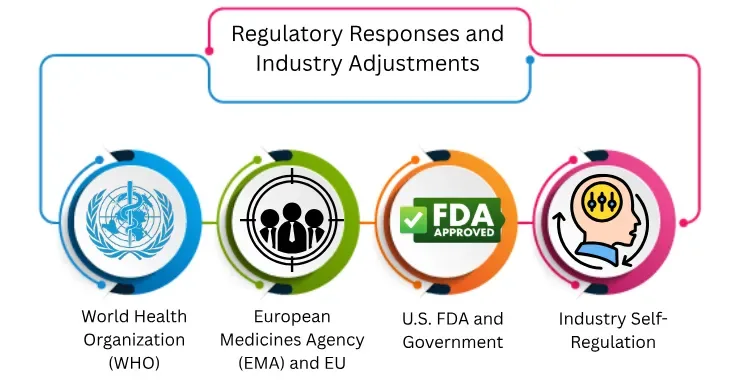
U.S. FDA and Government
The FDA and the U.S. government are stimulating the homecoming of domestic production. Incentives, grants, and emergency arrangements are available, but results take time due to cost and strict regulations.
Industry Self-Regulation
Pharmaceutical companies are also responding on their own. Some are diversifying suppliers, securing longer agreements, and creating collective stocks.
Although these actions are helpful, they have the effect of raising costs, which is then passed to customers.
Impacts of API Shortages for Antibiotics
Most self-evident is the effect on patients. Stalled treatment increases risks, especially in hospitals. Doctors are forced to use subpar or more expensive medications.
For healthcare systems, shortages mean higher expenses and strain for procurement departments. For manufacturers, it means uncertain contracts, higher costs, and fluctuating markets.
What’s Being Done And What More Needs to Be
Steps already underway are government subsidies, WHO coordination, and industry diversification.More must be done. More cooperation among countries, faster regulatory approvals, and better monitoring systems are needed.
Solutions further into the future involve more plants, more locations producing APIs, and better stockpiling systems.
What Lies Ahead: Risks and Opportunities
If nothing changes, shortages will continue in 2025 and beyond. Risks are higher costs, lower patient access, and worldwide health risks.
But opportunities also exist. Those nations that invest in domestic manufacture today may find themselves positioned to play a strong part in the international market. Green technologies and next-generation manufacturing could also make production less expensive.
What B2B Buyers Need to Know in 2025
Business clients, including wholesalers and healthcare providers, need to expect more expense and less consistent supply. Adaptability, long-term contracts, and close monitoring of suppliers are the secrets. Buyers should never assume supply.
Procurement Team and CDMO Recommendations
Final Takeaway & Conclusion
Antibiotic shortages in 2025 are a global phenomenon. Shortage of APIs is the prime cause. These are caused by undue cost, tough regulations, trade wars, and overdependence on a few sources.
Patients, hospitals, and companies are all affected. The problem will not subside anytime soon. But steps are being taken. Governments, regulators, and companies are all trying to solve the problem.
Most relevant is the lesson that planning and resilience are the ultimate defense. Procurement teams and health systems must prepare for a world prone to shortages. Acting now will avoid pitfalls in the future.