
Active Pharmaceutical Ingredients (APIs) are the elements of drugs that do the main functions.
Excipients help with stability or distribution, but the API is what really makes the drug function.
APIs are the hidden heroes behind every pill, vial, or injection.
For instance, they make paracetamol work for headaches, imatinib work for leukemia, and insulin work for diabetes.
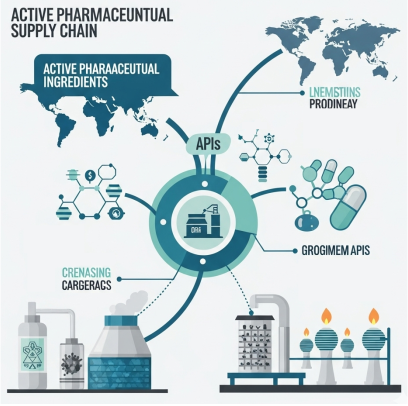
The global API sector is essential in manufacturing drugs.
It connects a big network of chemical synthesis to the manufacture of both brand-name and generic medications.
APIs are more than simply raw elements in this position.
They are important things that affect the price, quality, and availability of drugs.
This is exactly why APIs are important for the global pharmaceutical supply chain.
Discussing 2025 – A pivotal year for API trade:
Global API Market Overview (2025 Snapshot)
The global API market in 2025 will be big, strong, and increasing at a healthy rate.
This shows how important it is to the healthcare system.
Market Size and Growth Forecasts:
According to Precedence Research, the API market will be worth $238.38 billion in 2025 and $405.09 billion by 2034, with a CAGR of almost 6%.
The market would grow from $247.8 billion in 2023 to $347.9 billion in 2029, with a CAGR of about 5.9% according to BCC Research.
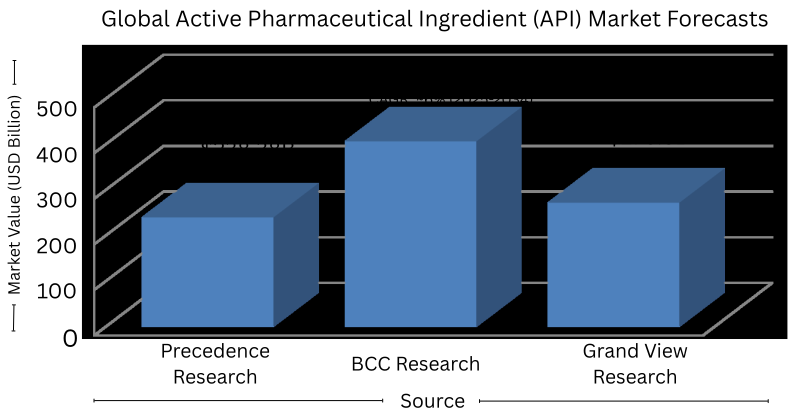
Also, Grand View Research states that in 2025, it will be about USD 270.5 billion.
All these predictions show a lot of potential for growth and help in the API industry forecast.
It is due to an older population, increasing chronic conditions, and high demand from new markets.
APIs manufacturing companies:
India is using WHO-GMP and EU-GMP certifications, cheap costs, and the Production Linked Incentive (PLI) scheme to increase domestic production.
China is still the biggest manufacturer of chemical intermediates, although it is under pressure to diversify with “China+1.”
Italy and the US are experts in high-quality, regulated-market APIs, especially for complicated compounds.
Therapeutic classes:
Pharmaceutical API growth is increasing day by day.
Oncology APIs are at the top of the growth curve because there will be around 20 million additional cancer cases every year by 2025.
Then, antibiotics are still very important, especially in places where they are hard to get.
Also, there is always a need for cardiovascular and antiviral APIs.
For buying:
Europe has a lot of rules to follow, and there is a growing focus on reshoring.
In Latin America, more people can get healthcare, which is pushing up demand for imports.
Indian and Chinese suppliers are in charge of anti-infectives in Africa.
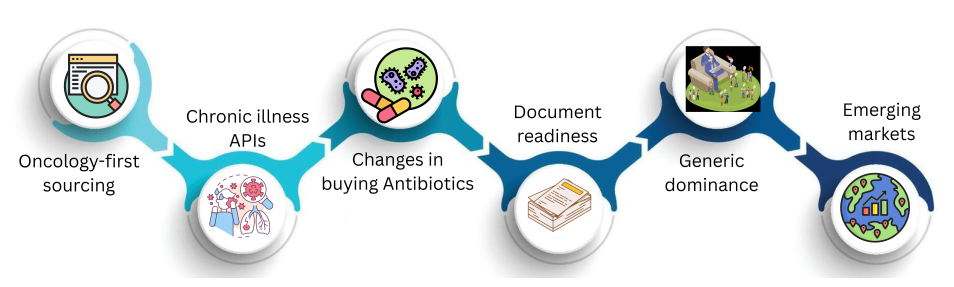
Demand-Side Trends: What Are Buyers Looking For in 2025?
In 2025, people who buy APIs are smarter, pickier, and less willing to take risks than ever before. Some important patterns are:
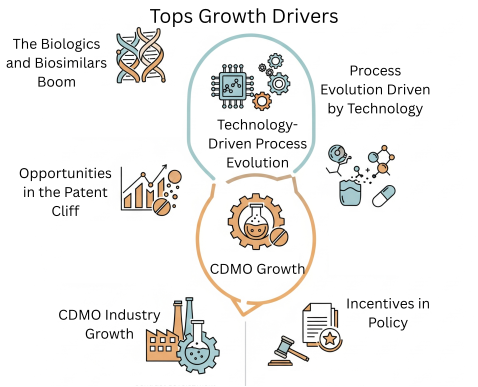
Top Growth Drivers Shaping the API Industry
There are a number of factors working together to move the API market forward:
Strategic Regional Shifts
Europe
The share of EU API filings fell from about 42% in 2000 to about 10% in 2023.
The Critical Medicines Act wants to bring production back to the US and cut down on dependency on Asia.
API trends in Europe want the industry to meet the standards of the EU-GMP, CEP, and EDQM.
Latin America
The Latin America pharma sourcing market for branded generics is growing.
More things are being made locally, yet the country still relies heavily on imports.
Regulatory delays mean that pre-qualification is necessary for timely entry.
Africa and the Middle East
In the Africa pharma market API, there is a lot of demand for cardiovascular and anti-infective APIs.
Saudi Arabia and other countries encourage domestic production.
Southeast Asia
Vietnam, Indonesia, and Malaysia are all working to increase their manufacturing capacity.
NIMP 2030 gives biologics and vaccine-related APIs more reasons to work.
The Role of Digitalization in API Buying & Marketing
Digital transformation is changing how B2B APIs are traded:
Cloud systems allow you to send and receive data in real time.
This helps fast check the quality of the batch.
It also makes sure that the rules are followed and gives shipment information very clearly.
Automating e-procurement cuts the time it takes to go from RFQ to purchase by 40% to 60%.
API manufacturers are currently using SEO and LinkedIn to get connected with people in top positions so as to get proper leads.
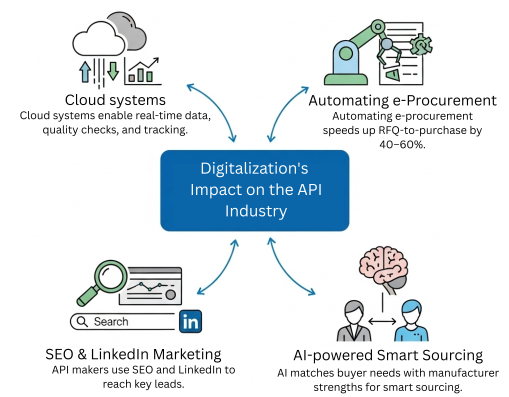
AI guides in matching what a buyer wants with what a manufacturer can do, which is smart sourcing.
This method results in optimal production as per the buyer.
Key Challenges Manufacturers Must Navigate
Regulatory compliance, as Import laws change all the time in different markets.
Concentration in the supply chain means relying too much on India and China for intermediates.
Costs of Environmental Compliance, as the tighter ESG rules make capital expenditures more expensive.
Price Pressure is real deal. The commoditization of generic APIs lowers profitability.
Strategic Recommendations for API Manufacturers
To do well in the competitive API market of 2025, businesses need to have a plan that covers a lot of ground:
One should start by focusing on therapeutic areas that are in high demand, such as cancer, cardiovascular, and anti-infective APIs.
These topics are very important for global health problems and are growing quickly in the market.
At the same time, I received a few certifications from the government.
It is recommended to get accepted by regulatory boards like the EU, WHO, etc.
This will make your industry trustworthy in the market.
Also, it’s very important to maintain proper documents like DMF or CoA.
The internet presence should be strong, SEO-friendly, and ready for AI.
Make sure it shows your company in a good light. It is better to add this to a solid LinkedIn presence.
Share information that shows you are a thought leader and make connections.
Also, make landing pages that are exclusive to certain markets.
One should benefit from the government scheme like PIL, which helps in the production of our very own API solutions.
In 2025, it will have already helped 48 industries. It brought in more than ₹3,900 crore in investments.
This made it possible for 25 selected KSMs, DIs, and APIs to sell ₹1,556 crore worth of goods.
Using this kind of legislative support can help increase productivity, lower prices, and make supply chains more resilient.
Conclusion
The API market in 2025 is at a point where it could grow or be disrupted.
Chronic disease demand, biotech advancements, and policies that bring jobs back to the US create opportunities like never before.
Manufacturers who change in smart ways are bound to thrive in this API world.
Companies need to make their portfolios more diverse, learn how to follow the rules, digitize their procedures, and make solid connections in their regions.
Partner with Actiza Industry today to get a competitive edge in the 2025 API market by working with a reliable API supplier.
We are committed to delivering consistent, high-quality, and affordable API solutions.