
The quality of an active pharmaceutical ingredient (API) is considered the main factor in drug manufacturing. An unstable API cannot be fixed with a simple formulation.
Advanced analytical techniques are essential for gaining positive outcomes during the synthesis and storage processes.
If there is any gap or minor error, the entire batch can be at risk. This can delay approval from regulatory bodies and also affect the safety of the patient.
Chemical testing is just one part, but modern API testing goes through other rigorous testing.
API manufacturers use several AI-assisted methods today for higher accuracy and speed.
Regulatory Framework Governing API Quality Control
API quality control does not operate in a vacuum. Manufacturers have to follow global guidelines as mentioned below at every stage of production.
ICH Guidelines
ICH Q7 is adopted globally for consistent quality and safety throughout the API manufacturing process. These guidelines represent the agreement within other regulatory bodies and industry representatives.
Analytical Method Validation
ICH Q2(R2) sets the rules for the way analytical methods must be validated before use. Every method must prove its accuracy, precision, specificity, linearity, and robustness.
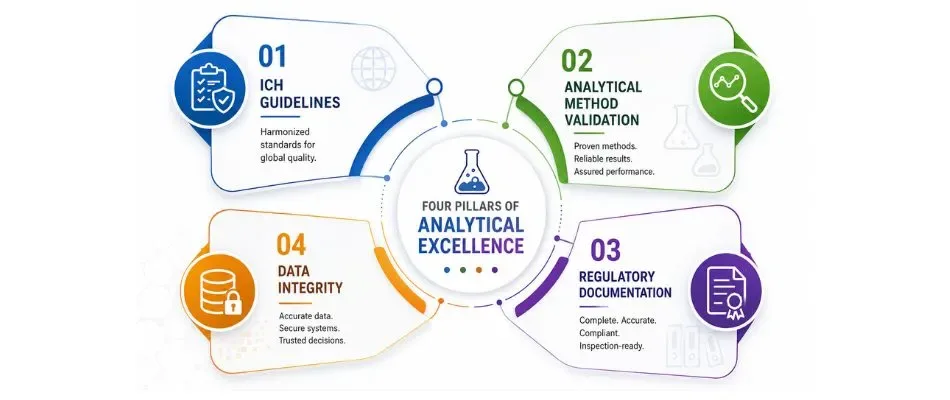
Data Integrity
The ALCOA+ framework requires that there is no opportunity for untraceable changes for every validation file. This applies from chromatography software to spreadsheets.
The files need electronic signatures for final reports and time-stamped calibration logs.
Regulatory Documentation
The manufacturing unit has to maintain the records of each step in the production process.
This record may include validation reports with accurate analytical results and reproducibility required for regulatory submissions.
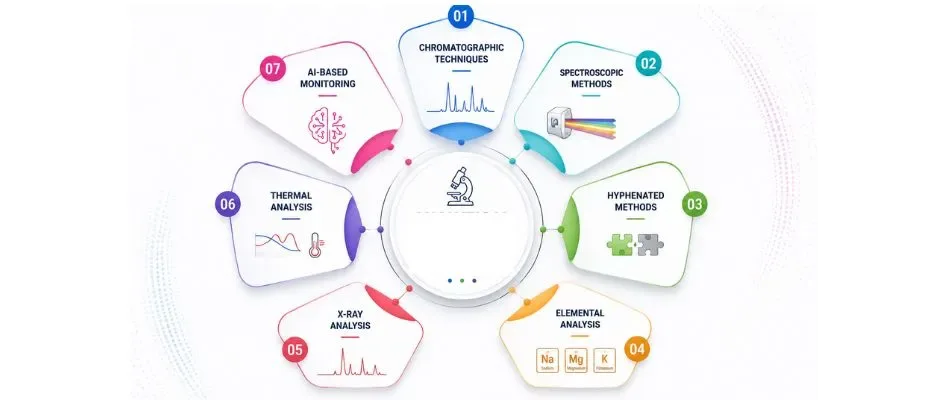
Classification of Advanced Analytical Techniques
There are many categories of analytical methods in API quality control, built for a specific purpose. They are listed below.
Chromatographic Techniques in API Quality Control
Chromatography is the most widespread API testing used in practice. The purity and the potency of compounds are determined by HPLC and GC.
The quality teams can keep track of the proportion of batches that fulfill the utmost criteria to ensure that the process delivers high-quality results on a consistent basis.
HPLC is the standard for most purity and impurity testing. It can separate and identify compounds present in any liquid-soluble sample, down to trace concentrations as low as parts per trillion.
GC handles volatile compounds. A significant part of GC testing is the residual solvents analysis that includes chemical residues at the trace level that are used or produced during the production of drug substances and excipients.
Hyphenated techniques proceed one step further by integrating separation with identification. Methods like HPLC-DAD, GC-MS, LC-MS, and LC-NMR provide a parallel quantitative and qualitative analysis of drug substances and impurities. They recognize and report degradation products.
Development of chromatographic profiles is done through reversed-phase HPLC to detect all the known and unknown impurities in the drug substance and separate them.
Challenges in Advanced API Analytical Techniques
The advances in analytical technology are a reality, and so are the problems associated with its implementation.
Skilled Workforce
The absence of qualified staff and unwillingness to innovate may slow the adoption of modern analytical tools, such as process analytical technology.
Complex Method Development
Reliability issues surface when a project moves between organizations, or when methods developed at lab scale need to be adapted for plant-scale production.
Data Management
Integrating large volumes of data from multiple sources requires strong data management systems.
Any shortage in the capacity of the workforce to work with intricate data analytics has the potential to pose severe quality and compliance concerns.
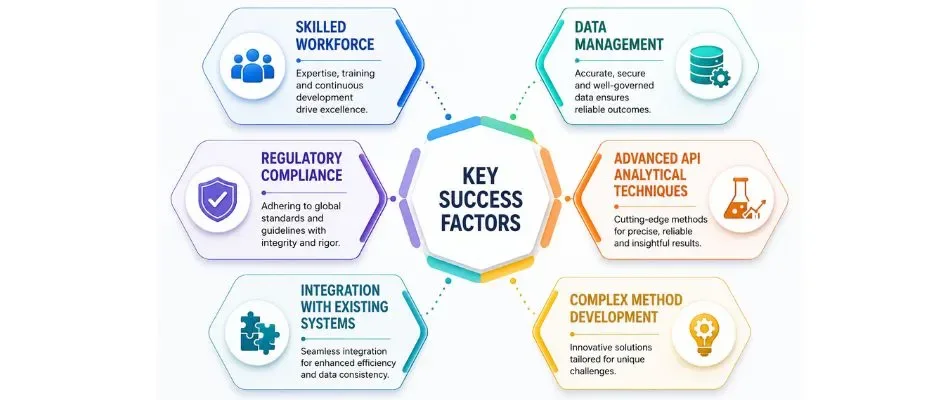
Regulatory Compliance
The question of how much validation is sufficient at each stage of development is always a matter of constant debate.
An insufficient number of risks can compromise the integrity of the data, whereas having too many threats too prematurely will result in the squandering of resources if the approach shifts in the future.
Advanced API Analytical Techniques
Advanced API analytical techniques can be a bit challenging today. It affects the personnel and technical execution. The multifaceted nature can affect compliance, further impacting data handling.
Integration with Existing Systems
Integrating the modern analytical tools with the legacy Laboratory Information Management Systems or ERPS can often bring data silos or compatibility issues.
This siloed implementation often reduces the effectiveness, further affecting real-time decision-making.
Future Trends in API Analytical Technologies
The next concept of API quality control will include smarts, expedited data, and automation. The global API market is expected to reach $198.39B by 2030.
AI and Machine Learning
Machine learning algorithms can be used to use previous data to know the trends and forecast quality failures before they occur. They are also able to anticipate equipment breakdowns within a usage pattern.
Real-Time Analytics
Process analytical technologies and state-of-the-art data analytics enable control over critical parameters with great accuracy.
To keep a check on the real-time reaction, temperature, pH and other variables, they install sensors, spectroscopy and chromatography within the production lines.
Automated QC Laboratories
New methods like terahertz spectroscopy provide additional possibilities for analyzing the molecular structures and interactions, which provide manufacturers with a better understanding of API properties.
Such technologies, in conjunction with digital LIMS platforms and automated workflows are minimizing the manual intervention in the QC labs.
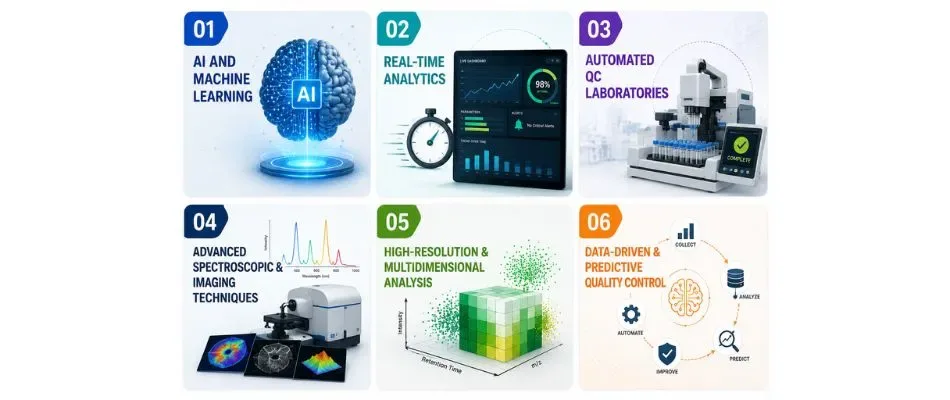
Advanced Spectroscopic & Imaging Techniques
Advanced imaging and spectroscopic techniques help analyze molecular structures, particle characteristics, and polymorphism. This drives high-throughput imaging further contributing to accurate inspection.
High-Resolution & Multidimensional Analysis
High-resolution tools are the standard today for addressing the increasing complexity across new APIs.
It supports multidimensional chromatography through techniques such as 2D-LC, which separate complex mixtures and improve resolution.
Data-Driven & Predictive Quality Control
AI and analytics will help forecast issues based on real-time production parameters and historical data. This will reduce downtime, minimize the risk of defective products, and boost proactive maintenance.
Strategic Importance for API Manufacturers
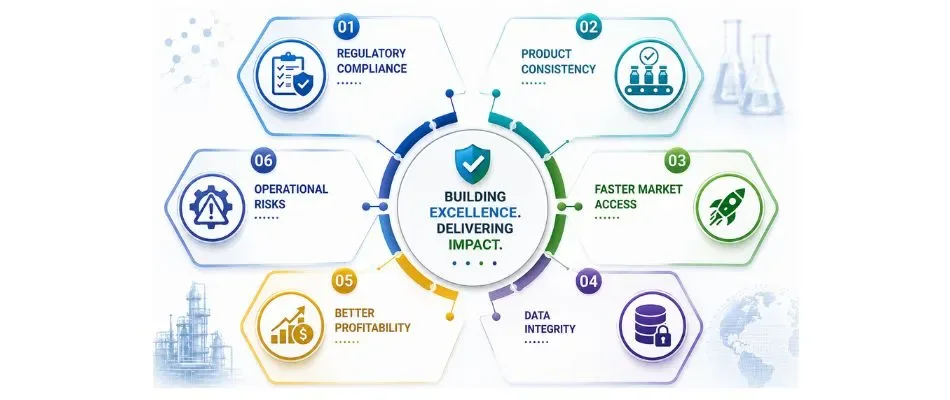
Analytical capability is not just a quality function. It directly shapes a manufacturer’s ability to compete globally.
Conclusion
Advanced analytical techniques are not just a regulatory requirement. These are what make a trusted API manufacturer one that does not face problems with quality variance and entry to the market.
The tools available today are more powerful than ever, from HPLC-based purity testing to real-time PAT systems and AI-driven predictive quality control.
As APIs become more complex with the growth of biologics, peptides, and highly potent compounds, manufacturers must invest in advanced analytical tools.
They need skilled people and integrated digital systems to manage the full API lifecycle.
Manufacturers who treat analytical excellence as an investment will always be better placed to protect product quality. They can continue to meet global regulations and serve patients reliably.