
Introduction: A Turning Point in API Manufacturing
Active pharmaceutical ingredients, or APIs, are basically the main components of medicines. They help stop, treat, or manage diseases.
Today, the process of creating these APIs is equally important as the drug itself. New technology is making a big difference in how companies make their products.
It speeds up the process, improves efficiency, and helps them earn more money. This change helps businesses get more value for their money.
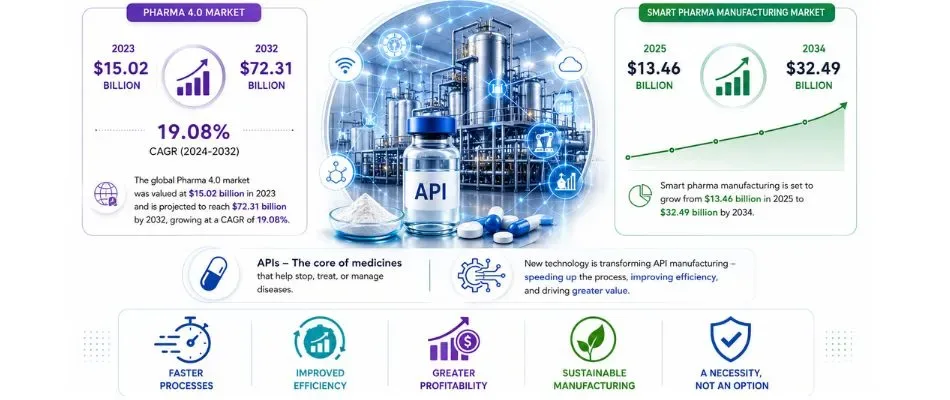
In 2023, the global Pharma 4.0 market had a value of $15.02 billion[1]. It’s set to hit $72.31 billion by 2032, and it’s growing at a rate of 19.08% annually.
Smart pharma manufacturing is growing fast. The amount is set to rise from $13.46 billion in 2025 to $32.49 billion by 2034[2].
There will be a big increase in the next nine years. This change is no longer optional. It’s now a necessity for API manufacturers worldwide.
What is Smart Manufacturing in the API Industry?
In the API industry, smart manufacturing is all about using digital tools. It includes AI, sensors, and automation. These technologies work together to make drug ingredients easier and faster.
It connects machines and data, which makes them, work well together. This happens in real time, so everything stays up to date.
Data integration is a challenge for 73% of pharma companies. This approach helps get it under control. It also boosts quality, lowers errors, and helps production move faster.
Core Technologies Driving Smart API Manufacturing
Smart API manufacturing makes use of data and automation. This really helps to enhance speed and quality. It leads to better outcomes overall. Below are key technologies shaping this change:
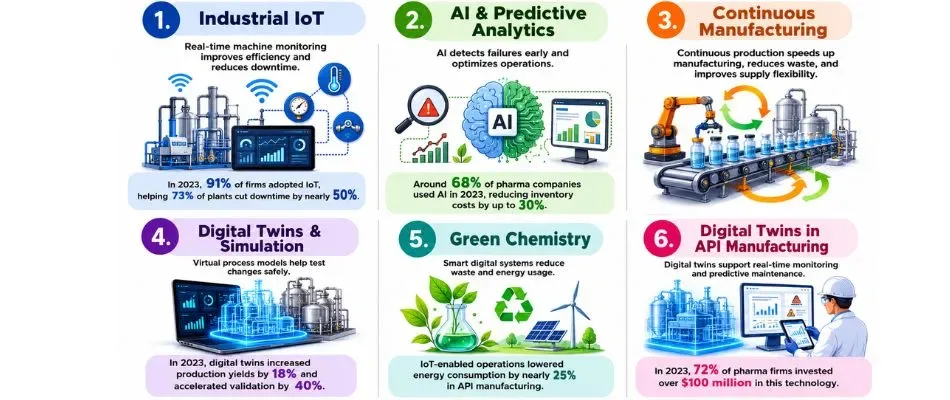
1. Industrial IoT
Industrial IoT brings together machines and sensors. It helps to keep an eye on temperature, pressure, and flow in real time. This connection helps gather information and respond quickly. In 2023, 91% of firms used IoT. This caused a big drop in downtime. It’s 50% less in about 73% of plants.
2. Artificial Intelligence & Predictive Analytics
AI reviews a lot of data. It spots potential failures and makes performance better. It helps find issues and improve results. In 2023, about 68% of pharma companies used AI. This led to some big savings. Predictive analytics lowers inventory costs. It can cut them by almost 30%.
3. Continuous Manufacturing
Continuous manufacturing keeps going all the time. It’s not like batch methods, which stop and start. It makes things faster and gets rid of waste. It speeds up production and helps companies keep up with changing demand quickly. This makes things more efficient for them.
4. Digital Twins & Simulation
Digital twins make virtual copies of real-world processes. This allows you to try out changes without risking anything. In 2023, they saw an 18% rise in production yields. Their processes were also validated 40% more quickly.
5. Green Chemistry
Green chemistry uses smart systems. These systems help cut waste, and they also use less energy. IoT and digital tools lower energy use by 25%. API manufacturing is cleaner now. It is also more sustainable.
6. Digital Twins in API Manufacturing
Digital twins in API manufacturing are useful for monitoring things as they happen. This real-time monitoring is pretty helpful. These systems can predict and stop maintenance issues from happening. They also help make processes run more smoothly. In 2023, about 72% of pharma firms spent over $100 million[3] on this technology.
Smart Manufacturing’s Impact on Global API Market Dynamics
Smart manufacturing is making a big difference in how we make APIs. It is also changing the way they are shared around the world.
It helps boost speed, quality, and keeps costs in check. The API industry is on the rise. It’s seeing a lot of demand for new meds and more efficient production systems. Here is how Smart Manufacturing impacts global API market dynamics:
The global API market hit $238.7 billion in 2024. It’s set to reach $428.5 billion by 2033[4]. This works out to a yearly growth rate of around 6.8%.
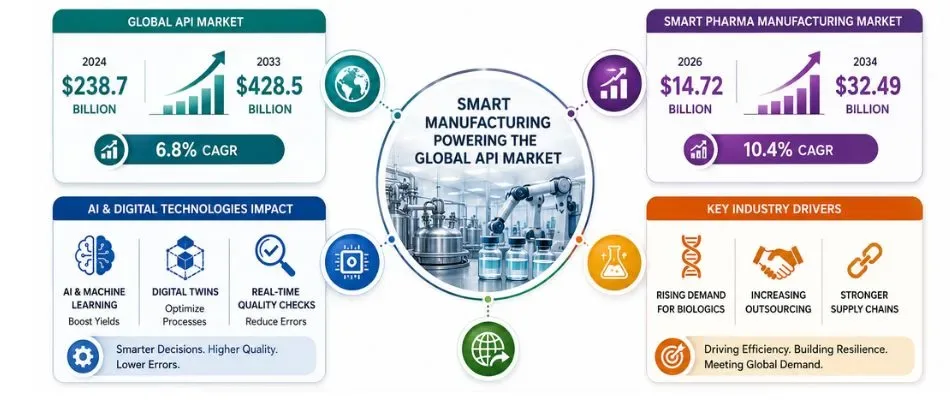
The smart pharma manufacturing market is set to grow from $14.72 billion in 2026. It’s expected to hit $32.49 billion by 2034[5]. The growth is around 10.4% CAGR.
AI, machine learning, and digital twins are great tools. They can boost yields effectively. They lower mistakes. They also allow real-time quality checks at smart API factories.
The demand for biologics is going up. At the same time, outsourcing is becoming more common, and supply chains are getting stronger.
These changes are changing the way APIs are built. They’re also changing how people share them around the world.
How Smart Manufacturing Is Transforming API Production
Smart manufacturing is making a big difference in API production. It helps us work faster and better. Below are the key technologies improving production systems and efficiency.
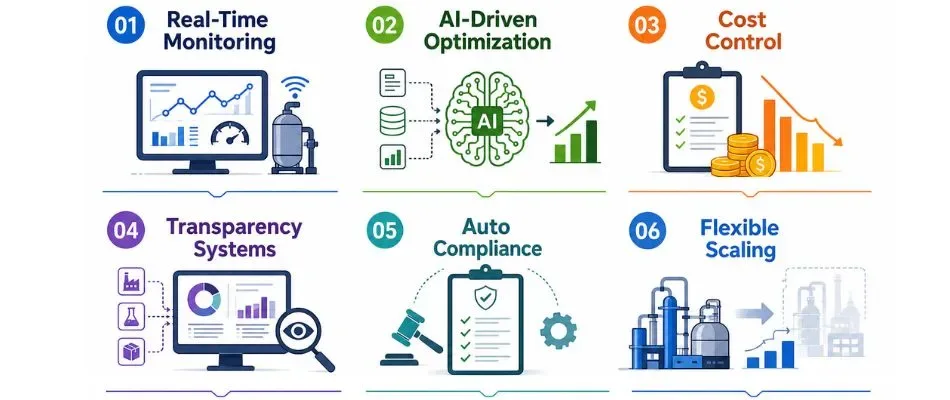
Real-Time Monitoring
Real-Time Process Monitoring uses sensors and IoT to keep an eye on production. It helps you to keep track of everything. It helps spot problems early, cut waste, boost accuracy, and maintain stable API quality during manufacturing.
AI Optimization
AI-Driven Process Optimization uses data. It also uses machine learning. Together, they improve processes. It helps to improve reactions, predict outcomes better, and reduce errors. It makes production faster. It also improves yield and consistency in API manufacturing.
Cost Control
Automation and better resource use help reduce costs. They cut down on waste and make things more efficient. Smart systems help companies save money. They cut waste, lower energy use, and reduce manual work.
Transparency Systems
The Transparent Production Ecosystem connects data across the entire supply chain. It basically brings all the data together in one place. This improves tracking and builds trust. Plus, it makes it easy to see the flow from raw materials to final API delivery.
Auto Compliance
Automated Compliance makes use of digital tools. These tools help us follow strict rules more easily. It reduces mistakes on paperwork and keeps records spot on. Plus, it helps companies pass audits more easily.
Flexible Scaling
Scalability and flexible production give you the ability to scale up or down quickly. This means you can easily change the size of your production as needed. Companies can easily produce small or large batches. This helps them change with demand. They can then respond quickly to what their customers need.
Workforce Transformation in API Manufacturing
Workforce transformation is having a big impact on API manufacturing. It’s changing the factory work environment. Workers don’t rely on manual work anymore.
Now they use digital tools, AI, and automation. Their top priorities are data, safety, and system control. This change makes things smoother. It cuts mistakes and helps make better medicines.
New skills are important now. They include data analysis. Machine handling and smart systems understanding are also key.
Trained workers help in continuous manufacturing. They improve safety and quality. Companies use AI to train and run simulations, which helps them teach faster.
In the future, skilled workers will team up with technology. This will help make API production safe, flexible, and efficient.
Supply Chain Transformation in the API Industry
The API supply chain is undergoing some positive changes. It’s getting cleaner, smarter, and more reliable. Companies are turning to green hydrogen these days.
They’re also leveraging AI tools to get the job done. Better transport systems are a key part of their plan too. This decreases pollution and enhances efficiency.
It also secures a consistent supply of important materials.
Green hydrogen is set to replace fossil-based hydrogen in key processes. This change lowers emissions and helps improve ESG goals.
AI helps out with predicting demand, which in turn helps avoid delays. To ensure safe delivery, new pipelines, storage systems, and transport methods are used.
This helps keep the purity level high, which is important for API production.
Sustainability & Green API Manufacturing
Sustainable API manufacturing is about producing API in a cleaner, safer way. Here are the key sustainability practices:
Sustainability Matters
Sustainability is a big deal in API manufacturing. Companies seek to cut down on pollution. They work hard to save resources and follow strict rules. It’s also key to making safer medicines. It helps the industry grow over time.
Smart Manufacturing
Smart manufacturing is gaining speed. Automation and digital tools are pushing this growth forward. This approach cuts waste and boosts quality. It also helps support sustainable practices in API manufacturing.
Green Chemistry
Green chemistry principles are our guide. They help us pick safer chemicals and make for cleaner reactions, too. This approach makes a big difference. They cut harmful by-products and lower risks. They also make API production greener. It’s more efficient, too.
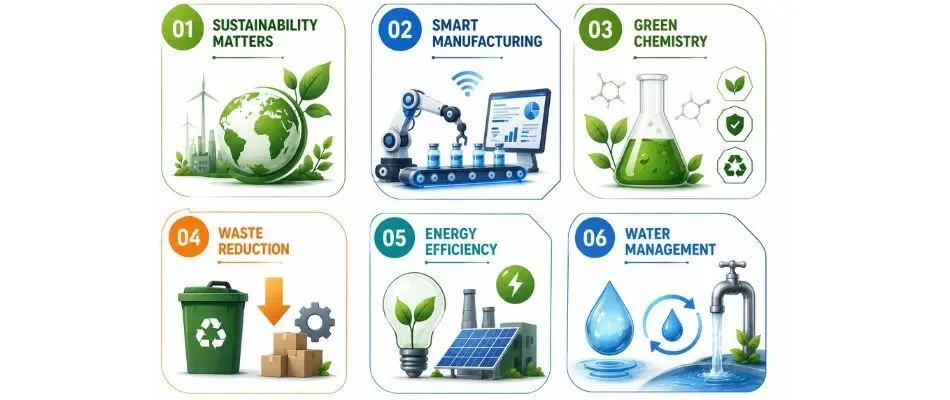
Waste Reduction
Waste reduction aims to cut down on extra materials used in production. Smart processes and good planning really make a difference. They cut down on waste, lower costs, and are better for the environment when it comes to making APIs.
Energy Efficiency
Energy efficiency means using less power to make things. New equipment and smart systems are a big help when it comes to saving energy. They also cut emissions. This basically makes API manufacturing a lot more environmentally friendly.
Water Management
Water management is all about using water wisely. It’s also about recycling it when you can. It cuts water waste and stops pollution. It also supports eco-friendly API manufacturing in areas with little water.
Indian Position in the Smart API Manufacturing Race
India is the third-largest producer of APIs, with around 8% of the global share. It plays an important role by supplying about 20% of the world’s demand. Here’s India’s scale, low costs, and future growth.
It makes over 500 APIs while covering different therapy areas. This shows the different types of production.
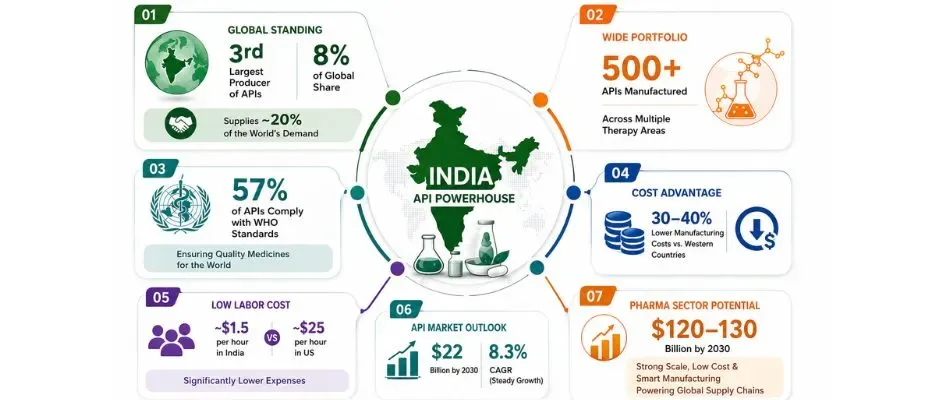
It provides 57% of the APIs that meet WHO standards. It’s really important to get good medicine to people all around the world.
India has a big cost advantage in manufacturing. Costs are 30-40%[6] lower than in Western countries. This cost difference is a big advantage. It helps businesses compete better and grow in the market.
Labor costs are roughly $1.5 an hour, compared to $35-45[7] an hour in the US. This cuts expenses a lot.
India’s API market is on track to reach $39.2 billion by 2030,[8] growing at a steady rate of 7.85% each year. This shows a positive trend for the industry.
The pharma sector could reach $120-130 billion[9]. India’s got some major strengths that make it a hub for global supply chains.
Its size, low cost, and increasing use of smart technology in manufacturing all help with this.
Challenges in Smart API Manufacturing Adoption
Smart API manufacturing is growing quickly. However, it faces tough challenges. Below are key challenges:
Legacy Systems
Old equipment often doesn’t match new smart technology. They don’t work well together. This slows down data flow. It also delays upgrades to modern digital processes in factories.
Regulatory Lag
New tech is moving faster than the rules can keep up. This causes delays in approvals. Regulators take time to check and accept advanced manufacturing methods. They also need time for digital systems.
Skill Gap
There is a shortage of workers skilled in pharma and digital tools. Companies need to invest in training. This helps their teams manage smart manufacturing systems better. It helps operations run better.
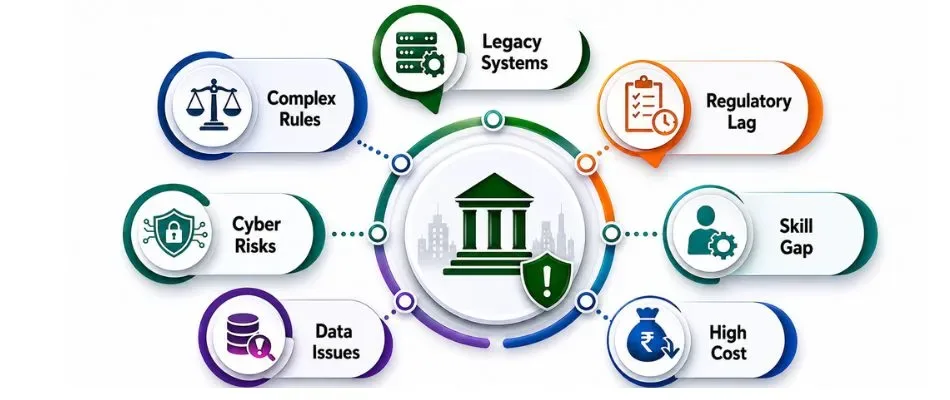
High Cost
Smart manufacturing needs a lot of money. Investment in machines, software, and automation is a must. Smaller companies have a hard time paying for these upgrades. They do save money over time, but the costs are tough to handle.
Data Issues
Many systems find it hard to share data. They often can’t do it easily. Data integration issues make it tough to track processes. They also raise errors. This limits the benefits of digital manufacturing.
Cyber Risks
Connected systems can really raise the stakes when it comes to cyber security risks. Sensitive pharma data needs top-notch security. It’s crucial to have solid security systems in place to keep it safe. This protects data. It helps to avoid theft, hacking, and loss due to system failures.
Complex Rules
Regulatory complexity makes it tougher to adopt. Companies have to meet some really tough global standards. They need to make sure their data is accurate and reliable. This means they’ve got to keep their data safe and secure. Each digital process needs to be properly validated.
Strategic Advantages for API Manufacturers
Smart manufacturing is a big help to API companies. It improves quality, cuts costs, and lets them grow quicker. Here are the Strategic Advantages for API Manufacturers:
Better Quality
Better quality means safer medicine. It also makes it more reliable. Automated systems cut down on the mistakes people make. They’re more accurate than humans in many cases. Real-time monitoring is key to keeping purity levels high. AI analytics is pretty good at cutting down defects and helping with regulatory Compliance. This makes a big difference in the end.
Lower Cost
Cost optimization is all about cutting out waste. It’s also about using resources smartly and automating processes where you can. Companies save money by improving production. They should use less energy and also cut down on manual work and errors.
Faster Delivery
Getting medicines to market faster is a big help for companies that want to launch them quickly. Continuous manufacturing and fewer bottlenecks really speed things up. Patients get their meds a lot faster as a result. It also makes companies more competitive.
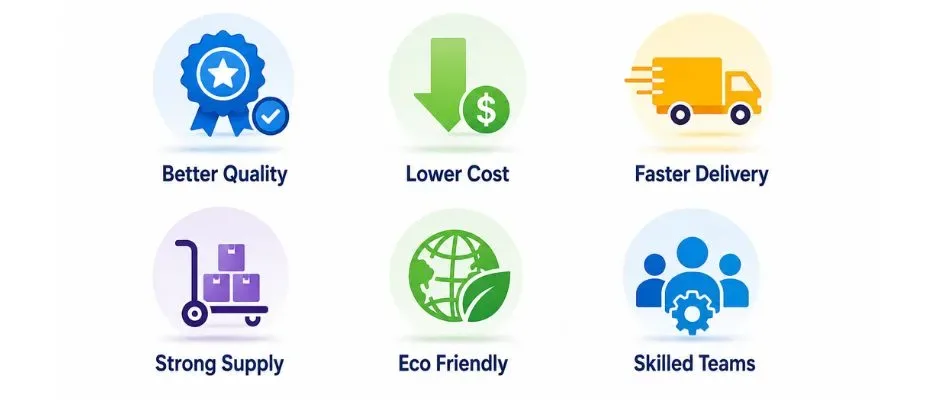
Strong Supply
Tracking and planning are key to a more resilient supply chain. Technology like blockchain helps make things more transparent. This boost in transparency is a major advantage. They cut delays and make sure that supplies keep flowing, even during global crises. This helps them stay on track and avoid running out of essentials.
Eco Friendly
Sustainability gets better with lower emissions. It also improves with less waste and energy-efficient processes. Companies can hit their environmental targets and global ESG goals by going green. These methods focus on cleaner production. They also use resources wisely.
Skilled Teams
Skill enhancement is a big help to workers when it comes to adapting to new tech. Companies train employees in automation, AI, and data tools. This creates a smarter workforce. They can manage advanced manufacturing systems better.
Future Trends in Smart API Manufacturing
Smart API manufacturing is moving quickly. This speed comes from innovative technologies and fresh ideas. The following explains key future trends in Smart API Manufacturing:
Personalized APIs
As treatments focus on individual patients, personalized API production will grow. We can expect this trend to continue. Making medicines in small batches helps customize treatments. This method allows for personalized care. This will improve outcomes and reduce side effects.
AI Systems
AI-driven autonomous manufacturing will control processes. It will need very little human input. Smart systems can spot problems and adjust quickly. This makes API production faster. It also improves quality and consistency. They’ll change operations in real time. This will lead to better results and bigger improvements.
3D Printing
Printing meds in 3D will let us make drugs as needed. This tech is all about producing APIs on demand. This will help make custom doses quickly and support clinical trials. Also, it will let hospitals and remote areas make their own medicines.
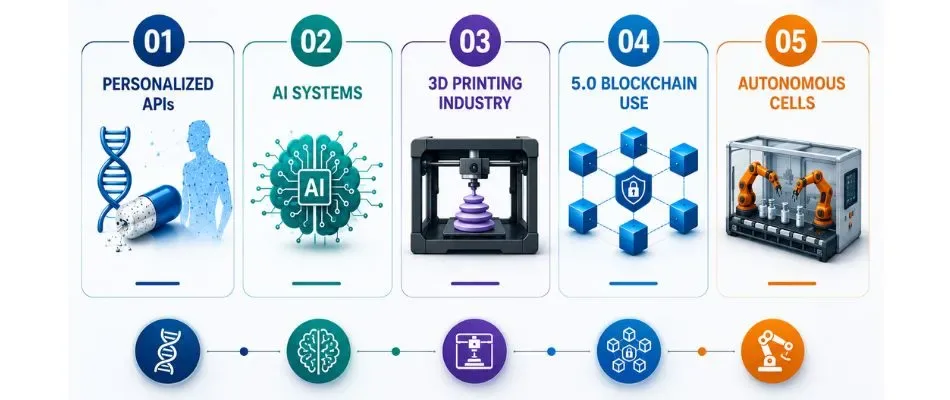
Industry 5.0
Industry 5.0 will connect humans and machines. They will work together. It aims for better decision-making and focuses on smart teamwork. It will create flexible, efficient, and human-centered manufacturing systems.
Blockchain Use
Blockchain is going to make API supply chains way more trackable. It will track every step from production to delivery. This will cut down on fake drugs. It will also make global supply chains safe, clear, and trustworthy.
Autonomous Cells
By 2030, autonomous API cells will function on their own. These units will be fully automated and won’t need any human input. These systems will handle production. They will also manage quality checks and data analysis. This will make things faster and more accurate.
Pharma 4.0 is set to grow. It could reach over $81.20 billion by 2034.[10] Adoption is really taking off in Asia-Pacific. It’s growing fast. India is on track to become a major global hub for APIs, thanks to its cutting-edge manufacturing technology.
Conclusion
Smart manufacturing is transforming the way we create APIs. It helps make our processes faster, safer, and more efficient. The Pharma 4.0 market is set to become $72.31 billion by 2032[10]. This shift is becoming a must. AI, IoT, and automation are big help to companies when it comes to boosting quality. They cut costs and also help meet the rising global demand.
The API market is growing fast. It’s expected to hit $428.5 billion by 2033.[11] This has a lot of potential going forward. India’s role is on the rise. Personalized APIs and autonomous systems are key trends to watch. Together, they will shape the industry. Even with challenges, smart manufacturing will continue to boost innovation. It will support sustainability and improve healthcare worldwide. It’s set to make a big impact globally.
1. https://introspectivemarketresearch.com/reports/pharma-4.0-market/
2. https://www.fortunebusinessinsights.com/smart-manufacturing-in-pharma-market-115664
3. https://www.globenewswire.com/news-release/2024/07/31/2921611/0/en/Digital-Twin-Technology-in-Pharmaceutical-Manufacturing-market-is-projected-to-grow-at-a-CAGR-of-31-3-by-2034-Visiongain.html
4. https://www.biospace.com/press-releases/active-pharmaceutical-ingredients-market-size-is-to-reach-usd-428-5-billion-by-2033-with-a-6-8-cagr-growth-report-by-datam-intelligence
5. https://www.fortunebusinessinsights.com/smart-manufacturing-in-pharma-market-115664
6. https://www.visionresearchreports.com/pharma-4-0-market/41564
7. https://www.precedenceresearch.com/tech-enabled-pharmaceutical-facilities-market
8. https://www.novaoneadvisor.com/report/Pharma-4-0-market
9. https://ddnews.gov.in/en/domestic-pharma-market-seen-touching-130-billion-by-2030/
10. https://www.precedenceresearch.com/pharma-4-0-market
11. https://www.biospace.com/press-releases/active-pharmaceutical-ingredients-market-size-is-to-reach-usd-428-5-billion-by-2033-with-a-6-8-cagr-growth-report-by-datam-intelligence