
Introduction
Active pharmaceutical ingredients, or APIs, are the main parts of medicines that make them work. If an API is weak, impure, or unstable, the final drug may not work as it should.
That is why API manufacturing is so important for drug quality, patient safety, and steady supply.
Today, this part of pharma is changing very fast because of Industry 4.0. This term means the use of digital tools in manufacturing.
These tools include artificial intelligence, connected sensors, cloud systems, automation, and real-time data. In API plants, these tools are changing how companies track processes, record quality, manage materials, and release batches.
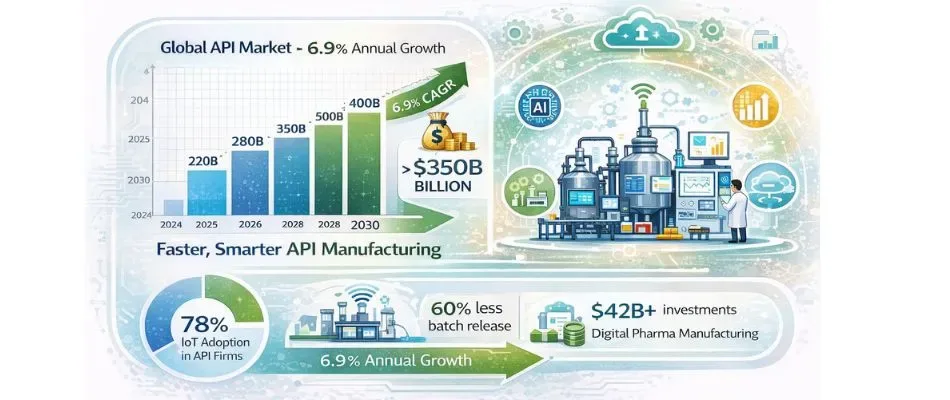
The pharma industry is using more digital tools every year. These tools help plants work better and follow rules more easily.
One source says digitalization can raise work efficiency by 20-30%. It can also cut batch release time by up to 40%. Industry data shows fast growth. It says the global API market may be worth $350B+ in 2025.
It also shows a 6.9% growth rate from 2025 to 2030 and $42B+ in digital pharma manufacturing investment. The same data says 78% of API firms use IoT sensors. It says AI/ML in QC may cut costs by 35%. It also says MES may speed batch release by 60%.
All these numbers point to one thing. API manufacturing is moving away from paper-based work and moving toward live, connected, digital systems.
Why Digitalization Matters in API Manufacturing
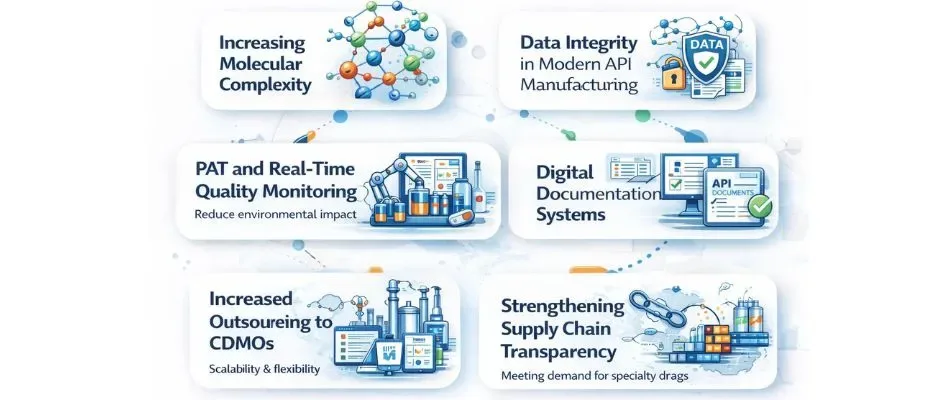
Increasing Molecular Complexity
Modern APIs are harder to make than before. Companies now work with high-potency molecules, many reaction steps, strict impurity limits, and more sensitive process conditions.
As products become more complex, manual tracking becomes less dependable.
Digital tools help plants deal with this complexity. They connect process data, quality data, and equipment data in one place.
This helps teams see changes early and act faster. Recent trend analysis for 2026 points to digitalization, automation, specialty APIs, and stronger supply chains as major forces shaping the sector.
Data Integrity in Modern API Manufacturing
Data integrity is now a major compliance issue. Many API plants still use handwritten records, manual transfers, and systems that do not connect well. These old ways can create errors, delays, and gaps in records.
Digitalization helps cut these problems. It adds time stamps, audit trails, access control, and direct data transfer from machines to the system.
Pharmaceutical Technology says many API manufacturers still use manual methods, such as handwritten batch records and paper documents. Digitalization is helping them improve transparency, traceability, and accuracy in daily work.
PAT and Real-Time Quality Monitoring
Process Analytical Technology helps manufacturers check quality while the batch is still running.
They do not have to wait until the batch is finished. Studies show that real-time release testing with PAT has cut testing time from 5-7 days to less than 24 hours.
That kind of speed matters in API operations. Delays can hold up equipment, tie up working capital, and slow batch release.
Shift Toward Smart API Manufacturing
It is not only about automation. It is about building a plant that can sense problems, learn from data, and respond faster. This shift is happening for clear reasons.
Customers want more visibility into quality. Regulators want stronger control. Manufacturers want fewer errors and less waste.
Commercial API Production
At commercial scale, digitalization helps make routine work more consistent. It supports scheduling, material tracking, deviation control, and release management.
This is very useful when one company runs many APIs across shared equipment and teams. It helps create repeatable work instead of depending too much on memory or paper files.
Digital Documentation Systems
Digital documentation systems replace large paper files with structured, searchable records. This includes electronic SOPs, change controls, deviations, CAPAs, and release records.
When data is digital, review becomes faster. Version control becomes easier. Inspection readiness improves. These tools help make product release faster and make customs work easier.
Strengthening Supply Chain Transparency
Digitalization matters outside the plant too. API supply chains often include raw material suppliers, contract manufacturers, test labs, freight partners, and drug product customers. Digital systems give better visibility across these links.
When teams can see supply and quality data in real time, they can act faster when a problem begins. Pharmaceutical Technology says better digital systems help track products more easily, make the process clearer, and help quality and regulatory data move faster.
Core Digital Technologies Transforming API Manufacturing
Reports estimate that AI could add $350 billion to $410 billion in value each year to the pharma industry by 2025. It also says that 80% of pharma professionals already use AI tools in drug discovery or manufacturing. It further states that IIoT can reduce unplanned downtime by up to 50%. It also says the pharma IoT market may be worth more than $14 billion by 2030.
These numbers explain why API manufacturers are investing now. They show that digital tools are not just trends. They are already changing how work is done in the industry.
Artificial Intelligence in API Manufacturing
AI helps manufacturers find patterns that people may miss. In API plants, it can help predict yield, find unusual changes, track deviations, and improve the process. It can also help QC labs by marking unusual results and making large data easier to check.
Data indicates that AI/ML in QC can cut costs by up to 35%. Another note says AI-based quality systems have lowered batch failure rates by 30-40% and cut quality costs by an average of 25%. This shows that AI is already bringing real value to API production.
Industrial IoT for Real-Time Process Monitoring
Industrial IoT means smart sensors and machines that send live data from the factory floor. In API manufacturing, this can show heat, pressure, flow, shaking, moisture, reactor status, and storage status.
With IIoT, teams can spot process drift early and reduce unplanned shutdowns. Your numbers show strong adoption, with 78% of API firms using IoT sensors. That means this is no longer a small test project. It is becoming normal practice in the industry.
Process Analytical Technology (PAT) for Quality Control
PAT gives fast insight into process quality. It helps control impurity levels, detect endpoints, and manage critical process parameters. It also cuts the waiting time between manufacturing and release. For API makers, this can mean less rework, fewer rejected batches, and better use of plant time.
Electronic Batch Records in Digital Manufacturing
Electronic batch records, or EBRs, replace handwritten records with guided digital workflows. This reduces transcription errors, missing signatures, and delayed review.
When EBR is linked with MES, batch review becomes faster and more organized. Research suggests MES can support 60% faster batch release. That is a major gain for plants that run many batches and work under tight delivery timelines.
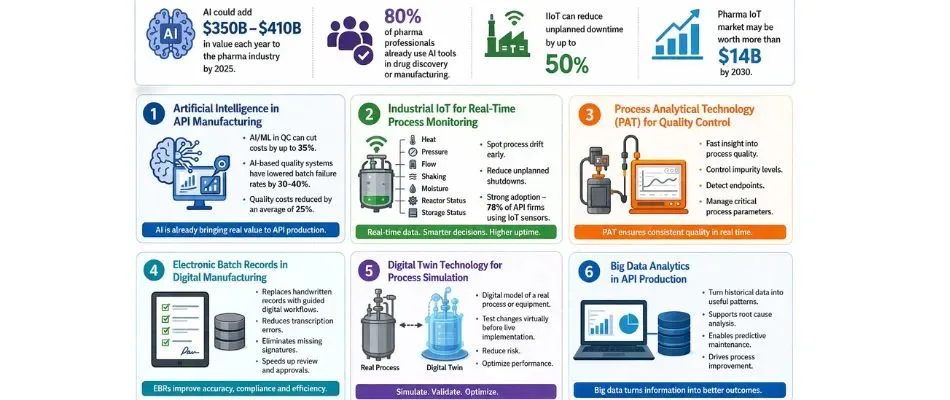
Digital Twin Technology for Process Simulation
A digital twin is a digital model of a real process or a real piece of equipment. API manufacturers can use digital twins to test changes before those changes affect live production.
This helps with scale-up, troubleshooting, and energy optimization. It also helps engineers study “what if” cases without putting product quality at risk. In a complex plant, this can save time, cost, and effort.
Big Data Analytics in API Production
Big data tools turn years of process, quality, and maintenance records into useful patterns. This supports root cause analysis, predictive maintenance, trend review, and process improvement.
When plants collect enough good and trusted data, analytics becomes very useful. It can help improve yield, raise quality, and lower cost. It also helps manufacturers act early, before a small problem turns into a big one.
Digital Supply Chain Management in API Manufacturing
Benefits of Digitalization for API Manufacturers
Digitalization gives API makers many practical benefits. It supports higher API quality and better consistency because data is captured sooner and reviewed more clearly.
It strengthens compliance and data integrity through audit trails and controlled workflows. It lowers costs by reducing batch failures, unplanned downtime, and slow release cycles.
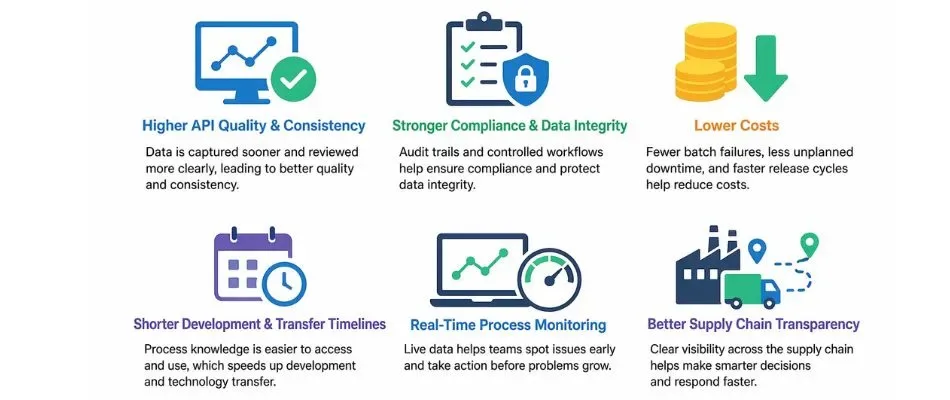
It can also shorten development and transfer timelines by making process knowledge easier to use.
Most of all, it gives real-time process monitoring and better supply chain transparency. This helps teams act before a small issue turns into a costly one. In a tightly regulated business like API manufacturing, that kind of early control is very valuable.
Challenges in Digitalizing API Manufacturing
Digitalization is not easy. NIST highlights several challenges. In API manufacturing, these issues can be even harder because GMP systems cannot be changed too easily.
Pharmaceutical Technology points out another challenge in data sharing. Some companies may use cloud systems, while others still depend on paper-based systems. This makes smooth data flow harder.
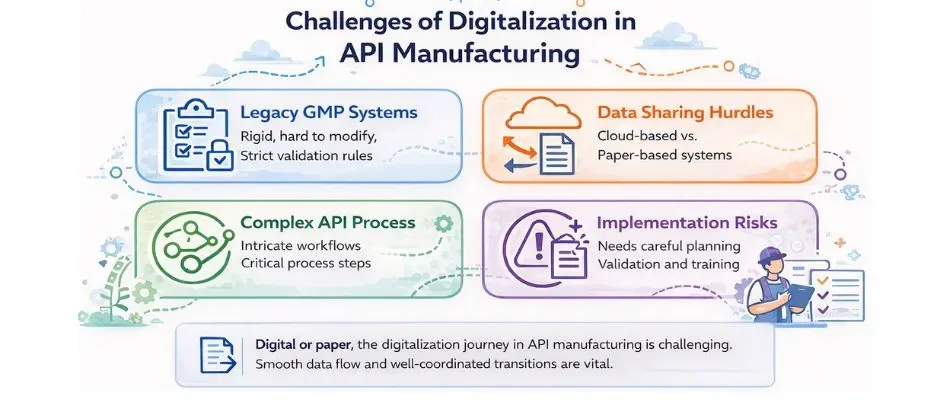
Besides this, API manufacturing itself may already be complex. Adding digital systems requires planning, validation, training, and support.
If the change is rushed, the plant may face confusion instead of improvement.
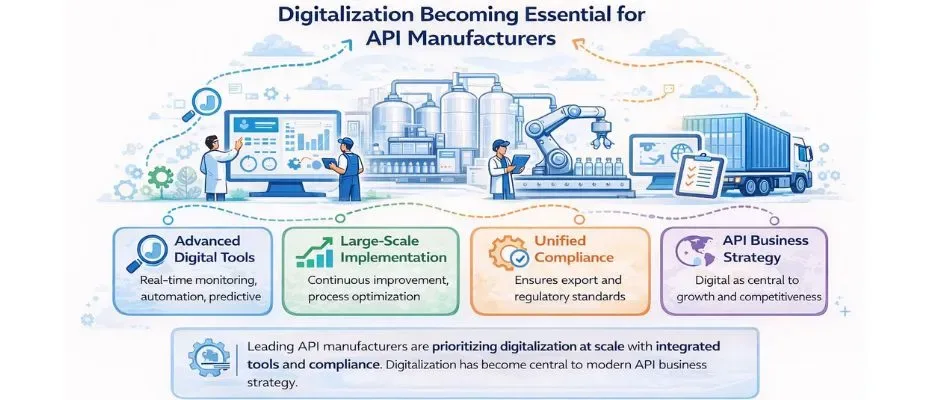
Digitalization in Leading API Manufacturing Companies
Green Chemistry Trends in API Manufacturing
Digitalization is closely linked with green chemistry. To make API production more sustainable, companies need better control of solvents, energy, water, and waste.
Digital tools can help a lot with this. They make it easier to track use, reduce loss, and improve control.
Recent reports show that API makers are changing the way they work. Many are now using water-based solvents, biodegradable solvents, flow chemistry, solvent recycling, and enzyme-based methods.
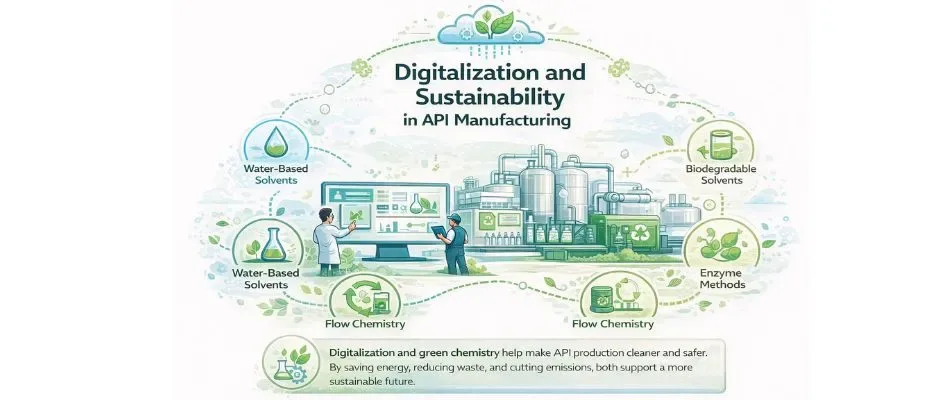
These methods are better for the environment and can also make the process cleaner and safer. For example, some plants in Gujarat have used solvent recovery systems with more than 90% efficiency.
Some plants in Andhra Pradesh have also moved to closed-loop water systems.
Green chemistry can make API production more sustainable. It can cut emissions, reduce waste, lower health risks, and in some cases improve purity and process efficiency.
In short, digitalization and sustainability are moving forward together. One supports the other.
Major Trends Influencing API Manufacturing in 2026
Market projections indicate digital pharma manufacturing market could grow from $8.2 billion in 2024 to $23.6 billion by 2030, which means a 19.2% CAGR.
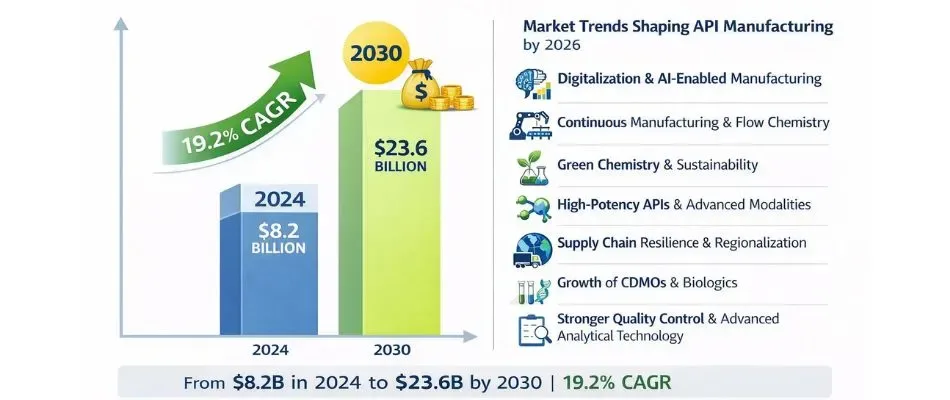
It also lists the main forces shaping API manufacturing in 2026:
Industry trend analysis for 2026 supports this same direction and points to sustainable processes, digitalization, automation, specialty APIs, and stronger supply chains.
Future Outlook: The Smart API Factory
The future API factory will be more connected, more automated, and more predictive. Experts believe digital manufacturing will give pharma companies a strong advantage in the next ten years.
Analysts project the API sector may grow to more than $350 billion by 2030. It also shows that digital tools will play a big part in better efficiency and new ideas.
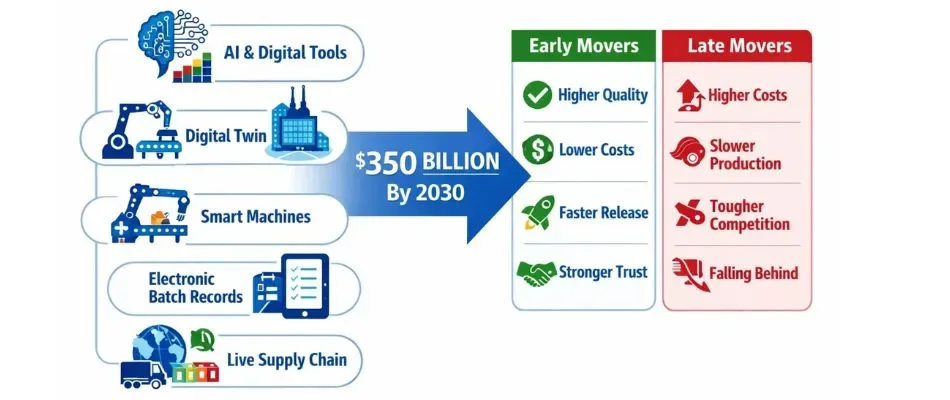
In simple terms, the future smart API factory may use connected machines, AI-based data tools, digital twins, electronic batch records, and live supply chain systems, all working together in one system.
Companies that move early may gain better quality, lower costs, faster release, and stronger customer trust. Companies that move late may find it harder to compete.
Conclusion
Digitalization is changing API manufacturing from end to end. It is improving quality control, speeding up documentation, strengthening supply chains, and helping manufacturers deal with rising complexity.
The gains are real. They include better efficiency, faster batch release, fewer disruptions, and stronger traceability.
At the same time, the shift is not simple. Plants must handle legacy systems, training needs, validation work, and data integrity demands.
Still, the direction is clear. API manufacturing is moving toward a smarter and more connected model. Companies that do not modernize may lose ground to competitors that are faster, more agile, and more data-driven.