
The Unveiling of Fragility – A Post-Pandemic Reality
COVID-19 has hit the pharmaceutical industry hard. The heavy use of Active Pharmaceutical Ingredients (APIs) led to big drug shortages and delays.
Companies need to strengthen themselves by building a more reliable supply chain.
This can be done by diversifying how and where they supply APIs.
In this blog, readers will look at past weaknesses and today’s challenges.
These include political tensions and strict regulations.
To improve the supply chain, we should diversify production and build stronger partnerships.
It will also focus on new technology, like digital tracking and advanced manufacturing.
This can make the overall process easier and more transparent.
The Pre-Pandemic Landscape: A Foundation of Hidden Risks
Geographic Concentration:
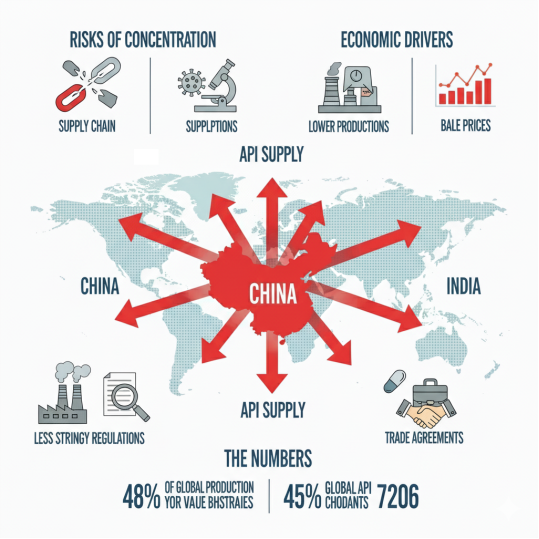
Before the pandemic, the global pharma industry depended on China and India for API production.
This reliance created some hidden risks. China provided 82% of the world’s antibiotic ingredients.
Most countries relied on this supply. India is known as the pharmacy of the world.
It supplies over 50% of global vaccines and about 40% of the U.S. generic drug market.
This covers nearly 30% of global generics by volume.
Together, both countries also held over half of Europe’s certified APIs, including cancer medicines.
The concentration of the API production (both in China and India) was cost-effective.
This was due to large-scale operations, low raw material costs, cheap labour, and supportive government policies.
This made both countries very competitive in the Western market.
But it was found that this economic advantage also created inherent risks.
Most of the world was dependent upon a few regions, and with disruption- like
Or factory shutdowns could rapidly trigger a global shortage of essential medicines.
Cutting costs often led to lower-quality standards. This caused supply issues and drug shortages.
Just-in-Time (JIT) vs. Resilience:
Many pharmaceutical companies use the Just-in-Time (JIT) inventory model.
This means they keep very little stock and produce or order APIs only when needed.
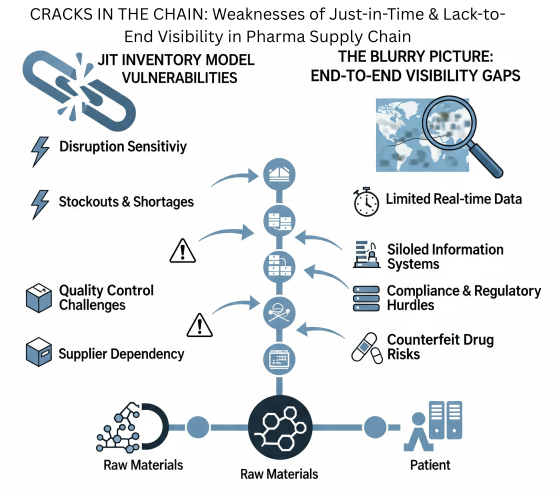
This approach cuts storage costs and keeps operations lean.
This makes the whole process more affordable.
Unexpected events, like the COVID-19 pandemic, lockdowns, and transport delays, revealed a big weakness: there were not enough buffer stocks.
Factories closed, supply chains were blocked, and many countries faced sudden medicine shortages.
This happened because there was no backup inventory. JIT saved money, but it made the system fragile.
This showed the need to balance efficiency with resilience by adding safety.
Lack of end-to-end visibility:
Many pharma companies only watch their Tier 1 suppliers.
This leaves them blind to risks further down the supply chain.
Upstream suppliers of raw materials, intermediates, and excipients often can’t see what’s going on.
This makes it harder to predict or even respond to disruption.
No doubt, these gaps can develop problems like shortages, delays, and even compliance risk.
The FDA emphasises the need to know the source and quality of bulk ingredients.
This helps prevent contamination.
Companies face challenges in safety, reliability, and following regulations without full visibility.
The Pandemic’s Wake-Up Call: Exposed Vulnerabilities and Their Impact
COVID has triggered unprecedented disruptions mainly
All of these conditions severely affected the flow of API across borders.
But at the same time, the pharma sector becomes a global spotlight.
They demanded for API surge as companies raced to develop treatment for pandemic related symptoms like fever and cough, while pushing API into the market.
Consequences for Pharma Manufacturers:
Product Stock-outs
COVID-19 has disrupted the supply chain of raw materials and API even harder.
This turns out to the shortage of essential medicines and impacted lives.
Since India has been reported API price hikes of 10–15%, with peaks up to 50%, and reflects the strained supply chains and intermediates’ impact on drug availability.
Increased Costs
The poor demand and prolonged lead times, and the need to hold more working capital, impacted the increased cost.
Here, some manufacturers has to pay premium prices for delay productions and thereby increasing the operational cost significantly.
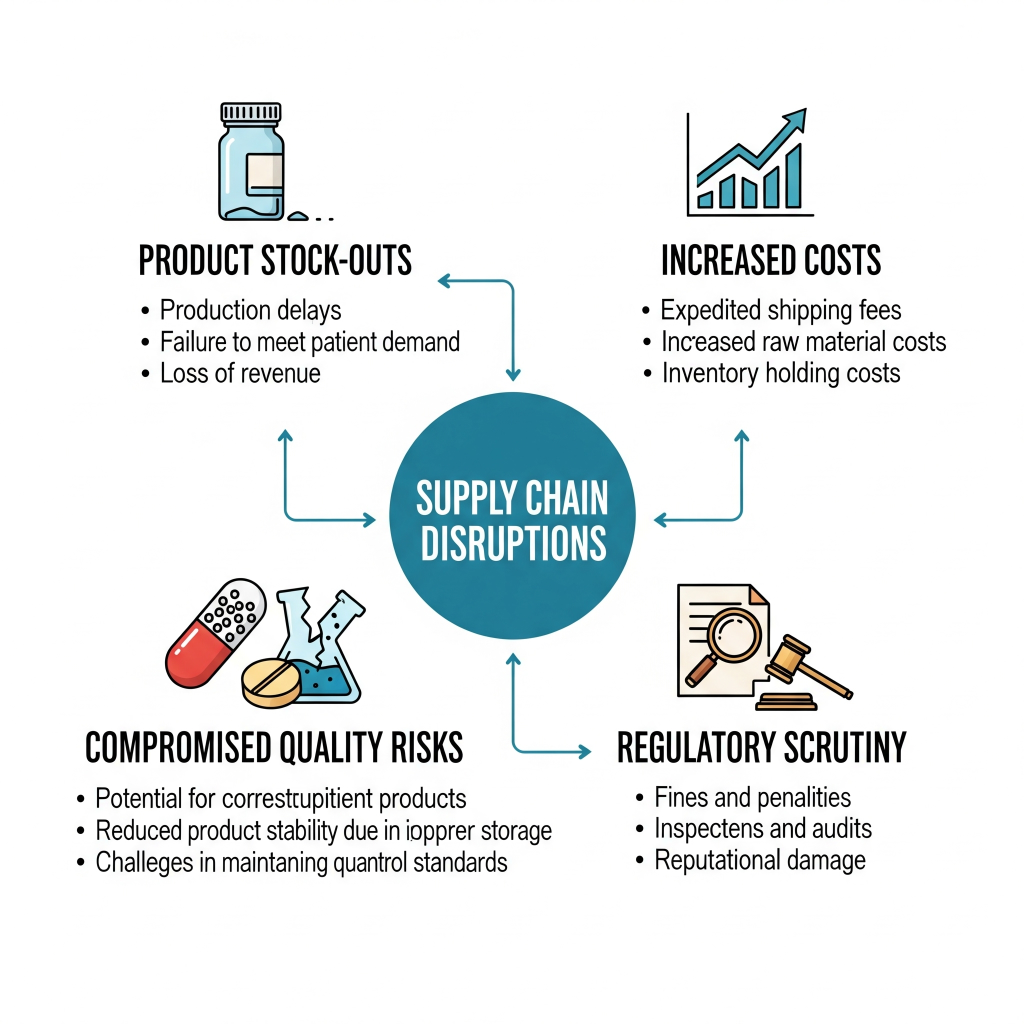
Compromised Quality Risks
To keep a good supply chain, some manufacturers turned to alternative or lower-quality raw materials.
In 2008, contaminated heparin was found. It even had cancer-causing impurities.
No doubt these compromises can lead to a severe impact on health.
Regulatory Scrutiny
Regulatory authorities worldwide are now focusing on the pharmaceutical supply chain after the pandemic.
They expect strong quality management and clear transparency from upstream suppliers.
They also want an improved system.
Strategic Imperatives for Building API Supply Chain Resilience
Diversification of Sourcing:
Geographic Diversification
The API industry is making a shift from relying on a single region.
This means industry leaders are aiming to source APIs from multiple regions.
This is to reduce susceptibility to disturbances.
Developing severance through partnerships with CDMOs in the different areas adds flexibility and agility.
Multi-Vendor Strategy
A multi-vendor model brings competitive pricing, greater flexibility, and even stronger risk resilience.
This means if one supplier faces issues, others can step in seamlessly.
This approach has enhanced performance scalability and operational stability.
Onshoring and Localised Production Initiatives:
The pandemic and changing geopolitics have led to a global shift.
Now, many countries are moving API production closer to home.
Countries see that depending on just a few areas, like Asia, has led to big problems.
It’s harder to access essential medicines now.
The government is stepping in. They are offering financial incentives, supportive regulations, and help to boost local production.
The U.S. government is promoting local API production.
They do this by offering contracts with fixed prices and guaranteed volumes.
A bold initiative aims for the U.S. to produce 25% of all small-molecule APIs at home within five years.
The EU recognises the need for local API production to reduce supply chain risks.
The European Parliament’s 2020 Pharmaceutical Strategy calls for Member States to offer financial support and adjust regulations.
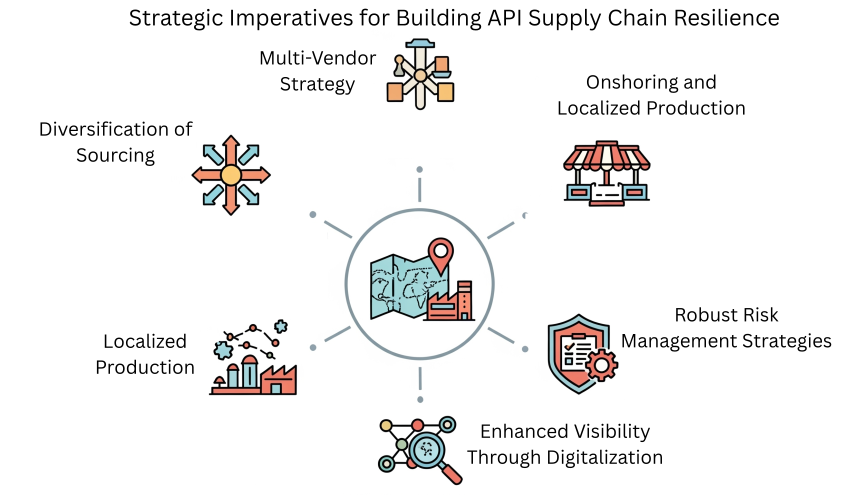
Enhanced visibility and digitalisation:
Digitising manufacturing uses advanced process control systems.
These systems integrate real-time analytics and Process Analytical Technology (PAT).
Companies with this can streamline inventory, monitor product quality, and quickly react to changes.
This will help to increase consistency and minimise waste.
Using IIoT sensors in supply chains lets us track and monitor conditions in real time.
This will help to capture data on temperature, location, humidity, and even more.
This keeps inventory accurate, aids decision-making, and allows for quicker, clearer information sharing.
Robust Risk Management Strategies:
Pharma companies follow a defined structured process, like-
Review and manage the risk across the product lifecycle.
This mainly involves everything from raw material to final doses.
Under cGMP and ICH Q9 guidelines, this includes tools like Quality by Design (QbD) and Design of Experiments (DoE).
Tools such as Failure Mode and Effects Analysis (FMEA) are used to proactively anticipate and alleviate potential failures in the manufacturing process.
They mainly link material attributes and process parameters to product quality.
Advanced supply chains now include a risk management framework.
This framework can predict, prioritise, and reduce risks.
Using tools like FMEA in digital monitoring systems helps companies spot weak points quickly.
This includes unreliable suppliers or demand surges.
Taking preventive measures helps avoid shortages.
This ensures patients have consistent access while keeping quality care intact.
The Role of Advanced Manufacturing Technologies in Resilience
Continuous Manufacturing (CM):
Continuous manufacturing makes medicine in a steady process instead of separate batches.
This means it reduces downtime, cuts waste, and makes production much faster.
This helps to keep the supply chain much stronger.
DrugPatentWatch states that CM uses smart tech like AI and sensors.
This helps improve quality, lower costs, and respond quickly to damages.
Whereas Carbogen Amcis points out the CM support, just-in-time production.
Companies don’t need to keep a lot of inventory. They can make exactly what they need.
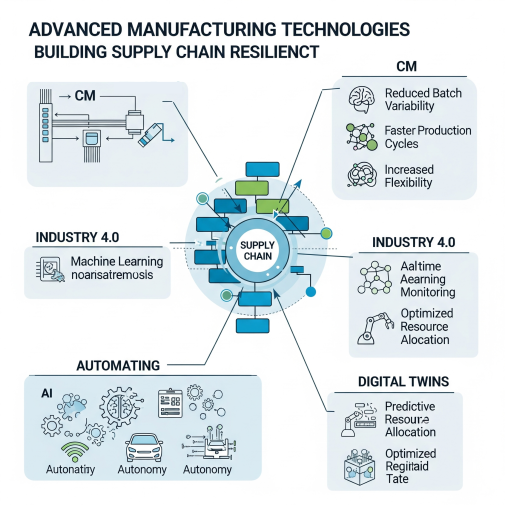
Industry 4.0 Technologies:
AI and Machine Learning
Automation and Autonomy
Digital Twins
Selecting a Resilient API Manufacturing Partner: Key Criteria for Pharma Companies
Proven Track Record & Longevity:
A reliable API manufacturing partner must be able to showcase a strong track record along with longevity.
Since longevity in the market represents following regulatory compliance, consistent quality and being able to adopt the trends.
Since long-term experience showcases not only consistency but also the capacity to swiftly adjust the overall process, documentation, and controls, thereby reducing the risk of non-compliance.
Unwavering Regulatory Compliance and Certifications:
When picking an API manufacturing partner, it’s important to choose one that follows global and regional quality standards closely.
We need to follow GMP, ICH Q7, and local rules like India’s Revised Schedule M.
This also matches WHO-GMP and PIC/S standards.
Robust Quality Assurance and Data Integrity:
A strong API manufacturing partner must hold data integrity, following the ALCOA+ principles.
This ensures every record is reliable and also transparent at the same time.
Along with this, the use of Quality by Design (QbD) helps to build quality into the process from the beginning.
While Quality Risk Management (QRM) identifies and reduces the potential risk during production.
These practices ensure compliance and guarantee the medicine is safe and effective.
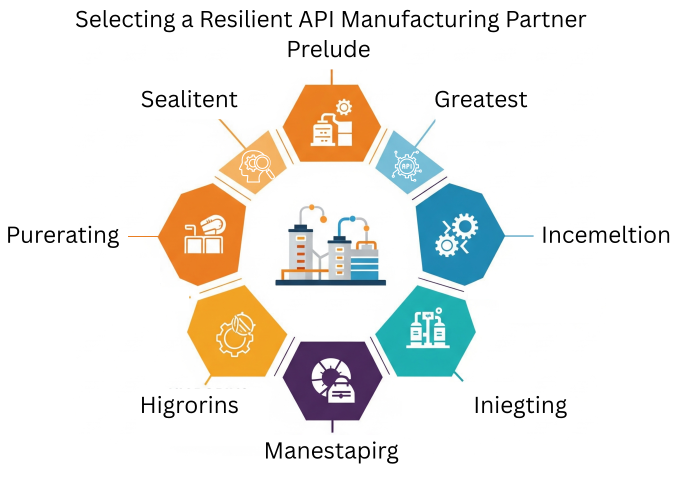
Reliable & Secure Supply Chain Management:
A dependable API manufacturer must be able to keep the supply running smoothly.
It is also the case when unexpected conditions arise.
This ensures they have full traceability in their supply chain.
They also need a strong vendor qualification program.
This is to ensure each partner meets high-quality standards.
Research has shown that an API partner must effectively improve logistics and supply shifts.
The FDA says that when repackaging or distributing APIs, the original manufacturer must be clearly shown to customers.
R&D and Process Development Expertise:
A strong API manufacturer should have robust R&D capabilities.
This drives innovation and helps meet changing pharmaceutical needs.
They quickly troubleshoot synthesis challenges. This helps keep projects on track and avoids costly delays.
This is important. Their skill in creating new APIs lets pharmaceutical companies react quickly to market needs.
Transparency & Business Ethics:
Choose an API manufacturer that follows clear and honest business ethics.
This majorly involves transparent pricing, operational integrity, and strong protection of intellectual property.
Researchers believe that pricing should be clear. This way, you get fair prices and quality.
Keeping confidentiality and respecting IP rights are key.
This protects your unique formulations and builds trust.
Be cautious of suppliers who offer prices below market rates. They often provide poor-quality products.
Conclusion: Forging a Future of Secure API Sourcing
The pharma industry is shifting from being vulnerable to becoming resilient.
Now, supply security is essential, not just an option. Advanced technologies are changing production.
Continuous manufacturing, digital twins, and automation are key.
These innovations reshape how we make products.
Choosing the right API manufacturing partner is crucial for long-term stability and growth.
Pharma companies must now take a proactive approach.
They need to review their supply chain, demand, and transparency.
They must choose partners that not only meet compliance but also innovate for the future.
Our company commits to these values by providing complete security and reliable API solutions.
We build our foundation on trust and compliance.
We focus on helping our partners deliver safe and effective medicine to patients everywhere.