
What Are Active Pharmaceutical Ingredients (APIs)?
Active Pharmaceutical Ingredients (APIs) are the active substances used in modern medicines. These are the most essential portions of a medicine that work on the body to make the desired therapeutic effects happen. APIs are necessary for all drugs to function well.
They are used in pharmaceutical formulations across multiple delivery methods. You can make APIs with chemicals, fermentation, or biotechnology.
The process will depend on how complex the molecule is and what it will be utilized for. APIs are very important for generating new medicines because there is a growing need for both new and generic medicines. They ensure drug safety and efficacy.
The market for APIs is expanding a lot all across the globe. By 2027, it should be worth more than $265 billion. More and more people are getting long-term illnesses.
This makes more generic medications available and makes biologics more important. Everything here is helping APIs grow.
What is Pharma API Manufacturing?
Manufacturing APIs is a complicated and regulated procedure. It changes basic materials into active chemicals that can treat patients.
It needs to be exact, have strict quality control, and follow international standards. The manufacturing process comprises a number of steps.
It involves chemical synthesis, fermentation (for biologics), extraction (for natural goods), purification, crystallization, and drying. To make sure that each batch is the same and pure, each stage is watched.
Biologics vs. Small Molecules:
Regulatory Standards: We seriously focus on these rules to confirmed that the API meets potency and purity specifications.
The API Production Process
The making of APIs involves various stages, prepping from scratch. It has both biological and chemical procedures involved.
All these stages make sure that the final formulation turns out to be effective, potent, and secure. From getting raw materials from trusted sources to chemically mixing it in perfect proportions, it is all done with utmost care and responsibility.
Before packing, the solution is purified to remove particulates and impurities in many ways, like crystallization or filtration. GMP rules are followed throughout all the processes. The final API meets required purity and quality specifications for pharmaceutical formulation.
Key Trends Shaping API Manufacturing in 2025
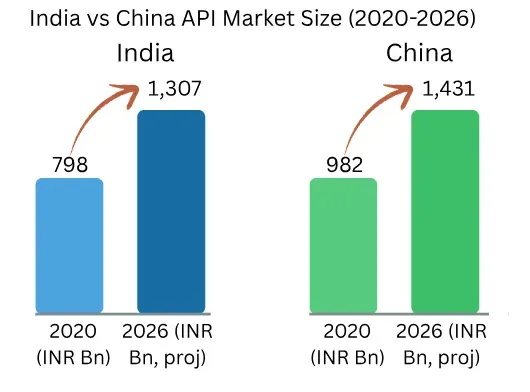
Move from China to India
A lot of big firms throughout the world are worried about problems with their supply chains and with politics. So, they are switching their sourcing strategy from China to India. India has cheap manufacturing, strict rules, and a solid infrastructure.
Pay attention to complex APIs
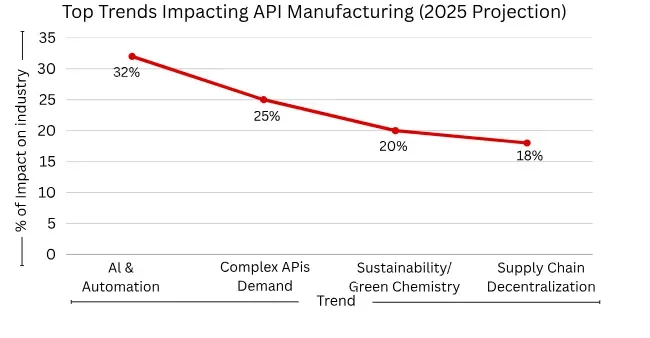
Pharmaceutical firms are concentrating on specialized therapeutic domains. APIs that involve complicated chemistry, like chiral compounds, cytotoxics, and peptide APIs, are needed in these domains. These need sophisticated containment facilities and technical know-how. It has a 25% influence on the industry.
Making rules the same
The USFDA, EMA, and CDSCO are all global regulatory bodies that are trying to make rules easier to understand and consistent, as supply chain decentralisation has an 18% impact on the industry. So, this makes it easier for products to get on the market and speeds up the approval process.
Green Manufacturing and EHS:
Sustainability is increasingly a big part of making APIs. More and more companies are using the ideas behind green chemistry. We are using modern wastewater treatment plants. Also, tight rules for worker safety help us fulfil worldwide requirements for the environment. It has a 20% impact on the industry.
More people want oncology and anti-diabetic APIs:
The rise in cancer and diabetes cases around the world has made APIs for cancer and diabetes treatments even more important. Now, manufacturers are concentrating on APIs with high potency and specific compounds. Also, AI has a huge influence on manufacturing these essential solutions, with a nearly 32% impact.
The Growing Demand for Complex APIs
HPAPIs:
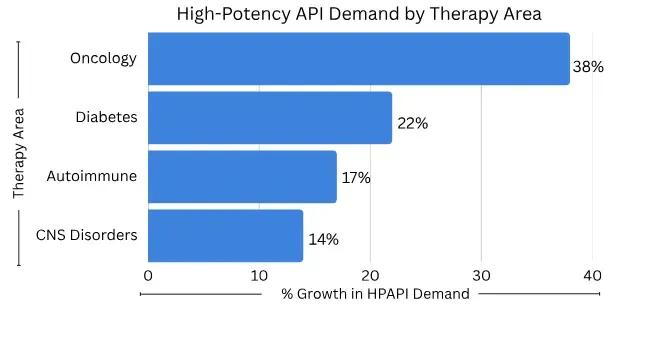
High-potency APIs are becoming more and more important in pharmaceutical manufacturing. According to the data, about 24% of the world’s API market is made up of HPAPIs.
These drugs are mostly utilized in cancer treatment, hormone therapy, and immunology.
As the industry pushes toward more personalized and precise therapies, manufacturers are focusing on improving their infrastructure. This helps them achieve the safety and quality standards for making HPAPIs.
Personalized Medicine:
Over 40% of the world’s API market is made up of oncology APIs. This trend demonstrates that more and more people are interested in personalized medicine and focused therapies.
These treatments work on certain molecular pathways. Scientists are learning more about the genetics of cancers. So, drug companies are putting money into APIs that help with these personalized ways.
The data reveals that there is a lot of demand for specialty, high-value APIs. This change means that drug development is moving away from making a lot of drugs and toward making drugs that are better for patients, especially in cancer and uncommon disorders. A New Era of Resilience: Supply Chain Transformation
A New Era of Resilience: Supply Chain Transformation
AI and Automation in API Manufacturing
AI and automation are changing how APIs are developed all over the world extremely quickly.
According to the PwC Pharma Outlook (2023), the US will have the most AI usage by 2025, with 65%. The EU will be next with 54%, China with 52%, and India with 48%.
AI helps make processes better, lets workers see data in real time, and cuts down on the number of mistakes humans make when doing vital activities.
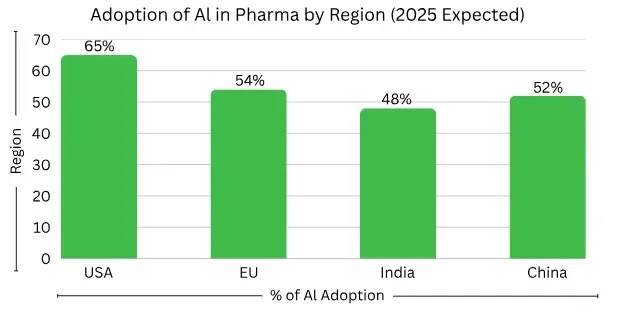
According to the study, AI-driven competition is becoming more common in critical areas of the pharmaceutical industry.
Sustainability and Green Chemistry
Sustainability is very important in API development. More and more people are trying to lessen their impact on the environment.
The industry is well aware now and moving forward to solutions that are better the environment. This is how the Environmental factor is controlled and doesn’t add up in the future. The steps involve having as little waste as possible.
Moreover, the investment towards these sustainable methods is a very important aspect. The manufacturing units have these stringent rules about waste management and eco-friendly ways. Every small or big step towards a better environment is commendable and the right thing to do.
Opportunities in API Manufacturing
India’s API export business will probably keep increasing consistently in major regions of the world.
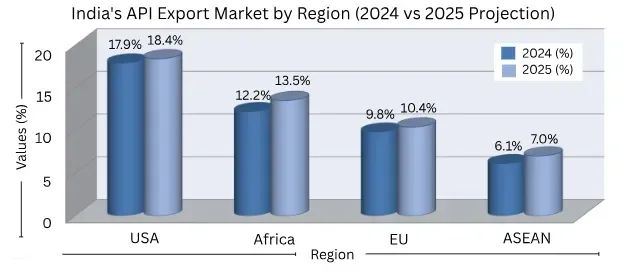
According to the IBEF Export Report (2024), shipments to the US will go up from 17.9% in 2024 to 18.4% in 2025.
Exports to Africa will rise from 12.2% to 13.5%. Exports to the EU will also rise, from 9.8% to 10.4%. The ASEAN area is also becoming better, going from 6.1% to 7.0%.
This trend is getting stronger, which means that India is becoming a better global API provider and that business is rising.
Challenges in API Manufacturing (2025)
Even when business is good, manufacturers still have to cope with a lot of problems:
Future Outlook: What’s Next for API Manufacturing?
This field, making APIs, will keep evolving in the future:
How We Manufacture APIs to Global Standards
We manufacture APIs as we aim towards providing the best of them while adhering to rules and high-quality standards.
We follow the stringent cGMP requirements and the regulations imposed by the US FDA, EMA, and WHO for businesses all over the world. At every stage of manufacturing, we follow the rules.
This means having control over all processes, analytical methods, data integrity, etc. Our plants have all the amenities for manufacturing safe, effective, and potent APIs.
We meet the highest safety and potency standards, potent standards is our expert advantage. We have and are planning to deliver the solutions across the world.
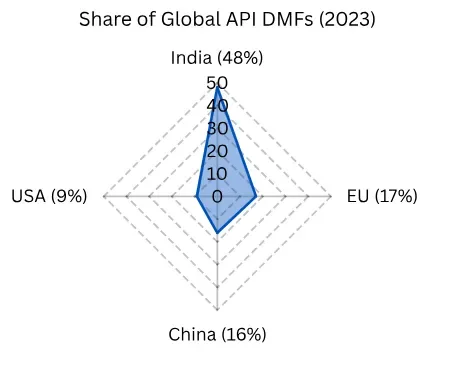
India’s Global Pharma Connections (Country-wise Relations)
Final Thoughts
The API production business in India is at a crossroads. New ideas, strong rules, and environmentally friendly practices are all important for a pharmaceutical ecosystem that is ready for the future.
Demand is changing throughout the world. Now, it likes to make affordable drugs, good for the environment, and that work well. India is ready to be the first to make this transformation.
The country’s infrastructure is strong, its personnel are skilled, and it meets international standards. We need to strengthen global alliances, put money into green technology, and change how we treat people as their needs change to keep this momentum going.
Indian API makers care a lot about quality, following the rules, and coming up with innovative concepts. They aren’t just doing what everyone else is doing they’re making it happen.