
APIs are the key components of every medication. They help create the desired effects of drugs. Intermediates are the chemical compounds that form the steps in making these APIs.
Understanding APIs and intermediates is key for anyone in the pharmaceutical trade.
India makes more medicines than any other country in the world. It is a key supplier of APIs and intermediates. Its affordable medicines and strong infrastructure meet the global demand for quality drugs.
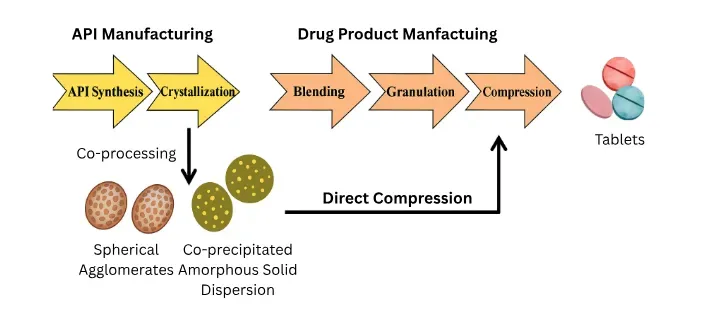
The image illustrates the pharmaceutical manufacturing process, focusing only on the API lifecycle.
After synthesis, APIs typically undergo crystallisation. Co-processing techniques, such as forming spherical agglomerates or co-precipitated amorphous solid dispersions, enhance properties.
This helps APIs skip blending and granulation. They can then be directly compressed into tablets. This streamlines manufacturing by improving flowability and compressibility.
What Are Active Pharmaceutical Ingredients (APIs)?
Active pharmaceutical ingredients (API) are key parts of any drug. They create the effects that the drug is meant to have.
In simple terms, an API is the chemical compound present in the drug. The different key characteristics of API are
API should be able to meet the strict quality and purity standards.
They should also be able to be chemically stable under specific storage conditions.
It should also be easily absorbed and utilised.
Examples of APIs in common drugs:
Types of APIs
Synthetic APIs are made in labs through multiple chemical reactions.
High Potency APIs work well in small doses. They need special handling during manufacturing.
Biotech-based APIs are produced during biological processes or by living organisms.
Herbal APIs come from natural plants. They are used in both alternative and traditional medicine.
There is no doubt that the API is the core part of the drug. The API defines the drug’s effectiveness, safety profile, and therapeutic category.
Getting people the medicine they need is important for widespread care to work. Encouraging local medicine production in developing countries is the goal. Additionally, determining the quality of pharma goods—APIs also determines their cost.
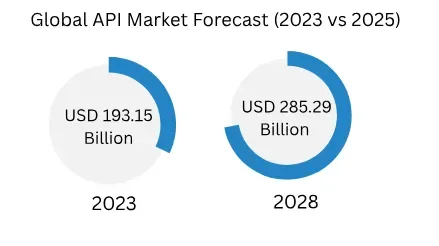
The active pharmaceutical ingredients market is set to grow. It will rise from USD 193.15 billion in 2023 to USD 285.29 billion by 2028.
India and China are very important to Pakistan’s supply of active pharmaceutical ingredients.
Countries such as China, India, and Bangladesh have boosted their API industries. There are both financial and non-financial reasons for this rise.
Pakistan’s current domestic API market is worth around $150 million. After the policy was introduced, existing units are boosting their capacity. Also, eight new API units are being set up.
What Are Pharmaceutical Intermediates?
Pharmaceutical intermediates are chemical compounds. They serve as the main building blocks in APIs. They are not the final drug substances. Instead, they are traditional molecules formed at different stages.
Intermediates, however, play an important role in the multi-step process of manufacturing APIs. They are created and modified in a measured order before the final conversion into the API.
Different functions of intermediates are present.
Examples of intermediates in API manufacturing include:
Targeted therapies and complex generics are driving up the need for high-purity intermediates. Green chemistry, chiral synthesis, and continuous flow processing can define future pharmaceutical intermediates.
Key Differences Between APIs and Intermediates
It is necessary to understand the difference between APIs and intermediates in the pharmaceutical manufacturing process.
Both APIs and intermediates are important to drug development, but they serve different roles, having different purity standards.
The pharmaceutical intermediates undergo multiple chemical reactions, the purification steps, and even the testing process, since each stage requires adherence to GMP to ensure consistency and safety of the final API product.
| Aspects | APIs | Intermediates |
|---|---|---|
| Use | Directly used in the drug formation | Use to produce API |
| Purpose | The biologically active compound used in pharmaceutical formulations | Use to produce the API |
| Purity standards | Extremely high | Moderate |
| Regulation | Regulated by authorities like US FDA, EMA, CDSCO | It is less regulatory but has to be monitored during GMP manufacturing |
| Final application | Administered to patients as part of the drug | Not administered to patients; |
API Manufacturing Process: From Intermediate to Finished Ingredient
Choosing raw materials is the first step in making APIs. This includes pharmaceutical intermediates.
Chemical synthesis is the next step. Here, APIs can be made through chemical reactions, fermentation, or cell culture.
Next, add solvents and crystals. Use ethanol and acetone to dissolve the reagents.
This process also involves multiple reaction stages, forming new bonds and chemical groups.
Isolation and purification happen when the API forms and is separated from impurities.
The last and final step is drying, where the purified API is dried to remove any residual solvents. Later on, the process includes micronization, which makes the particles smaller.
Pharmaceutical intermediates act as the essential transitional compounds formed in earlier stages. It has been found that each stage’s chemical structure is closer to the final API.
Use solvents and catalysts in reaction techniques. Solvents help dissolve reactants and control temperature.
Catalyst, on the other hand, enhances yield and selectivity.
Technique, on the other hand, also includes alkylation, oxidation, hydrolysis, and hydrogenation.
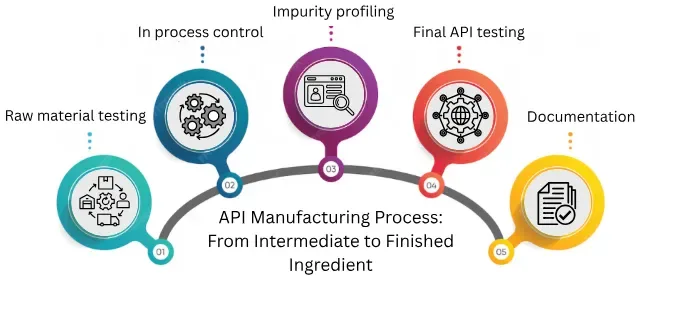
The different quality control checkpoints in the API lifecycle are:
Manufacturing & Regulatory Considerations
API should comply with strict global regulations and include them.
FDA (USA), CDSCO (India), WHO-GMP, and EU-GMP guidelines.
Since intermediates often have more regulatory flexibility. Manufacturers must conduct thorough testing. They must keep detailed Drug Master Files (DMFs) and maintain audit trails for transparency.
Proper documentation is key to compliance. It also makes global imports and exports easier.
India’s Leadership in Manufacturing APIs & Intermediates
India plays a key role in the pharmaceutical industry. It contributes 20% of global API exports. Additionally, it serves more than 200 countries.
This means the nation’s skilled and cost-effective workforce makes it a top partner globally. Government programs, such as the
Production Linked Incentive (PLI) Scheme and bulk drug parks support domestic manufacturing. This also reduces our reliance on imports.
We take pride in following all compliance. We stand strong by adhering to WHO-GMP, FDA, CDSCO, and EU-GMP standards. We have modern equipment, skilled chemists, and a strict quality management system. This helps us ensure product quality.
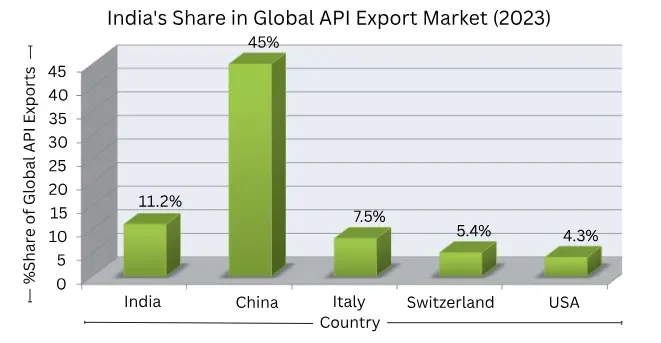
India shares a global API export market-2023, where- India is contributing 11.2%, China – 45%, Italy-7.5%, Switzerland- 5.4%, and USA- 4.3%.
Global Demand: Countries Dependent on Indian API & Intermediate Supply
India is now a key supplier of APIs and intermediates. Major pharma markets like the USA, UK, Germany, Brazil, and South Africa rely on these products. These countries depend on India for cost-effective production, good quality, and regulatory compliance.
India is key in the generic drug supply chain. It provides APIs for more than 60% of global generic formulations. The China+1 strategy has been adopted by many nations. This has made India a strong alternative to the Chinese supply chain. Recent trade data shows a big rise in export volumes, especially for life-saving drugs.
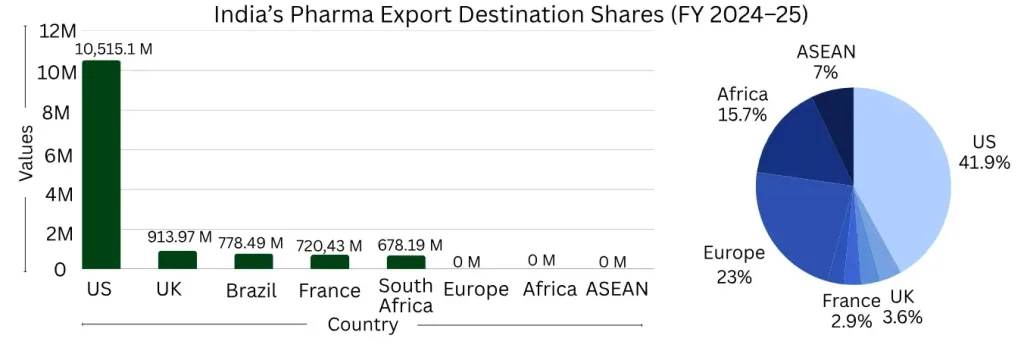
India’s pharmaceutical exports for FY 2024–25 are mainly to the United States. This country holds the biggest share at 34.5%, worth USD 10,515.1 million.
The United Kingdom follows with 3.0%, while Brazil contributes 2.6%, France 2.4%, and South Africa 2.2%.
Regional contributions are:
This data shows that Indian pharma has a strong global presence. This is especially true in regulated markets like the US and Europe.
How We Manufacture APIs and Intermediates at Our Indian Facility
Indian manufacturing facilities ensure the high production of API and intermediates. Our plant is equipped with advanced infrastructure. We comply with USFDA, EU-GMP, WHO-GMP, and CDSCO standards. We also monitor, test, and validate continuously.
We have a mix of in-house and selectively sourced intermediates. This depends on how complex the compound is.
Our production line includes:
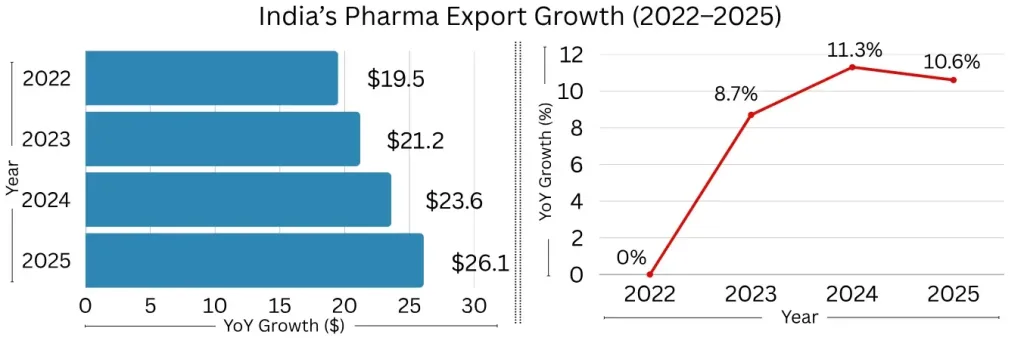
We enhance efficiency, maintain product quality, and improve traceability throughout the entire life cycle. India’s pharmaceutical exports grew steadily. They rose from USD 19.5 billion in 2022 to USD 21.2 billion in 2023.
This is an increase of 8.7%. By 2024, it is expected to hit USD 23.6 billion, growing 11.3% from the previous year. Then, in 2025, it should rise to USD 26.1 billion, marking a 10.6% increase. This upward trend highlights India’s expanding global footprint in pharmaceutical exports.
Global Trade Relations: APIs and Intermediates in the International Pharma Ecosystem
India plays a key role in making and exporting APIs and intermediates. A major example is Paracetamol API made in India. It is further processed in EU pharmaceutical facilities.
The India-China-EU link is important. China supplies raw materials. India then turns these into high-purity APIs. Finally, the EU uses these APIs in branded products. APIs serve as key links in global health systems. They connect manufacturing across borders and help people access essential medicines everywhere.
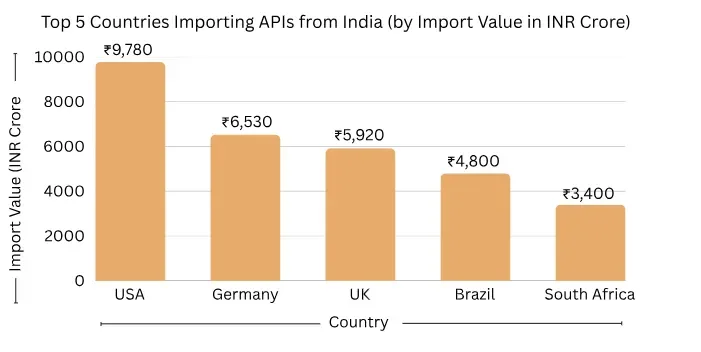
Pharmexcil’s Annual Report shows that the USA leads in importing Indian APIs. Its import value is ₹9,780 crore. Germany follows with ₹6,530 crore. The UK ranks third with ₹5,920 crore, Brazil is fourth at ₹4,800 crore, and South Africa rounds out the top five with ₹3,400 crore.
Why Global Buyers Trust Indian API & Intermediate Makers
Global pharmaceutical companies often depend on Indian API and intermediate manufacturers. This is because they offer cost efficiency and meet strict regulations.
India provides competitive prices while ensuring quality. It meets international standards such as US FDA, EU-GMP, WHO-GMP, and CDSCO.
Indian suppliers handle a range of order sizes. They can manage small pilot runs and large-scale production.
They offer flexible contract manufacturing that adjusts to global needs. The industry’s strength comes from strong documentation, technical dossiers, and DMFs.
We are a certified manufacturer that focuses on exports. With decades of expertise and well-equipped facilities, we are committed to quality. We use integrated QA/QC systems and a responsive supply chain. We deliver APIs and intermediates reliably and on time to over X+ countries worldwide.
Can I consume intermediates like APIs?
Since intermediates are the raw material, they cannot be consumed directly as they are not safe for human use.
Does every API involve intermediates?
In most cases, yes, API manufacturing is a complex, multi-step process and is rarely made in a single step.
Why are there more restrictions in terms of regulation on API?
APIs have a direct therapeutic effect on the body in this manner; regulatory authorities ensure their quality.
Conclusion
APIs (Active Pharmaceutical Ingredients) and intermediates have different definitions, functions, and rules.
However, they are closely linked in the pharmaceutical manufacturing process. Intermediates are key building blocks in drug synthesis. APIs are the final active pharmaceutical components prior to formulation.
Together, they form the backbone of global healthcare.
Reliable sourcing is critical for consistent drug availability worldwide. Its strategic importance shows in supply chains, R&D innovation, and regulatory compliance.
India is now a key player in production. This makes quality and scalability easier to access than ever.
To know more about our API and intermediate manufacturing capabilities, reach out to our team.